
Brazilian GP Qualifying: Norris Takes a Rain-Soaked Pole, but Russell Was the Real King of Interlagos
The Brazilian qualifying session is over, and it was worth the wait. After almost an hour and a half of delay, the full wet tyres finally came out of storage. We had not seen them in a qualifying session for a year: I went back to check, and the last time was Las Vegas on 22 November 2025. Since then, every wet session had been run on intermediates.
1. Interlagos and the Water
The amount of rain that fell on Interlagos today was extreme, but the layout helps. With its climbs and descents, the track lets the water drain away better than most circuits.
I calculated the elevation profile of the lap. Turn 1 sits at the highest point of the circuit, and after the first straight the track drops by more than 43 metres through the Senna S and down to Turn 4 and Turn 5, the lowest point of the lap. It then climbs again towards Turn 6, dips through the infield and rises one last time up the long climb to the finish line.
For me this is one of the reasons Interlagos is such a beautiful circuit, and on a day like today it is also what made qualifying possible.
2. A Session in Constant Motion
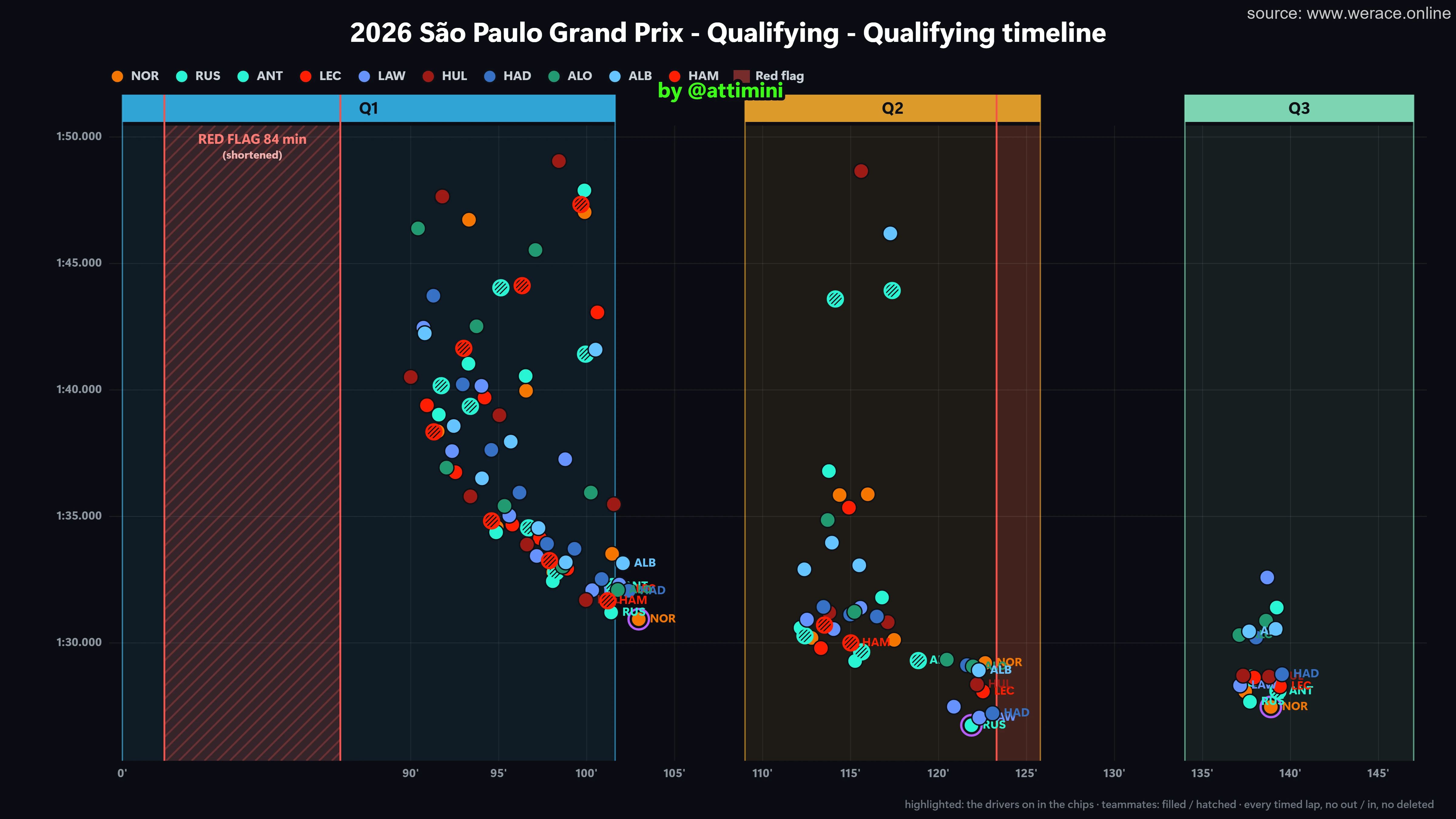
The positions changed endlessly throughout Q1. Out of curiosity, I built a chart to show how much the lap times fell during the session.
On the left, in Q1, almost every lap was at least a second faster than the one before. In the middle, in Q2, the gain was much smaller. On the right, in Q3, the green-edged dots show the switch to intermediates: the times dropped at first, then rose again as heavy rain returned.
This second chart shows every timed lap of more drivers against session time, including the 84 minutes of red flag before Q1. It makes the pattern immediately clear. With 22 drivers on track in Q1, the descent was very steep. In Q2 the drop was smaller, but those were the fastest times of the whole session: Russell's dot, circled in purple, is the fastest lap of the entire qualifying. In Q3, with the rain back, the times actually got worse.
How far behind were the back markers?
I also wondered how much time the slowest cars, Cadillac, Alpine and Stroll's Aston Martin, were losing to the front.
In Q1 I highlighted Norris and Russell at the front, then the Alpines in pink, the Cadillacs in grey and Stroll in green. On practically every lap they were clearly slower.
The trend lines tell the real story. At the start of Q1 the gap was less than half a second, but the more the times came down, the more it grew, until it reached two to three seconds by the end. It is unusual to see it this clearly, and it shows both the difference between the cars and how hard some of them are to drive when grip is this low.
Wet versus dry
And just for fun, to show how much the wet is really worth: this chart compares each team's fastest lap in today's wet qualifying with last year's qualifying at Interlagos, which was run in the dry. It is not a like-for-like comparison, of course, but it gives an idea of the price of the rain: every team was between 17 and 23 seconds slower. Red Bull, Mercedes and Racing Bulls lost the least, while Alpine paid by far the highest price.
Apart from that, there were no red flags except the one for Camara, who made an impressive debut. He was excellent in conditions right at the limit. It is a reminder of the level of today's Formula 1: we often underestimate these drivers, but all of them did a great job today.
3. The Front: Norris on Pole
At the front, the order did not change much compared with practice: Norris took pole with a 1:27.470, ahead of Russell (+0.204s), Antonelli (+0.625s) and Leclerc (+0.819s). There are a few points worth analysing, though.
McLaren: the step is real
McLaren had already shown a good step forward on Friday, and today it was confirmed. I see three reasons.
The upgrades. In my view they helped the papaya cars a lot, Piastri included on Friday, even though he went out in Q2 today. McLaren brought a new front wing, rear wing, beam wing and diffuser, all designed to add downforce. Their problem is that the MCL is the shortest car on the grid. A shorter car has less surface available to generate downforce, so the team had to find more local load through new solutions, and the full package arrived this weekend. Norris said the car now feels more intuitive to drive.
The gearbox.
A few weekends ago I studied the gear ratios of every team, normalised to the shortest ratio on the grid. McLaren has a long first gear, but from third gear upwards it has the shortest ratios of the field. That means in every traction phase, even on wet asphalt like today, the car always has a gear ready to pull it out of the corner.
Norris himself. He sometimes lacks something in wheel-to-wheel battles, but he is very sensitive to the car and has a lot of raw speed. He reads every change of grip and every change of tyre very well.
Put together, these factors gave Norris a pole that was built properly, lap after lap.
The season chart puts it in context: McLaren's best car is back on pole for the first time since Madrid, while Mercedes' best car qualified second, Ferrari's fourth and Red Bull's seventh.
4. Russell: the Real King of Qualifying
To be honest, the real king of this qualifying was Russell. I am very happy for him, because over the last days, weeks and months he has been heavily criticised. I consider George a very good driver in an unlucky season: his power unit has often played tricks on him, especially at the start. Today there was no "battery formula", as I ironically call it, no harvesting energy here and deploying it there. It was simply about pushing, lap after lap, and the fast Russell we know came back.
In the middle sector he was in a league of his own. In the most twisty part of the lap he was 0.228s faster than Hadjar, the second-best, and almost a second faster than Antonelli.
This chart shows where he made the difference throughout qualifying. As usual, speed is at the top, then the gap, the throttle and finally the brake.
Look at Turn 14, the left-hander that opens the climb up the final straight. Russell (light blue) is the only driver who keeps the throttle at 100%, and he did it all through qualifying. Norris lifted to around 59% and Leclerc to around 61%. Flat out there in the wet is the sign of a rock-solid rear end and an enormous amount of courage.
A pole thrown away
Unfortunately, the team let him down again with the strategy. On his second lap in Q3, he was clearly the fastest of everyone. The white dashed line is that lap: its gap line stays the lowest of all, ahead of Norris's pole lap, almost until the end.
But he had Albon in front of him, and the team wrongly told him to abort the lap, back off to create a gap and then go again. As the lap-time charts at the start of this article show, the final laps were slower than the earlier ones, because heavy rain had returned. The next lap was never completed. You can see it in the speed trace: the white line collapses after Turn 11.
Russell came back to the garage visibly shaken and angry. This was a 100% certain pole, and after a long time he had finally beaten his teammate clearly. To make things worse, he had also taken a new internal combustion engine, which carries a five-place grid penalty: from second in qualifying, he will start seventh.
Leadership
It was the team's mistake. Yet on the radio, Toto Wolff stepped in and silenced him in a few words. Even though the team had made the wrong call, one sentence from Toto was enough to calm him down.
This is what I meant in my FP2 analysis when I talked about leadership. Mercedes has a team principal with full control over his drivers and huge influence over the whole team, and that team has won world championships. At Ferrari, in recent times, it has seemed that anyone can speak openly in interviews or make costly mistakes on track, and those points end up going to their rivals.
With so much being said about Ferrari at the moment, I think this difference deserves attention. Having a clear reference point, technically and psychologically, changes how a team works from the inside. Mercedes has always had one. Ferrari either have not yet found the right, effective leader, or have never given that person full freedom to lead.
Antonelli
To complete the Mercedes picture: Russell's driving style, which sacrifices corner entry to gain grip on traction, proved better suited to these conditions. Antonelli has the opposite style, and in the wet his strengths did not come through. Thanks to the penalties, though, he starts from the front row and is a serious contender for the win.
5. Ferrari: Better Than It Looks
At first sight this might look like a disaster. In my view, though, it was a clearly better qualifying than the result suggests.
In the past we have seen Ferrari not just struggle in the wet, but struggle badly. This time they did not lose a huge amount of time, and they did not have to resort to desperate tricks.
If we look at the improvements from Q1 to Q2 to Q3, Ferrari were fairly close to the others. Leclerc went from 1:32.934 in Q1 to 1:28.289 in Q3, a progression in line with the cars around him. In the dry sessions the Ferrari lost a lot, both in top speed, with an engine that is not up to the level of the others, and in the corners. The wet session became a test session. On Leclerc's side, even in Q3, the team changed the set-up several times, including the front wing angle he asked for on the radio, and the difficulties were reduced.
I think, however, that moving so much of the balance to the front in these conditions made the rear struggle on traction, which matters most in the second half of the lap. That is exactly where he lost time: the best-sectors chart shows him third in sector 1 and fourth in sector 2, but only twelfth in sector 3.
Hamilton put together a good Q1 and one lap in Q2, enough simply to gain one place on the grid. As I explained in the FP3 analysis, Lewis had to change his complete power unit after the worrying noises in the last practice session, so, like Max, he starts from the back.
6. Verstappen, Lawson and the Grid
It is a pity not to have seen Verstappen fight for pole, because I think he would have entertained us in these conditions. I was also surprised that Red Bull, clever as they usually are, did not skip Q2 so that he would start ahead of Hamilton. Verstappen said in the interviews that he did not care much, that he did not want to put mileage on the engine or take risks. In reality, I think very little would have been needed. In my view, they simply did not think of it.
A final mention of honour goes to Lawson in the Racing Bulls, who will start third after the penalties. In these conditions this is not a complete surprise. The second Red Bull team, run with less experienced drivers, has always built its cars with an eye on driveability, stability and predictability. They have said openly that they do not chase pure performance, but a softer car suited to rookies. In these conditions, the excellent Lawson, still without a seat for 2027, delivered a great performance, with Hülkenberg alongside him in the Audi and all of Nico's years of experience.
7. The Race: Anything Can Happen
The race is impossible to predict. If it is dry, as I have said since Friday, degradation is high and a two-stop strategy is very possible.
But the weather here is crazy. In theory, the chance of rain on Sunday was lower than on Saturday, but we cannot know anything for sure.
The grid is turned upside down, and comebacks are possible. Leclerc, with his new engine, starts in mid-pack in fourteenth. Above all, Hamilton and Verstappen start at the back and will certainly try the comeback drive of their lives. And if the weather changes completely, they could break parc fermé, change their set-up entirely and start from the pit lane with a car built specifically for the race conditions.
In short, I think it will be pandemonium, and we are going to enjoy it. I can't wait!