
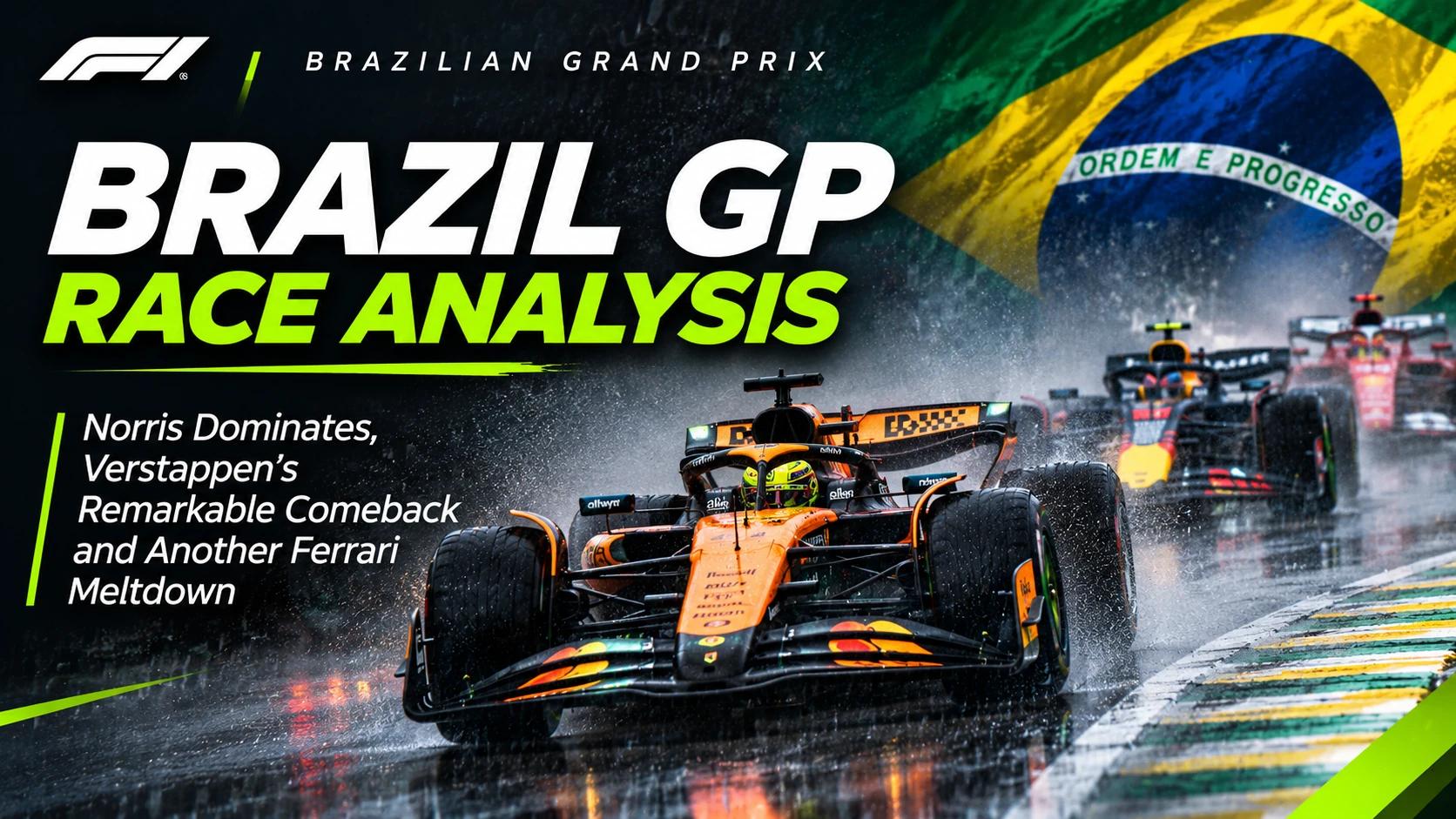
Brazilian GP Race Analysis: Norris Wins at Interlandos, Verstappen's 19-Place Charge and Ferrari's Wet-Weather Chaos
The Brazilian Grand Prix is over, and these are my first impressions and analysis. We expected a crazy race, and with weather that never settled, that is exactly what we got. The warning signs came well before the start: on the installation laps Kimi Antonelli went off at Turn 12, making it clear that the afternoon would be slippery, interesting and at times dangerous. Remarkably, there was not a single Safety Car or Virtual Safety Car, which says a lot about how well the drivers handled the conditions.
Hamilton's Slingshot and Verstappen's Charge
Lewis Hamilton's start was a slingshot. He went all the way around the outside, using the entire right-hand corridor the others had left free, and at Turn 3, heading onto the back straight, he took the outside line again.
The opening-lap chart tells the story: Hamilton gained eleven places, from 20th to ninth, and Verstappen gained eight, from 21st to 13th. It looked as though these two were going to be the stars of the afternoon. That turned out to be only half true, because the driver who kept his performance at the same level until the flag was Verstappen. From the back of the grid he finished on the podium in second place, gaining nineteen positions in total. A monster of a drive.
Red Bull were very strong today. The balance was not perfect, but it allowed both Verstappen and Hadjar to make up places, helped by the power of the Red Bull Ford unit at a time when the FIA kept Overtake Mode switched off until lap 23. That undoubtedly helped Max in his recovery.
In the end he gave way only to Norris. The average race-pace chart shows him just 0.271s per lap slower than the winner, who had started many places ahead. On slicks alone the gap shrinks to 0.012s. It was a wonderful race, helped by Hadjar, who finished third and stayed closer to him than ever. The teammate chart shows the two separated by just 0.019s per lap on the laps they ran together, with Isack actually quicker on 32 of them. Hadjar gave Max room and the position a couple of times, probably because he was the one who had to let him through.
Interlandos: Norris and the McLaren Upgrades
As I explained in the qualifying analysis, McLaren developed and brought upgrades all the way to the final races of the season: front wing, rear wing, beam wing and diffuser, all aimed at finding more local downforce. It is a need not to be underestimated, because the McLaren is the shortest car on the grid and therefore has less surface to generate downforce. It is no coincidence that Piastri, eliminated in Q2 in such a difficult qualifying, finished sixth.
Norris, with his sensitive driving, managed the race throughout. The perfect call to switch to intermediates for the final rain secured the win, and it also forced Mercedes into an unsafe release at Antonelli's pit stop, for which the Italian received a five-second penalty. It did not cost him a position, as he had a margin of more than five seconds. Interlagos, Lando and intermediates: call it Interlandos. It still needs to be confirmed in the next races, but for now McLaren seem to have got their latest upgrades right, which will also matter with 2027 in mind.
Mercedes: Champions, but a Bittersweet Day
Mercedes won the constructors' championship, but finished off the podium. On one side, the Silver Arrows were very fast, especially on the intermediates at the start.
In the gap chart, Norris is the flat orange line at zero. In the first part of the race Antonelli, the dashed turquoise line, drops below it and builds a lead, with Russell, the solid turquoise line, right behind. The wet-only pace confirms it: Antonelli was just 0.055s per lap off Norris on intermediates, the second-best pace of the field.
Then came the switch to slicks, and Mercedes suffered.
The crossover chart shows the moment the track became faster on slicks, from lap 17 at around 1:27.0. After that, the lap times dropped very quickly and then levelled off. It was in that falling phase that Mercedes struggled, and looking only at the race pace on slicks, Antonelli was even slower than Piastri.
It is no coincidence that Kimi spun and went long at Turn 1 on laps 20 and 24. There was also a strategic error.
The call for the second set of softs came on lap 53. That forced him to lose time on a used set first, and then to run the new softs for only nine laps before the final rain.
The other Mercedes mistake came from Russell. On cold tyres he accelerated too hard as soon as he could and, incredibly, spun on the exit of the pit lane, producing one of the images of the day.
The positive, of course, is the constructors' title. It puts a team with a winning mentality back at the top, led by Toto Wolff, in my view the best manager a team can have.
Ferrari: the Usual Wet-Weather Struggle
For Ferrari it was another difficult day in the rain. Both cars started with a fresh engine and took grid penalties for it, and Hamilton's brilliant start turned out to be only the prelude to bigger problems.
The first problem came on the intermediates. Ferrari chose higher tyre pressures to bring the tyres up to temperature faster. It worked, but after two laps the tyres were overheating, as the team confirmed on the radio to both drivers. That early overheating then caused sliding and excessive wear.
From there came, in my view, Hamilton's perfect call at the first stop. On the radio he had already asked to come in for softs two laps earlier, but the team hesitated. As the tyre chart shows, he was the first to fit slicks, and the undercut chart shows what that was worth.
Stopping on lap 14, Hamilton gained 7.6 seconds on Leclerc, who stopped two laps later, and he recovered plenty of ground on the field. Leclerc followed soon after, but on slicks neither Ferrari had a quick pace, as the slick-only chart shows. The problem was threefold.
Top speed.
This chart shows the average of every lap's top speed. Hamilton (323.2 km/h) and Leclerc (322.2 km/h) are near the bottom, 5-6 km/h below Russell and around 2 km/h below Verstappen. If you have lost time on the wet tyres and need to recover and overtake, an engine that does not help you is a real problem.
Front wing. On Leclerc's car the front wing angle had not been changed at the stop. It is normally adjusted, because switching tyre type changes both traction and the way the tyres are used, so the aerodynamic balance needs adjusting too. Leclerc asked about it on the radio, and it emerged that it had not been touched. It is not clear whether it was forgotten or whether the team thought it was fine as it was.
Cold tyres. If the intermediates had been too hot at the start, the situation reversed on slicks. With 26°C on the track and 16°C in the air, and perhaps with a car set up with too much front end, they struggled to switch the tyres on, and once again the car was sliding. Whichever way you look at it, they suffered for most of the race.
Two controversial calls
There were two other controversial moments with the pit wall. The first involved Leclerc, who was called in for a second stop to fit new softs but did not want to come in, and he was right.
On the gap chart we are around lap 40, where the arrow is. His race was going reasonably well: after a steep climb, his gap to Norris had stabilised and was even starting to fall slightly. The crossover chart confirms that, at that stage, lap times were almost flat for everyone. He was called in, said he preferred to stay out, and the next lap the team told him that yes, he was better off staying out, almost admitting that the call had been wrong.
The second episode is the one everyone has seen. Hamilton was called in for intermediates in the final part of the race and went straight on. A clarification is needed here. In some races Lewis was completely on top of things: he knew exactly what was happening on track, where his rivals were, their stops and their tyres. In this race, whether because it was so confusing, with so many changes of position and conditions, or because the well-known tensions inside the team have made things more rigid, or because communication was not at its best, at some point he lost the picture: where he was, what tyres the others had, how many laps were left, his own strategy and the others'.
You could hear it on the radio. He asked how many laps were left, and why they were so far back, and the answer was that they had lost positions on the intermediates at the start. He asked why Leclerc was ahead, and was told it was because Charles had not pitted and he had. He asked about the blue flags, and was told he had just been lapped by Norris. His race engineer, Santi, told him to keep pushing, because he was faster and would unlap himself. When the blue flags did not go away, Santi explained that he had to pull more than a second clear, and that the flags were now flashing rather than fixed. It sounded like someone who had landed there by chance.
That confusion also explains the final pit stop. Both Ferraris were eighth and ninth, the rain was starting to return, and the radio forecasts I was hearing, for Norris, Verstappen, Antonelli and Ferrari too, kept saying rain in ten minutes, then sooner and sooner. In eighth or ninth you are gaining almost nothing, so I expected them to come in and fit intermediates. And since Hamilton had made the right call for softs at the start, I thought he would do the same thing in reverse: get ahead of the others and be ready for the rain. Instead, he stayed out even though he was right on the pit-entry line. The call came too late, he was already going too fast and had chosen to stay out, and in that very moment the downpour returned.
On the radio he said he had missed the pit entry. The team pointed out that rain had been forecast; he replied that he thought he had to keep going on those tyres and that he was fine on track, then asked what position he was in. Santi, clearly frustrated, answered that he didn't know, and then told him P9.
At the start of the race he was fully in control and drove his strategy, but then he got lost in a glass of water. As the tyre chart shows, he was practically the last to fit wet tyres, and he also lost time when the rear stepped out before the pit entry and he hit the barrier with the rear wing.
It is not really about positions or points. They were eighth and ninth, so we are talking about two or three points. If anything, they could have gambled and fitted intermediates before everyone else. The real problem is the trust between driver and pit wall, the chemistry between them. In recent weekends the relationship seems to have gone backwards instead of forwards, and that says a lot about the atmosphere in the team. As I have been saying for days, it is a worn-out relationship, and it weighs on everything and everyone. The most serious issue is how to restart properly for 2027, and for the development of the future car. If driver and team are at odds on track, in their statements and now even in strategy and basic communication, I really do not know how they will get through it.
To finish, Leclerc received a five-second penalty after the race for a light contact while overtaking Lawson, which drops him from seventh to eighth. For me this is absurd: they barely touched, and in a downpour. If these overtakes are not allowed, I do not understand what they are racing for. All we will be left with is processions and overtakes made in the pit lane.
Conclusion
Those were the main events and the first analysis of the top teams. It was an intense, interesting race, made entertaining by the rain, which mixed everything up at both the start and the finish. Verstappen remains a step above the rest and once again climbed to the front. Norris looks reborn. Mercedes, whatever happened today, have won another world championship. And Ferrari, in the wet, keep losing pieces.