
Brazilian GP FP2: Antonelli Leads as Ferrari Struggle for Speed and Direction
The Brazilian Grand Prix weekend began with the new world champion at the top of the FP2 order. FP1 was difficult to interpret, with rookies taking part and the track surface still very slippery, but the second practice session offered a much clearer picture.
Kimi Antonelli was not merely fastest: he had a meaningful advantage over the tightly packed group behind him. Mercedes look to have started the weekend in excellent shape, while Ferrari still have major questions to answer on power-unit performance, energy deployment and the internal management of its driver line-up.
1. Antonelli Clear at the Front
The gap chart immediately shows the shape of the session. The four drivers behind Antonelli are separated by a very small margin, while the Mercedes driver sits noticeably clear at the top.
The sector breakdown explains where Antonelli built his advantage. He was at least 0.15 seconds clear of the others in the second sector, the most technical and demanding part of the lap.
That section requires strong mechanical grip and a responsive car through a sequence of slower corners. It is also the part of the circuit where tyre management is likely to matter most in the race. Regardless of the weather, Mercedes' performance there is an important sign for Sunday.
Antonelli was also competitive in the third sector, where his performance was close to Lando Norris's. Hamilton was the benchmark in the first sector, but Ferrari could not match the overall lap.
2. Ferrari's Deficit Appears Both Aerodynamic and Hybrid
Lewis Hamilton was the faster of the two Ferrari drivers, but he still finished almost half a second behind Antonelli. The result is particularly concerning because Ferrari had already used FP1 for an important test programme: Dino Beganovic drove Leclerc's car while the team ran aerodynamic rakes, sensors, set-up changes and a different floor. That work may be linked to the team's preparation for the 2027 regulations, but it also meant Leclerc had less running time to prepare for the weekend.
The telemetry compares speed at the top, the time gap in the middle and throttle application at the bottom. Hamilton is strong at the beginning of the lap, particularly through the exit of Turns 2 and 3, but the Ferrari's performance deteriorates progressively from the middle of the lap onwards.
Hamilton: Strong Start, Growing Losses
Hamilton's approach through Turns 1 and 2 is clear: he gives up some entry speed in order to prioritise the exit. That allows him to accelerate well through the opening part of the lap and explains why Ferrari is competitive in the first sector.
The picture changes from Turns 7, 8 and 9 onwards. Hamilton loses approximately 7 km/h at one of the first reference points, 13 km/h before Turn 10 and a further 3 km/h at the corner itself. More importantly, the Ferrari no longer has the same acceleration on the short straights.
The losses continue in the final section. Hamilton is around 14 km/h down on the straight and approximately 7 km/h slower than Norris at the braking point. In the complete-lap view, Ferrari is already around 10 km/h slower than Antonelli before the main straight.
The most plausible explanation is a combination of energy deployment and overall power-unit output. Ferrari seems to use a large part of its available hybrid energy early in the lap, then lacks both the deployment and the speed later on. The deficit is significant enough that a fresh power unit for Saturday and Sunday would not be a surprise if Ferrari decides that the performance gain justifies the penalty risk.
3. Leclerc's Ferrari Is Even More Exposed
Leclerc's comparison with Hamilton and Antonelli shows the same problem in an even more pronounced form. Both Ferraris gain speed at Turn 4 by spending energy, but the advantage disappears at almost every subsequent braking zone.
Ferrari is approximately 5 km/h down at Turn 7, 10 km/h down before Turn 10 and 15 km/h down before Turn 12. The gap then continues to grow towards the finish, where Leclerc is as much as 20 km/h slower than the reference car.
This is not only a straight-line issue. Leclerc is also around 12 km/h slower at the apex of Turn 9, suggesting that the car is difficult to place and rotate in the corners as well.
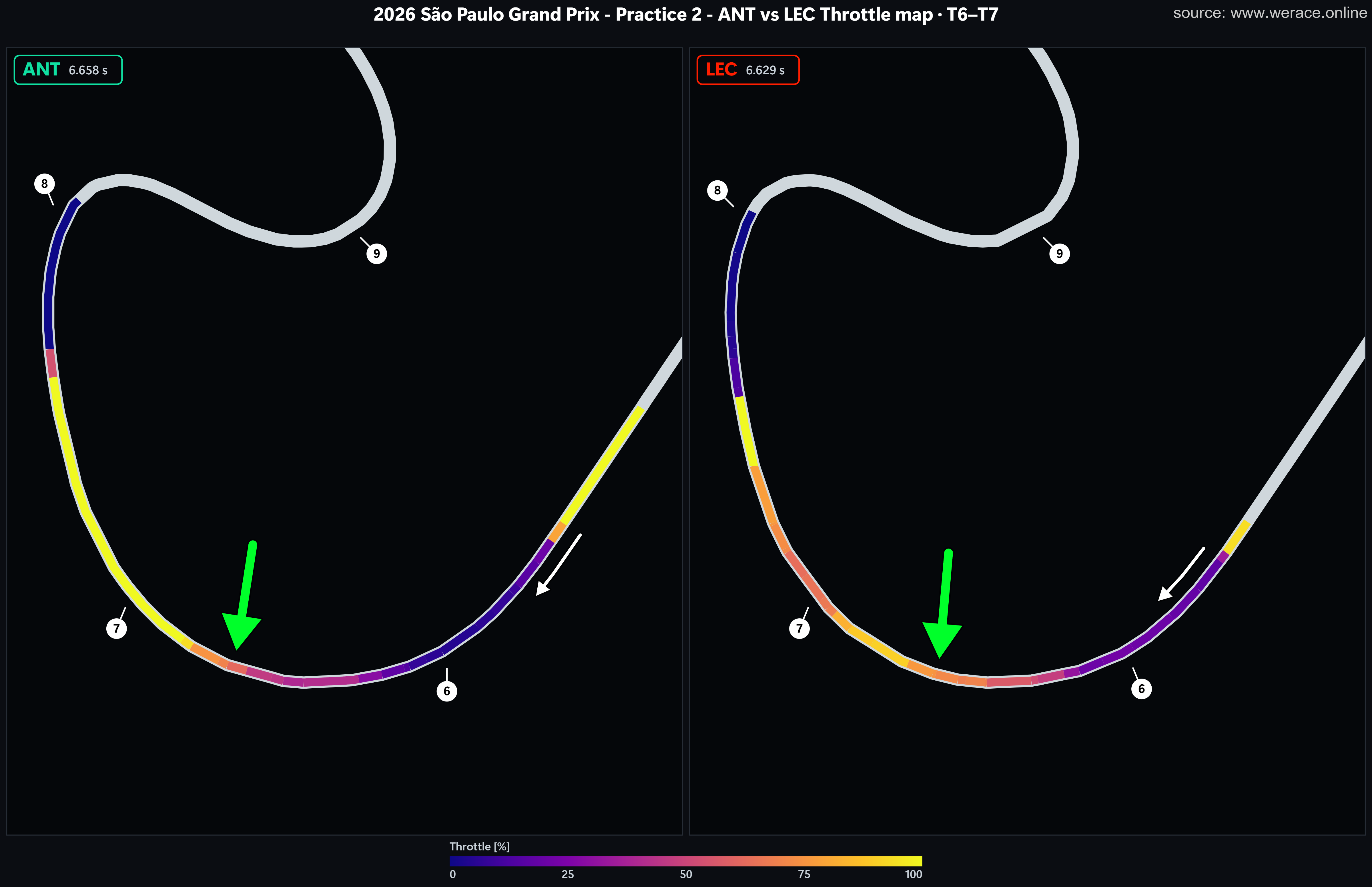
There is one notable exception: Leclerc is strong through Turn 6, reaching approximately 215 km/h.
The focused view shows Leclerc gaining roughly half a tenth in this section. It is a small but genuine performance gain rather than an artefact of the overall lap.
The throttle trace explains why. Purple represents zero throttle and yellow full throttle; at the critical point, Leclerc is visibly further towards full throttle than Antonelli. This is the only section where the Ferrari appears to find a clear advantage through a more effective combination of speed and throttle application.
Ferrari's final sector remains particularly worrying, with both cars ending up on the wrong side of the midfield. The team will need to understand whether the deficit comes mainly from the Friday engine specification, energy management or a fundamental limitation of the car's set-up.
4. Norris and Verstappen Are Closely Matched Behind Mercedes
McLaren and Red Bull were both behind Antonelli, but Norris and Max Verstappen were effectively level over the lap. Their strengths were different: the two cars traded time across the sectors before converging in the final part of the circuit.
At this stage, they look like the leading candidates to fight for the second grid position behind Mercedes. That picture could change quickly if the weather moves in, but neither team appears to have the same performance deficit as Ferrari.
5. Long Runs: Soft Tyres Are Fast but Fragile
All the leading teams devoted significant time to race simulations. The long-run traces rise progressively, and engineers could be heard reporting high degradation over the radio.
Hamilton began his programme on the medium tyre before switching to the soft, using the session to compare the compounds. Norris followed a similar approach, running the hard tyre first and then moving to the soft.
The broad picture is consistent across the runs:
- The soft tyre is clearly the fastest compound initially, but degradation is significant.
- The medium and hard tyres degrade less, but they are considerably slower from the opening laps.
- Ferrari appears particularly vulnerable on the harder compounds.
- McLaren is the exception, showing strong pace on the hard tyre as well.
That last point is worth watching. McLaren has displayed a similar strength at other circuits this season, suggesting that its tyre preparation and degradation characteristics could make it the most flexible team if the race becomes a long strategic battle.
The race-pace comparison should not be read as a definitive ranking because the teams ran different compounds, fuel loads and programmes. It does, however, confirm that tyre management will be central to the weekend. Mercedes' one-lap advantage is encouraging, but the race may reward the car that keeps its tyres alive rather than the one that produces the fastest first lap.
6. Rain Could Turn the Order Upside Down
The weather is the largest variable left in the weekend. Forecasts had suggested heavy rain for Saturday, especially around qualifying, although the situation remains uncertain.
Towards the end of the long-run work, a few drops began to fall. Mercedes told Hamilton that the timing was useful because it allowed the team to gather information about the car in changing conditions ahead of the race.
If rain arrives or temperatures drop sharply, Friday's order may become almost irrelevant. Mercedes currently look strongest, Norris and Verstappen are closely matched, and Ferrari are still searching for a solution, but a wet qualifying session would test an entirely different set of strengths.
7. Ferrari's Driver Management Remains a Strategic Risk
Ferrari's performance cannot be separated from the discussion surrounding its driver management. After the recent controversy, team principal Frédéric Vasseur finally met the drivers on Friday. The timing matters: after the Mexican Grand Prix, Vasseur returned to Maranello while Leclerc travelled to Monaco for the birth of his daughter, an event that had been planned for this week. The meeting could therefore only take place after Friday's media commitments.
Vasseur's comments suggested that Ferrari's approach remains based on the drivers' judgement rather than a formal hierarchy or written guidelines. A hierarchy is not necessarily required, particularly when no championship is at stake, but clear limits are essential. The team must define what happens when two drivers find themselves in the same situation and their individual choices begin to damage the team's result.
Leaving everything to common sense may look attractive, but it creates several risks:
- the drivers can fight each other without a clear point at which the team intervenes;
- every on-track incident damages morale and increases tension inside the garage;
- rivals gain points from Ferrari's internal battles;
- the team may struggle to change behaviour quickly if a championship opportunity appears.
Vasseur is managing two highly competitive drivers in the same car, and the responsibility for setting those boundaries rests with the team principal. Toto Wolff could not simply tell Kimi Antonelli and George Russell to do whatever they wanted if Mercedes were fighting for a title. The same principle will matter even more in 2027.
Ferrari will need more than a competitive car next year. It will need a structure in which both drivers understand that they are working for the team, with clearly defined roles and limits beyond which individual ambition cannot go. Friday's comments did not suggest that this restructuring has begun.
Verdict
FP2 at Interlagos produced a clear but potentially temporary picture. Antonelli and Mercedes were the benchmark, Norris and Verstappen were closely matched behind them, and Ferrari were still struggling to make the car work across a complete lap.
Hamilton remains competitive in the opening sector, but Ferrari loses speed progressively through the rest of the circuit. Leclerc's data points to the same hybrid and power-unit concerns, with an additional loss of corner speed except through Turn 6.
The long runs suggest high degradation, with the soft tyre delivering speed at the cost of durability and McLaren showing unusual strength on the hard compound. Rain and falling temperatures could change everything before qualifying.
For Ferrari, the weekend is not lost—but the team needs answers quickly, both from the car and from the people managing it.