
Mexican Grand Prix: Kimi Antonelli Makes History as Ferrari Lose a Winnable Race
Andrea Kimi Antonelli is a Formula 1 world champion at just twenty years old, bringing the title back to Italy after 73 years. That is the headline from Mexico, and it deserves to come first. But the same race also produced another painful Ferrari story: after nineteen qualifying weekends, the Scuderia finally started from pole with a car capable of winning, then let the opportunity slip away.
Lewis Hamilton and Charles Leclerc made a strong launch and initially had the race in their hands. Instead, Max Verstappen won without needing to make a decisive pass on track. The data tells a frustrating story: Ferrari had a competitive car, but lost control of the race through the opening lap, two safety-car restarts, traffic and a pit-stop sequence that handed Red Bull the lead.
Ferrari's first pole of 2026 came only after nineteen qualifying weekends, making the opening lap even more valuable.
Ferrari's first pole in nineteen weekends
Hamilton's pole was Ferrari's first of the season, and it came after nineteen qualifying weekends in which every other leading team had managed to start from the front. That made the first lap especially important. Ferrari had the track position, two cars at the front and a circuit that punished anyone running in dirty air.
The start itself was strong. Hamilton got away well, while Leclerc stayed alongside him into the first corners. The first lap then became the race's defining sequence. Leclerc cut the corner after the contact, did not give the position back and emerged ahead of Verstappen. Verstappen passed Hamilton, so the order became Leclerc, Verstappen, Hamilton. The five-second penalty for Leclerc followed, but by then Ferrari had already lost the clean 1-2 it had earned in qualifying.
The team also lost control of the situation inside the garage. A front-row Ferrari should have had an agreed plan for the first lap: protect the lead, keep both cars out of trouble and race Red Bull together. Instead, the drivers were left to fight for the same piece of track. Ferrari's team principal later described the incident as disrespectful to the brand, but the harder question is why the necessary rules were not already clear before the start.
The race was then interrupted twice by the safety car, with a red flag adding another reset to an already complicated afternoon. Those restarts gave Hamilton another chance to recover: he launched well at the first start, at both safety-car restarts and again after the red flag. Starting was one of his strongest aspects all afternoon. It was not enough to undo the first-lap order, because Verstappen remained in front of him and the circuit made following so difficult.
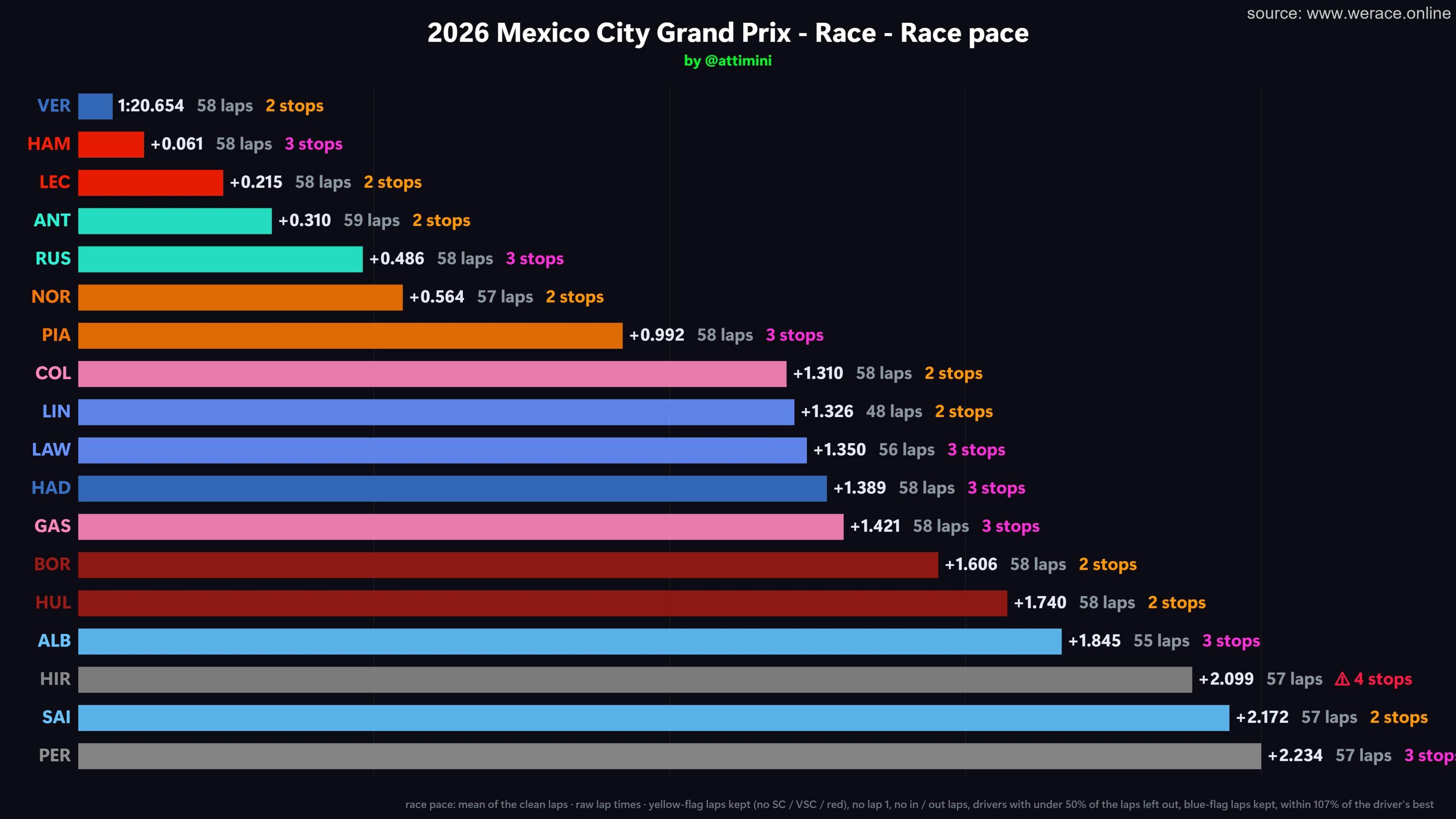
Verstappen was fastest, but not by much
The average pace is close enough to show that Ferrari had a race-winning car, not a car that was simply outclassed.
Verstappen's average race pace was the best of the leading group, but the margin over Hamilton was small. Leclerc was further back because the flat spot from his restart lock-up damaged his race pace, not because the penalty itself made the Ferrari slower.
That distinction matters. This was not a race in which Ferrari had no answer to Red Bull. The SF-26 was good enough to fight, particularly when it had clean air. But Mexico magnified every small tactical mistake: the long straights made the tow valuable, the thin air made following harder, and the brake temperatures forced drivers to compromise their laps.
The smoothed trace shows how tightly packed the leaders were before traffic and strategy fixed the order.
The smoothed pace trace shows how close the group remained before the race settled. Ferrari's performance was not a fluke from qualifying; both cars could run at the front when they were not trapped behind another car. The problem was converting that pace into track position and then defending it.
Clean air was the decisive advantage
Hamilton spent more than twenty-five laps directly behind Verstappen in the first part of the race. The gap trace is almost horizontal: close enough to threaten, but never close enough to complete a pass.
Hamilton's red trace stays almost flat for more than 25 laps: close to Verstappen, but never close enough to pass.
Hamilton repeatedly had to lift before the braking zones to protect the brakes. Lift-and-coast is normally a small compromise, but here it became a constant part of the race. Verstappen could defend on the straights, use the battery when necessary and force Hamilton to manage temperatures while following.
This explains Hamilton's radio message that matching Leclerc's pace was easy in clean air. Leclerc was leading and could use the whole track. Hamilton was running in Verstappen's wake, losing aerodynamic performance and cooling margin. The lap-time comparison between the two Ferraris therefore did not describe the same task: one car was attacking in clean air, the other was trying to attack while protecting its brakes.
This was exactly the problem identified in the FP2 analysis. The Ferrari drivers had to lift 50, 100 or sometimes 150 metres before the braking point to cool the brakes. The overtake mode did not deliver the usual extra boost, while the power units effectively plateaued on the straights. A car with similar pace could therefore defend without much difficulty. It was not just that Ferrari's brakes were hot: the circuit made the energy advantage needed for a pass almost impossible to create.
The same pattern appeared after the stops.
The second-half trace shows the same trap continuing: being close was not the same as having a realistic passing opportunity.
Even when the order changed, the gap trace remained remarkably stable. Once a driver was in front, the circuit made it possible to control the pace without creating an easy opportunity for the car behind. Mexico was effectively a race for clean air, with overtaking available only when the leading car made a mistake.
The limited number of meaningful passes reflects the lack of electrical and aerodynamic advantage for the attacking car.
The overtaking chart reinforces that impression. The race did not produce the usual sequence of meaningful passes between cars with similar pace. Track position, battery deployment and the first lap mattered more than a small advantage in raw speed.
The strongest proof came after the pit stops. Leclerc had been leading in clean air and had not been suffering the same way. Once the stop put him behind another car, he immediately faced the same hot-brake problem as Hamilton and was asked to lift and coast as well. In front, the Ferrari could push; behind, it had to protect the brakes. That is the clearest evidence of the weekend's central rule: in Mexico, clean air was worth almost as much as the car's outright pace.
Ferrari's pit-stop decision gave Verstappen the lead
Leclerc built a gap of roughly five seconds to Verstappen before the first stops, just enough to cover his penalty. Ferrari called the leader into the pits first, expecting to keep the Red Bull behind. Red Bull responded immediately and Verstappen stopped at the same time.
At lap 26 Leclerc leads by about five seconds and Hamilton is two seconds behind him; by lap 30 Verstappen leads Hamilton by roughly five seconds.
The numbers show exactly where the race slipped away. Before the stops, Leclerc led Verstappen by about five seconds, while Hamilton was only two seconds behind Verstappen. Ferrari's decision to stop Leclerc first allowed Verstappen to pit alongside him and use the five-second penalty to emerge ahead. By lap 30, Hamilton was also roughly five seconds behind Verstappen: Lewis had lost about three seconds in the sequence, as well as the lead.
The result was predictable: Verstappen used Leclerc's five-second penalty to emerge ahead without having to pass him on track. Hamilton then stopped a lap later, having lost further time while Ferrari's two cars were no longer controlling the race as a pair.
When Hamilton was told that Leclerc had received the penalty, he did not complain about the position he had lost. His answer was about the race he had already been forced to drive behind Verstappen, with the brakes overheating and the car unable to pass. That reaction says everything about the real cost of the incident: Ferrari had not merely lost a place, it had put Hamilton into the worst possible version of the race.
A more aggressive alternative would have been to stop Hamilton first and attempt an undercut, then bring Leclerc in afterwards. That would have sacrificed Leclerc's track position but potentially put Hamilton ahead of Verstappen and forced Red Bull to solve a different problem. It would not have guaranteed victory, but it would have made Verstappen work for it. Ferrari instead chose the sequence that gave Red Bull the cleanest path to the lead.
Leclerc's restart mistake changed the second half
Leclerc's race became even harder at the restart. He locked the tyres heavily, creating a flat spot and significant vibrations. He asked Ferrari whether he should pit, but the team told him to stay out. That decision left him with a damaged tyre and significant vibrations, and it is not something I would automatically call the correct choice: it was another risk taken by a Ferrari pit wall already trying to recover from its earlier errors.
Leclerc's pace falls by roughly a second after the flat spot, yet he still keeps Norris and Russell behind.
The final-stint pace shows the cost. Leclerc was around a second per lap slower after the lock-up, yet he still had to defend against Norris and Russell for roughly twenty laps. The chart is not evidence of a Ferrari that suddenly lost all performance; it shows a driver carrying a compromised tyre while managing a train of faster cars behind.
Leclerc's defence was one of the strongest parts of Ferrari's afternoon. He kept Norris and Russell behind despite the loss of pace, using positioning and the characteristics of the circuit to protect the car. It was an excellent recovery from a difficult situation, but it also underlined how much performance the flat spot had removed.
The running order hides the real story
The stable lines after the stops are the signature of a race where track position mattered more than small pace differences.
The position chart makes the race look relatively stable after the pit stops, but that stability was the consequence of the circuit rather than a lack of pace. The order became fixed because cars could not easily pass one another. Verstappen was able to manage the lead, Hamilton was trapped behind him, and Leclerc spent the closing stages defending a damaged tyre.
The first part of the race tells a different story.
The full-race view separates the genuine pace gap from the time lost in traffic, tyre management and strategic compromise.
Ferrari's strongest window was when the cars were at the front and running in clean air. Once the race placed Hamilton and Leclerc behind a rival, their tyres, brakes and battery were all working against them. In Mexico, losing the lead did not simply mean falling behind: it meant losing the conditions in which the car was most effective.
A good Ferrari weekend with a poor result
Hamilton drove an excellent race. He launched well, stayed within range of Verstappen for most of the afternoon and managed the brakes despite spending so long in dirty air. Leclerc also performed well after the contact and the flat spot, especially in the final defence.
The disappointment is that Ferrari had both drivers in the right place at the start and still left Mexico without a win. The car was quick enough, the qualifying execution was finally there, and the race data does not show a gap that Red Bull could not have been challenged.
The main lesson is not simply that Ferrari needs more pace. It needs clearer internal priorities. If the two cars are first and second, the team must race for the result rather than allow a fight that benefits Verstappen. If one driver is leading with a penalty to serve, the pit-stop plan must account for the response from the car behind. And if clean air is worth more than a tenth of pace, every decision should protect track position.
Most importantly, Ferrari needs a leader who can act as the bond between its two drivers. Hamilton and Leclerc do not need to be friends, and both should be allowed to fight when the situation permits. But when the team is fighting for a win, someone must set the limits, establish the priorities and make the two talents work as one. Without that authority, every incident becomes another layer of resentment, and the points lost today become ammunition for the next argument.
Ferrari's team principal went hard on the drivers after the race, calling the incident a lack of respect for the brand and saying that it would be discussed. Fair enough, but these conversations should have happened months ago. We are at the end of the championship, not at the first race. The team has had an entire season to understand that two ambitious drivers will not spontaneously organise themselves around the result.
There are only two honest solutions. Either Ferrari admits that it cannot manage two equal leaders and appoints a clear number one, with a second driver accepting that role. Or the team principal establishes rules that cannot be negotiated in the heat of a race: if situation X happens, one driver stays ahead and the other backs off. The drivers can still race, but they must race for Ferrari first. That is what a leader is supposed to do: not simply criticise the outcome afterwards, but create the structure that prevents the same outcome from happening again.
Verstappen took the victory because Red Bull executed the critical moments better. Ferrari had the opportunity, but once the lead disappeared, Mexico made it almost impossible to recover.
Kimi Antonelli, champion at twenty
The race also ended with a historic result for Italy: Andrea Kimi Antonelli became Formula 1 world champion at just twenty years old, bringing the title back to Italy after 73 years. That achievement deserves more than a passing mention, even in a race dominated by Ferrari's disappointment.
Antonelli's season has been the story of a driver and a car finding the right language. The Mercedes rewards precise energy recovery, careful management and exact braking points; Kimi has adapted to that new generation of cars better than anyone. George Russell has not suddenly become a lesser driver, but Antonelli has shown an unusual ability to learn from mistakes, change his approach and keep improving.
We have not yet seen every side of him. A dominant season does not tell us how a driver reacts to losing a championship at the final corner, fighting Verstappen wheel-to-wheel for dozens of laps or suffering a long run of defeats. Those tests will come, and they will be fascinating. For now, the speed, composure and willingness to keep learning suggest that Antonelli has the tools to meet them.
What makes the achievement especially striking is how naturally he seems to carry it. Before the race, with a world championship at stake, he was relaxed on the grid, eating and laughing. The day before, his father was still in Italy doing his normal job. Away from the circuit Kimi remains rooted in the same city, surrounded by family and ordinary friends rather than a carefully constructed celebrity bubble. Even after winning, his instinct was to treat the title as a beginning, not an arrival. His hesitation about using number one because it might make him take himself too seriously says a great deal about that mindset.
That lightness is not a lack of ambition. It is the freedom to perform without being consumed by the occasion. Kimi has already won a world championship; the next question is how far that same calm, spontaneous approach can take him.