
Mexican GP Qualifying: Hamilton Ends Ferrari's Wait — Nine Thousandths, Telemetry and Why Pole May Not Matter
Ferrari finally have their pole position. It took nineteen rounds and the best part of a year: in that time every other top team has started from the front, several times over, while the red car never did. In Mexico City it was Lewis Hamilton, his first pole in red, who put together an outstanding lap and used every metre of the track.
1. A Weekend of Ups and Downs
The weekend had not been linear. On Friday, especially in FP2, Ferrari looked very strong. In FP3, with a track surface almost 10°C hotter, the SF-26 looked lost: after their first qualifying simulation both drivers returned to the garage for front and rear set-up changes. The final push in FP3 was better, but it was clear that the competition was rising.
Qualifying changed everything. In Q1 the two Ferraris were the fastest cars on track. Q2 became harder, with Hamilton locking up and having to use an extra set of new softs. In Q3, Lewis found the lap when it mattered most.
What stood out was something that had been missing for a while: execution. The team sent the drivers out at the right moment and in clean track position, and the driver put every piece of the lap together. On a track that kept cooling, losing around 7°C between the start of Q2 and Q3, Ferrari did not get caught out, at least on Hamilton's side.
Why Ferrari Work Here
The turning point of the weekend came when it became clear that the thin air, at over 2,200 metres, was reducing drag enough to patch up Ferrari's power-unit deficit. Until last year, teams brought maximum-downforce wings to Mexico, front and especially rear. With this year's active aerodynamics, the idea of a bespoke wing package for each weekend has largely disappeared, and it was not obvious how the new cars would behave here. In practice, it went much better than expected.
The top speeds show how much the altitude levels the field. Taking the maximum speed reached on each driver's fastest lap, the whole grid is packed between 349 and 352 km/h, with only the two Aston Martins and Albon below. Hamilton and Russell are both at 350 km/h. One of the factors that has penalised Ferrari most often this season simply does not count here.
The car has also improved where it used to struggle. The rear axle had long been the SF-26's weak point, most visibly in traction. The upgrade package introduced in Austin seems to have widened the car's operating window, making it effective and balanced at low speed too. That matters twice over in Mexico, because more grip means less sliding and less overheating of the tyres.
With less downforce at altitude, many slow corners and very high kerbs, Mexico is a track where mechanical behaviour counts more than usual. As we saw in the FP2 analysis, the SF-26 runs a very soft set-up and rides the kerbs better than any other car, keeping its mechanical grip and letting the drivers attack without upsetting the balance.
The flip side, for everyone, was a lack of grip and great difficulty bringing the tyres into their operating window.
2. Nine Thousandths
It was an extremely tight session: Hamilton's 1:16.514 was just 0.009s clear of Russell, and the top six were covered by around two tenths. Leclerc (+0.119s), Verstappen (+0.178s), Antonelli (+0.193s) and Norris (+0.214s) completed the top six on time, with Verstappen dropping to fifth on the grid because of his FP2 penalty.
The sector times tell you a lot about Hamilton's lap: he was never the fastest in any single sector. Verstappen set the best sector 1, Russell the best sector 2 and Leclerc the best sector 3. Hamilton simply put together the most complete lap.
The Ideal Lap: Verstappen and Leclerc Had More
The ideal lap, built from each driver's best mini-sectors across the whole session, shows a different order. Verstappen had the best potential of all, a 1:16.407, 0.285s faster than his actual best, which would have put him on pole. Leclerc's ideal lap was 0.190s quicker than his real one and would have been worth second. Hamilton, by contrast, has no hatched bar at all: his pole lap was his ideal lap. When the margins are this small, extracting all of the car's potential on one lap is precisely what wins pole. Without Leclerc's mistake and Verstappen's traffic in the stadium, we could have had four drivers within a tenth.
3. Hamilton vs Russell: Where the Pole Was Won
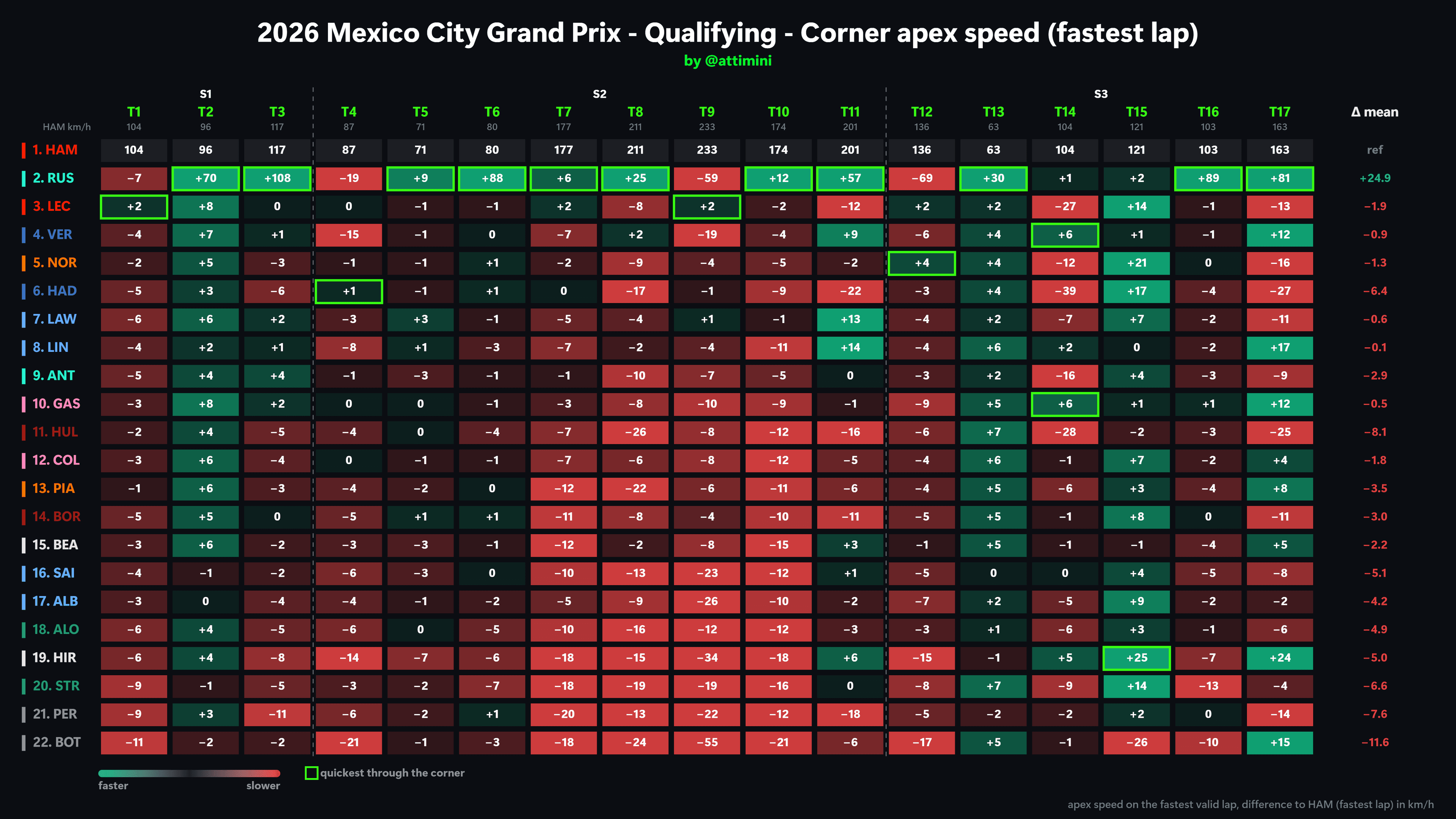
The first surprise in the telemetry is straight-line speed, which is now almost level, at least on a single lap: both cars hit 350 km/h on the main straight. Mercedes changed the set-up on Saturday, making the W17 more effective in the corners at the cost of some of the straight-line speed it had on Friday. Hamilton still loses a few km/h on the shorter straights (2 km/h before Turn 4 and 7 km/h before Turn 12), but the gap is small.
Russell also changed his approach for the final run: on his own initiative he skipped the double preparation lap Mercedes had used until then and went straight for the push lap, finding a lot of grip. Clearly the right call.
In the gap trace, a negative value means Russell is ahead. George was very quick through the corners and made only a small error in the final part of the lap.
Through the first three corners, Russell gains almost a tenth and a half (0.137s at the peak) thanks to stronger braking. Russell is a formidable driver when braking in a straight line, as the long stops in Mexico demand.
It is even better for him through Turns 4-6, where his advantage reaches 0.371s on the full lap. He does not get out of the complex perfectly, however, and the two drivers are back level through sector 2.
The lap is decided in the final sector. Russell reaches Turn 13 with less speed because Hamilton gets on the throttle earlier and harder through Turn 12: look at how much green there is on the throttle bar. The difference peaks at 0.225s in Hamilton's favour into the stadium, before shrinking towards the exit of Turn 16, where Russell gets back to within 0.03s. In the end it is not enough.
Splitting the lap by type of section confirms the picture. Russell is stronger in traction and in the medium/fast corners. Hamilton wins everywhere else, above all under braking and on corner entry (almost half a second over nine zones) and in the slow corners. It is a sign that Ferrari's upgrades are working, and that the car remains strong in the phase of the corner where it has always been good.
4. Leclerc: One Mistake Away from a Ferrari Front Row
Leclerc's third place points the same way. He complained that he could not prepare the tyres properly and said on the radio that he thought they had got something wrong. Part of the reason seems to have been the pace of the preparation laps: this weekend Hamilton was ahead of him in the pit lane, and Charles asked to go out alone for the final run.
In Q3, Leclerc made a tiny mistake, in exactly the wrong place. The chart compares his two Q3 runs: yellow is the first push, red the final one. Up to Turn 10 the final lap was almost two tenths quicker (0.175s) in sector 2. Then it slipped away on the exit of Turn 11. The brake trace at the bottom shows a different application from the previous lap, and the throttle is 13% lower at the point where the first run was already flat out. The result is a 22 km/h speed deficit over a short stretch, and two tenths gone. A strong final sector still made it his best lap, but only by 0.014s.
Without that error, Ferrari could well have had the whole front row. Then again, when second place is decided by nine thousandths, it is hard to talk about mistakes.
5. Russell Demolishes Antonelli
The other surprise of the day is the teammate battle. Russell and Antonelli are usually very close, but this time George beat Kimi by a huge margin compared with what we are used to seeing between them. The Italian struggled from Q2 onwards and needed two preparation laps in Q3 to bring his tyres up to temperature.
The telemetry shows where Antonelli loses out: in the corners, with four large steps in the gap trace, each corresponding to a cornering phase. The worst is the Turns 7-8-9 section, where he is down by as much as 12 km/h and loses the biggest chunk of time. My reading is that the set-up change put Kimi in difficulty in an area that has always been his strength, corner entry, where Russell clearly found more confidence. Antonelli usually attacks the entry hard, and the instability Mercedes suffered there in the slow corners probably hurt him more.
6. Red Bull and McLaren: Sliding and Inconsistency
Further back, Verstappen suffered all weekend with a car that slides. Anyone who watched the practice sessions could see the Red Bull struggling to stay planted. Max patched it up, but only to a point, and his final Q3 lap was compromised by traffic in the stadium and a lock-up at the hairpin.
McLaren looked as if they might rise again after Friday, but in the end they were simply inconsistent. Norris was the only McLaren in Q3. Piastri had a terrible Saturday and went out in Q2 in 13th.
Piastri was 0.918s slower than Norris, missing as much as 10 km/h through the corners: -7 km/h at Turn 4, -10 km/h at Turn 7, -6 km/h at Turn 10 and -8 km/h at Turn 12.
7. Clipping and Aston Martin
Clipping on the long straights confirms that Ferrari suffered less than many rivals, with 6 km/h lost in total. The least affected are the Mercedes-powered teams (Alpine, Mercedes and McLaren). Red Bull clip more than Ferrari, at 10 km/h.
Aston Martin keep making progress. Alonso was on a very good lap before a power unit problem stopped him in Q1, yet the team still finished only 1.805s off its 2025 time, closer than Williams. At the start of the season they were three to four seconds, sometimes more than five, off pole at every round. Small steps, but steps in the right direction.
8. The Race: Why Starting on Pole May Be a Disadvantage
Sunday will not be easy. Several factors stack up:
- The pace is very close. As we saw in the FP2 analysis, the long runs were all within about a tenth, even on different compounds.
- Overtaking is extremely difficult. It is hot, and the extra power from the overtake mode has turned out to be almost useless here, especially for Ferrari.
- Thin air makes following even worse. Pace in clean air is clearly better. In FP2, drivers stuck in traffic preferred to slow down for a lap, find clean air and push again.
- Ferrari's brakes. In FP2 Ferrari suffered badly with very hot brakes. I do not know whether anything has changed since, but the problem was significant, and a whole race of lift-and-coast would cost a lot of momentum and time.
Finally, the analysis I promised. Historically, starting at the front in Mexico is a real disadvantage. The run from the grid to Turn 1 is the longest of the season, and the cars behind get a long tow. In previous years, Turns 2-3 also turned into a circus of drivers cutting the track. That should be avoided this year, as the race director has warned that anyone gaining an advantage there will have to give the position back.
I measured position changes at Turn 3, past the first corner and onto the next straight. In 14 starts from the front row in Mexico since 2018, drivers lost places seven times, held their position five times and gained only twice. The pole-sitter was still leading after Turn 3 in only three of seven races.
Extending the analysis to the rows behind shows that the second row is the only one that gains, because it is in the ideal position to use the slipstream. In four of seven years, at least one second-row driver passed someone: Verstappen from P3 in 2021 and 2023, Pérez in 2021 and 2022, and Hamilton in 2018 and 2022. Over 14 starts, the second row gained places six times and lost them only three. The first row loses half the time and almost never gains, while the third row is a complete shake-up, with lots of swaps in both directions.
Going by the statistics, then, the best place to start in Mexico is not on pole but just behind, on the second row. That is what the data says, with the caveat that seven races is a small sample, and launches, tyre choices, energy deployment and incidents all play their part. Leclerc starts there, and he also has an extra advantage: a new set of softs he saved in qualifying, while Hamilton had to use his in Q2.
It will not only be about the launch, though. After Turn 1 there is a second straight towards Turn 4, and drivers will have to decide how much electrical energy to spend on each, while also getting the turbo into its ideal operating conditions. With overtaking this hard and clean air worth so much, the real starting grid will probably be the order at the end of the first lap.
Today could also be a historic day for Italy. Let's enjoy the race, whatever it brings.
See you after the race!