
Mexican GP: Ferrari's Surprise Pace Revealed by Telemetry — Can Verstappen Fight Back?
Charles Leclerc ended Friday's running at the Autódromo Hermanos Rodríguez at the top of the timesheets, and the telemetry suggests that the SF-26 is far better suited to Mexico City than anyone expected, myself included. Ferrari, one of the few teams not to hand a car to a rookie in FP1, made the most of a full day of running on a track that, only a few weeks ago, looked like a nightmare for Maranello.
There are important caveats. Red Bull remain extremely strong on the straights, Lewis Hamilton's promising session was cut short by a power unit failure, and Ferrari's brake temperatures could become a real concern over a race distance. With the four leading teams separated by a few tenths, the picture is far from settled.
1. The Altitude Effect
Mexico City sits more than 2,200 metres above sea level. The thin air means less oxygen for combustion and more work for the turbocharger, but also less aerodynamic drag. So far, the net effect looks milder than feared, for every team: the power units are struggling less than expected, and the cars are reaching remarkable speeds.
Friday, however, rarely reveals true power unit performance. Engine modes are conservative, and at this altitude a Friday is a reliability risk, so most teams run older units. The real picture will only emerge on Saturday, with fresh, race-spec power units and the modes turned up.
2. One-Lap Pace: Leclerc Ahead, Hamilton the Hidden P2
Leclerc topped FP2 with a 1:17.827, a clear margin over Lando Norris (+0.103s) and George Russell (+0.106s), who were practically identical. Antonelli (+0.217s) and Verstappen (+0.311s) complete a top five with every leading team within three tenths.
The ideal lap, built from each driver's best mini-sectors, tells a different story. Hamilton is only P11 on the timesheet, but his ideal lap is 0.598s quicker than his actual best, which would have put him second, just 0.127s from Leclerc. Oscar Piastri (P10 to P7) and Fernando Alonso (P14 to P12) also left a lot on the table.
Hamilton's potential comes almost entirely from sector 2, the twistiest part of the lap, where he was fastest of all with a 30.632, nearly six hundredths clear of the two Mercedes. Leclerc was the benchmark in sector 3 and a hundredth off Norris in sector 1: consistently strong everywhere rather than spectacular in one place. It is an important clue: Ferrari's strength here is not straight-line speed, but the ability to carry speed through the technical sections.
Hamilton's Power Unit Failure
Hamilton never completed that lap. On lap 14 the telemetry shows his speed falling from 225 km/h to a constant 195 km/h, with the throttle held at only 35-40%: the car was still running but no longer delivering power. The team told him to stop immediately, most likely because of a cooling problem, and he parked the car after Turn 1. It was almost certainly a Friday unit, an older engine near the end of its mileage, so the consequences for the rest of the weekend should be limited.
3. Telemetry: Verstappen on the Straights, Leclerc in the Corners
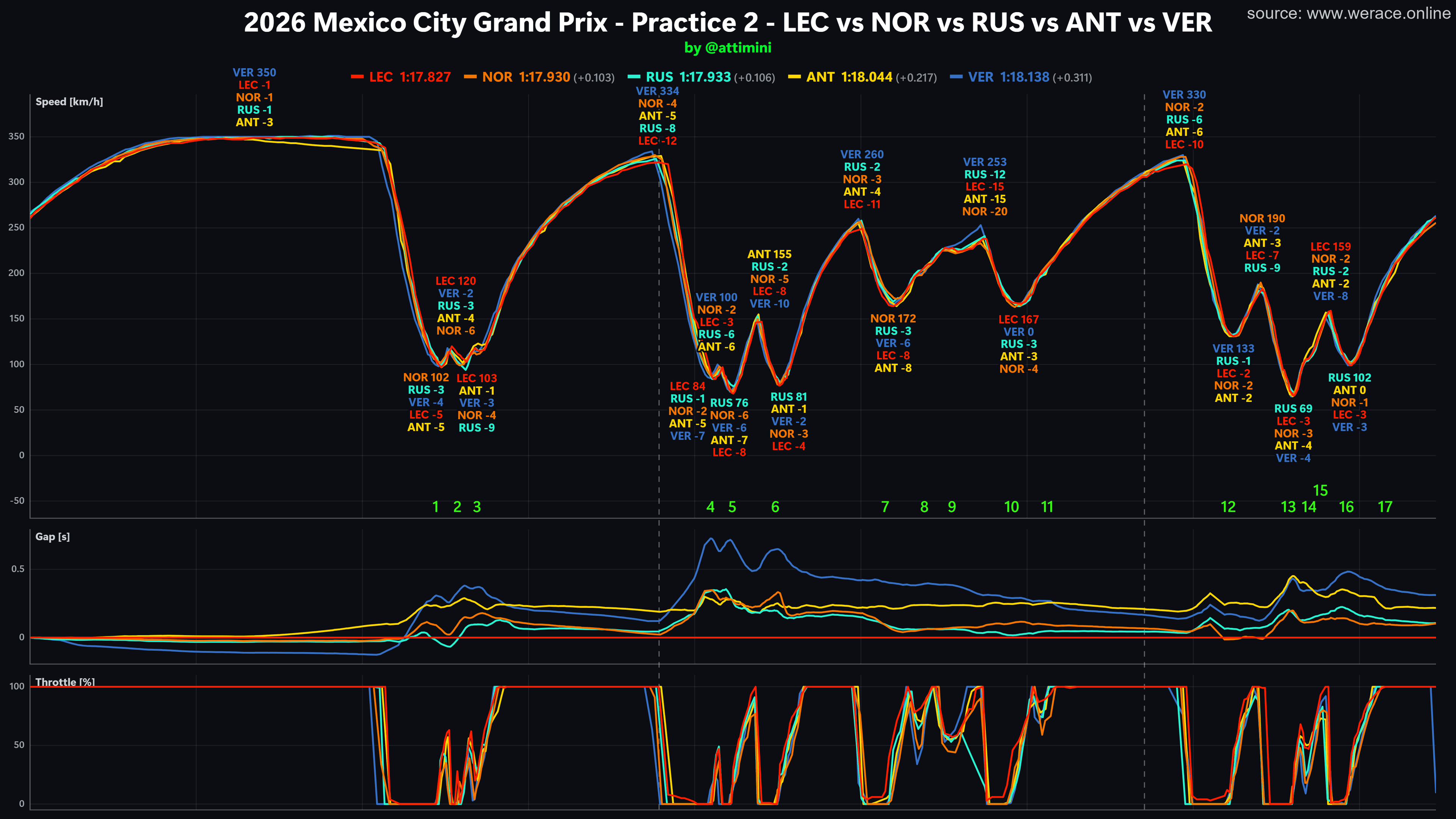
The chart compares the best laps of the top five: speed with values at each key point on top, the time gap to Leclerc in the middle, and throttle at the bottom. It is no longer a surprise that every top speed belongs to Verstappen: 350 km/h on the very long main straight, 334 km/h before Turn 4, 330 km/h before Turn 12. His blue line in the gap trace drops on every straight, then climbs back up in every corner sequence.
That is where Leclerc makes his lap.
Turns 1-3: Three Tenths in One Complex
From the braking for Turn 1 to the exit of Turn 3, Leclerc covers the section in 11.971s. Verstappen is 0.322s slower over that stretch alone, more than his entire gap on the lap. The braking bars at the bottom explain it: Max is on the brakes earlier than anyone, arriving faster but giving it all back before the apex, and the throttle trace shows him lifting earlier through the complex. Russell (+0.095s) and Norris (+0.124s) are closer, but Leclerc is the reference.
Turns 4-6: The Same Story
The pattern repeats through Turns 4, 5 and 6, with almost identical numbers: Verstappen gives away 0.313s to Leclerc, and again he is the first to brake. The Ferrari brakes later and deeper, confirming that the stops at Turns 1, 4 and 12 are where Leclerc builds his margin.
The mean-speed ranking makes the point clearly: Leclerc's fastest lap has one of the lowest average speeds of the field (192 km/h, behind even Antonelli and the Racing Bulls), yet it is the quickest lap of the session. The time is made in the slow corners, not on the straights. This does not mean Ferrari has the faster car overall, but it does suggest they have found a balance that suits a circuit where mechanical grip, braking and low-speed rotation matter so much.
The Ferrari Trade-Off: Energy Spent on the First Straight
On peak speed the field is almost flat: 346 to 352 km/h, a remarkable plateau around 350 km/h that shows how much the thin air reduces drag. The Ferraris are at 349 km/h, in line with Norris, Antonelli and Piastri.
Clipping, the speed lost at the end of a straight when the electrical deployment runs out, is not a Ferrari problem on the main straight either: 11 km/h for Leclerc and 5 km/h for Hamilton, comparable with the other front-runners and far below the Aston Martins or Lindblad.
The cost shows up later. Leclerc is 12 km/h down on Verstappen before Turn 4 and 10 km/h down before Turn 12. The pattern is consistent with a hybrid strategy that spends a lot of battery to stay at the top on the first straight, leaving less for the following ones. That puts all the weight on braking and corner entry: it works as long as everything goes right in the corners, while the power unit struggles elsewhere.
Then there is Saturday. All season we have seen rivals switch to more aggressive engine modes in Q2 and Q3, with the gap widening as qualifying progresses and the Ferraris struggling more and more. If Red Bull can fix their slow-corner balance without losing their straight-line advantage, Verstappen becomes a serious threat for pole.
That said, Mexico is one of the few tracks where pole is not decisive: the run from the grid to Turn 1 is so long that the front-row starters have historically lost more than they gained, with the cars behind using the slipstream. We will look at the numbers on this in the qualifying analysis.
4. Long Runs: Everyone Within a Tenth
The race simulations were split across compounds. Norris (27 laps), Russell (21), Verstappen (15) and Piastri (19) ran the soft, while Leclerc (17 laps on a used set) and Antonelli (13, also used) ran the medium.
The result is a remarkably compact group: once traffic is filtered out, average lap times sit within roughly a tenth of each other, and the degradation curves are almost superimposable. That Leclerc's medium pace matches the soft runners is encouraging, but the different compounds and the traffic make a definitive race-pace ranking impossible.
The full view, with every lap, shows something worth remembering for Sunday. Several drivers stuck in traffic used a slow lap to drop back and cool the tyres; when they resumed pushing, the tyres came back stronger. Antonelli is the clearest example: after his cool-down his pace returned to the 1:20.8 range, as Ferrari also told Leclerc on the radio. Tyre temperature management could matter as much as raw pace.
Leclerc's stint started in the 1:20.8-1:20.9 range, then lost around half a second once he caught Lawson. The radio log is telling: traffic with Lawson and Albon, a rear locking at Turn 2 requiring a brake-shape adjustment, and complaints about the bump at Turn 1, the same as in FP1.
Overtaking Looks Close to Impossible
The most significant finding of the day may not be a lap time at all. Overtaking looked extremely hard. Leclerc sat behind Lawson's Racing Bull for two laps without ever getting alongside, and Norris was then stuck behind the same car for three more. The reasons combine: the circuit already consumes most of the available energy, leaving little for an attack; the defending car has plenty of battery; and the thin air probably makes following even more difficult. Add a large bump at the entry of Turn 1, the best overtaking spot on the track, which causes lock-ups, and attacking becomes even less attractive.
The consequence is clear: in Mexico, track position may be worth more than a small advantage in race pace. A driver leading into Turn 1 with slightly worse pace could well win simply by running in clean air. Qualifying and the start could decide this race.
Brake Temperatures: A Ferrari Concern
The other warning sign for Ferrari concerns the brakes. Both Hamilton and Leclerc in FP1, and Leclerc again in FP2, were dealing with very hot brakes, most likely linked to tyre preparation, and the long lift-and-coast phases were back. Lift-and-coast means lifting off the throttle before the braking point and letting the car coast: it saves energy and cools the brakes, but it costs lap time. Leclerc was asked to increase it on practically every lap of his long run.
If that is confirmed on Sunday, it would be a real handicap, especially in traffic: a driver who must protect the brakes while attacking or defending faces an uncomfortable compromise, and following another car only makes the temperatures worse.
5. Team by Team
Ferrari looked quick, clearly better than my very low expectations. The car runs a relatively soft mechanical set-up that rides the kerbs well, and it rotates in the slow corners without excessive sliding from the rear, an advantage for rear-tyre temperatures. Without an MGU-H to spin up the compressor, Ferrari's smaller turbo seems to suit the altitude. The open questions are brake temperatures and the straight-line deficit after the first straight.
McLaren look more at ease here than in recent races, with Norris strong on both one-lap pace and long runs. Right now they appear to be Ferrari's main rival.
Mercedes are close, with a set-up window wide enough for both Russell and Antonelli to perform. The car looks very stiff, probably at the rear, presumably to help rotation in the slow corners. It is a reasonable choice, but one that may cost rear-tyre temperature over a race distance. I expect them to sort it out.
Red Bull are formidable on the straights, as the telemetry shows, but lose a great deal in the slow corners. In Mexico those corners come in sequences rather than in isolation, which magnifies the problem. Verstappen may still find a fix, and the team probably has more potential than it has shown so far.
Saturday morning note: Verstappen and Lawson were both handed a one-place grid penalty for their collision during FP2.
6. Record of the Day: Aston Martin
The most surprising chart of the day compares each team's fastest FP2 lap with last year's. All season long, Aston Martin have been five to six seconds slower than their 2025 times at almost every track and have been the slowest team on the grid. In Mexico they are only 0.658s down on last year, in the middle of the field, and not the slowest team. It has never happened before this season. One Friday is not a trend, but it is a remarkable step.
7. The Verdict
Ferrari's Friday in Mexico was far more encouraging than expected: Leclerc fastest, Hamilton on course for P2 before his failure, and an SF-26 that recovers substantial time in the slow corners. The concerns are just as clear: straight-line speed after the first straight, brake temperatures, and the extra power the rivals usually unlock on Saturday.
Red Bull own the straights but lose out in the technical sections, McLaren look revived and Mercedes are close enough to join the fight. Nobody has a margin to feel safe, and with overtaking this difficult, qualifying and the start may count more than pace. I am curious to see how much slipstream matters on Saturday, and how the order changes when the race-spec power units are turned up.
See you after qualifying!