
Brazilian GP FP3: Engine Penalties Reshape the Grid as Verstappen Tops a Slippery Session
The third and final practice session before qualifying at Interlagos is over, and the weekend has changed shape. The official power-unit changes have arrived, and they will reshape Sunday's grid before a single qualifying lap has been set.
1. Power Units: Verstappen to the Back, Ferrari Gamble on a Fresh Engine
Max Verstappen is taking a complete new power unit, with a new internal combustion engine, turbocharger and MGU-K, and will therefore start from the back of the grid.
The real news, though, comes from Ferrari. In the FP2 analysis I argued that their power-unit problem was serious and that a fresher engine might be needed to take on their rivals. Both Ferraris have now changed engines, but not the complete power unit: only the internal combustion engine has been replaced. That choice limits the penalty to ten grid places instead of a start from the back, which should leave both cars somewhere in the middle of the pack.
It is a compromise. Ferrari accept a smaller penalty in exchange for replacing the components that wear the most, and get back a more responsive, more powerful engine.
That would all be fine if Hamilton had not run into trouble during FP3. At first the car seemed to be working, then it appeared to lose power. He returned to the pits and went out again, but the car was making a loud metallic noise, and he finally came back to the garage with smoke pouring from the rear. His session was over, and the mechanics started taking the engine apart.
It was not just an assembly issue. A few hours later Ferrari confirmed it officially: after the checks, the team decided to replace the entire power unit. Hamilton will take part in qualifying, but he will start tomorrow's race from the back of the grid.
Red Bull team principal Laurent Mekies confirmed that the Red Bull Ford power unit is strong but perhaps a little delicate, which is why the team chose to change everything. He also made another important point, one I raised in my previous analysis: tyre degradation is high. Whatever the weather does, Sunday could be a race of survival.
2. One-Lap Pace: Verstappen by 25 Thousandths
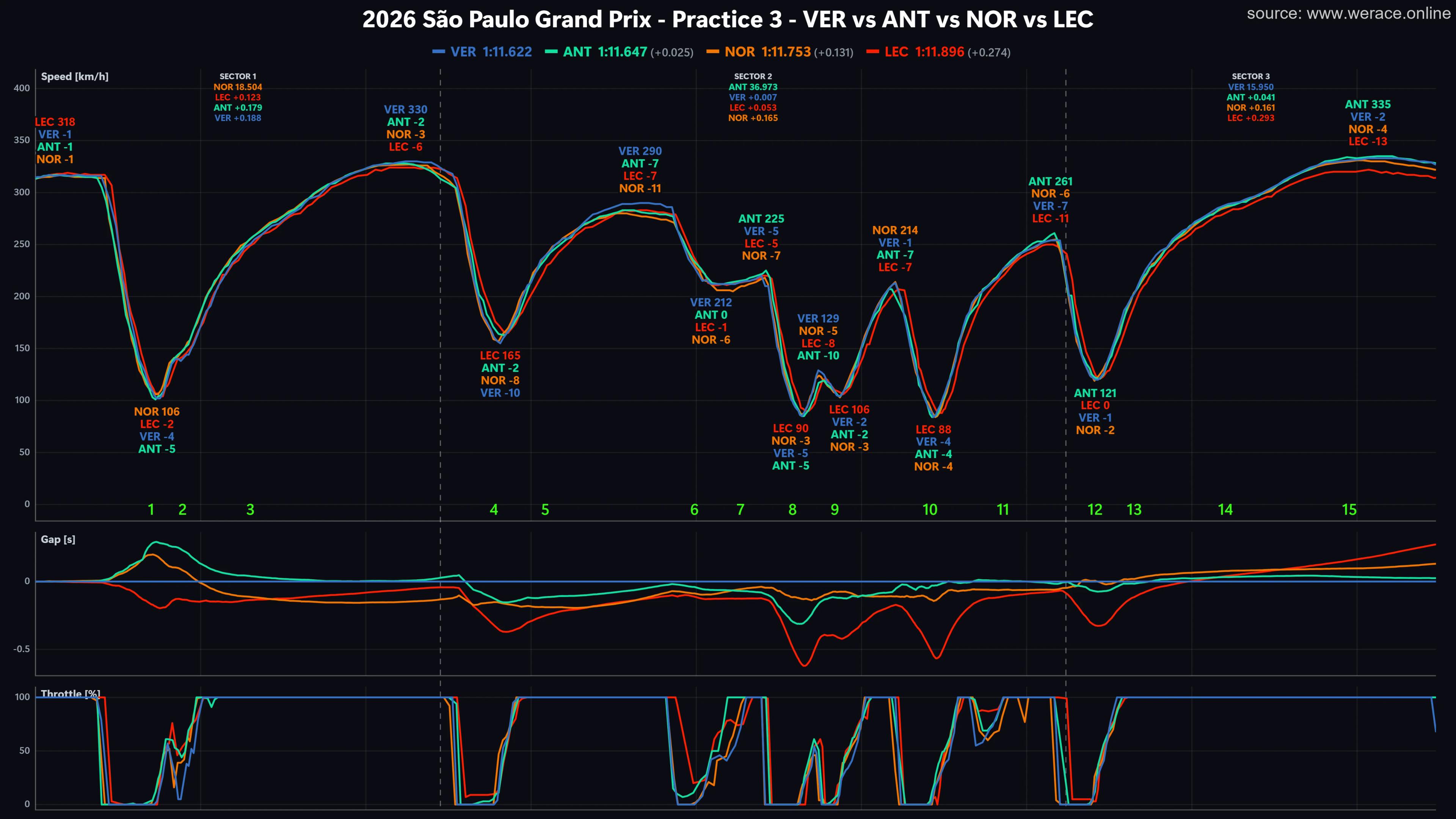
On track, the picture has shifted since Friday. Verstappen topped FP3 with a 1:11.622, just 0.025s ahead of Antonelli, with Norris third (+0.131s), Russell fourth (+0.184s) and Leclerc fifth (+0.274s). Hamilton, whose session was cut short, finished twelfth, more than a second down.
The ideal lap does not change the top three: Verstappen leaves 0.078s on the table, Antonelli only 0.025s and Norris 0.015s. Leclerc moves up to fourth on potential, while Russell drops to sixth, as his best lap was already his ideal lap.
The sectors show three different strengths: Norris was fastest in sector 1, Antonelli in sector 2 by just seven thousandths over Verstappen, and Verstappen in sector 3.
3. The Telemetry: How Verstappen Took P1
As usual, speed is at the top, the gap to Verstappen in the middle and throttle at the bottom.
McLaren have clearly improved from the exit of the Senna S. Through the first three corners Norris builds a good advantage and ends sector 1 with the best time.
In sector 2, Verstappen seems to have found grip again in the corners, but above all he unleashes a burst of electrical power on the run towards Turn 6, reaching 290 km/h, 7 to 11 km/h more than the others. That is where he recovers the ground he lost.
He does the same again on the final straight, the long climb to the line, which is where he takes the lead for good. Leclerc is the clearest victim: he is 13 km/h slower than Antonelli at the top of the hill, and his gap grows steadily all the way to the finish line.
The gap chart shows that Antonelli is very close, and in my view the two of them will fight for pole.
The top-speed chart confirms Ferrari's problem on the straights. On their fastest laps, Leclerc (324 km/h) and Hamilton (325 km/h) are among the slowest cars in the field, 10-11 km/h behind Antonelli and 8-9 km/h behind Verstappen.
4. Leclerc: Searching for Front End
With Hamilton unable to complete his programme, Leclerc carried Ferrari's work. On a very slippery track he struggled more than on Friday. On the radio he said: "It's only two tenths, but it feels like a lot because we are nowhere."
Then came a request I had never heard before. Leclerc asked how much maximum flap they had available. The team told him to come back to the pits so they could take a look, and he replied that they should add 13 clicks. That is enormous: normally the adjustment is two or three clicks. It shows how little front end Charles felt, so little that he wanted to transform the car's balance completely.
5. Qualifying: Rain and a Reshuffled Grid
Everyone is in the fight, grip is low, and at the end of FP3, while the teams were practising starts, it began to rain. Qualifying could have everything.
The grid could be turned upside down even more than the rain might manage. Verstappen and Hamilton will both start from the back, and both could adapt their set-ups to a race from behind. A lot can still change.
See you after qualifying!