
Kimi Delivers at Spa: A One-Car Mercedes Masterclass, a Lucky Ferrari, and Hadjar's Perfect Gamble
The lights went out, the safety car came out almost immediately, and by the chequered flag Kimi Antonelli had delivered exactly the kind of controlled, deserved win his pole position promised. Spa-Francorchamps is still the most demanding venue on the calendar, even in its 2026, energy-managed form, and Mercedes made it look comfortable.
There is a nice symmetry to where this win happened, too. This same circuit hosted the roughest weekend of Antonelli's rookie campaign twelve months ago - so taking his first Spa victory here, on the very track that once exposed him at his most vulnerable, feels like more than just another entry in the win column.
1. The Race in One Graph: Two Safety Car Periods and a Photo-Finish for P2
Before getting into pace and strategy, it is worth looking at how the whole afternoon actually unfolded relative to the winner.
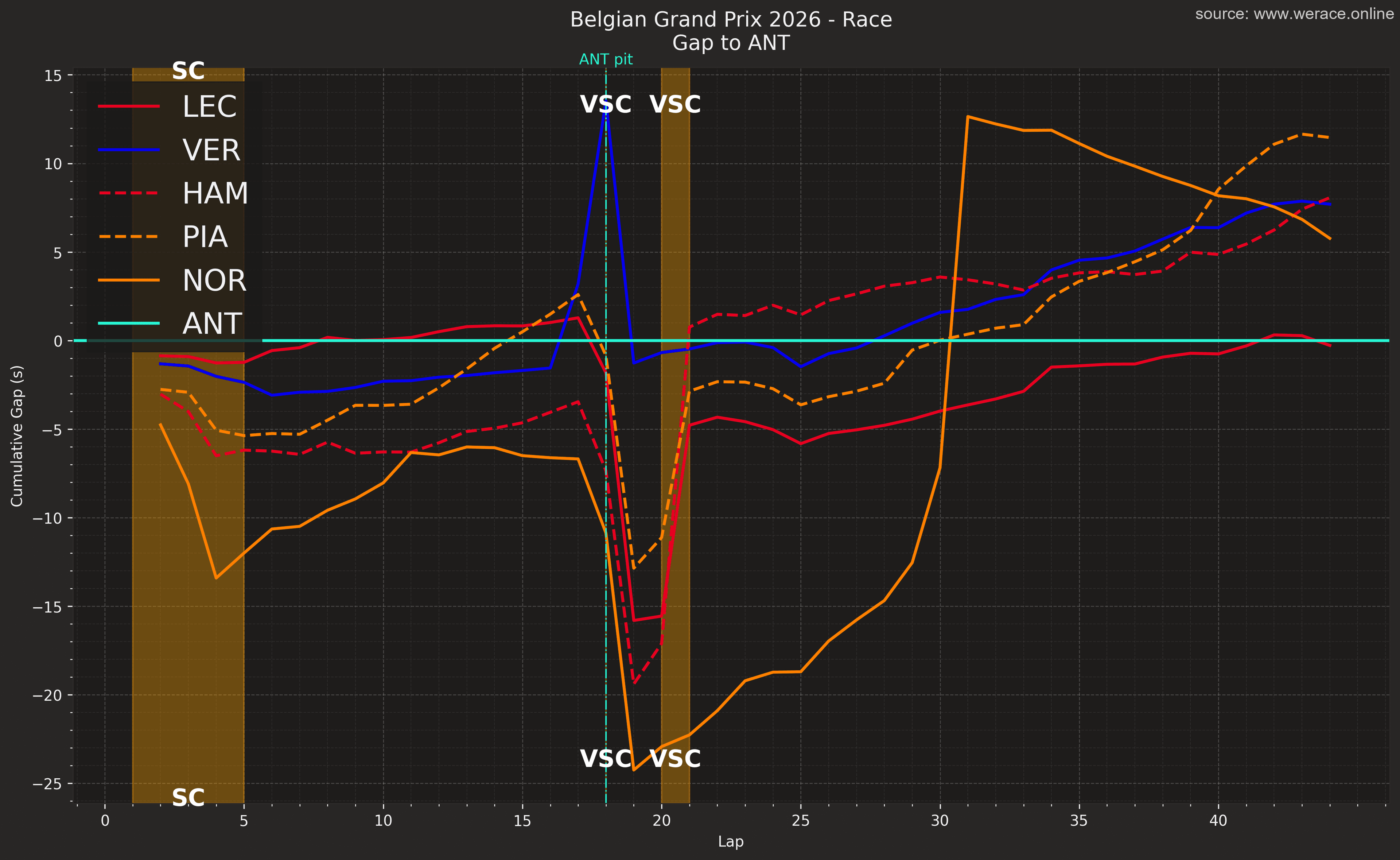
A Safety Car in the opening laps bunched the field up before it had even settled, then a double dose of Virtual Safety Car around Antonelli's own pit stop scrambled the picture further. What jumps out immediately is Charles Leclerc's red line: after diving as low as -15s relative to Antonelli mid-stint (track position gained through the VSC timing), it claws its way back up to finish the race hovering right around zero - basically a photo finish for second place on pure cumulative time, even though, as we'll see below, his raw pace across the race was measurably slower than Antonelli's. That gap between "how fast you actually were" and "where you actually finished" is the story of Ferrari's afternoon.
Verstappen and Hamilton, by contrast, both settle in the 7-8 second band by the flag, with Piastri further adrift near 11 seconds. Norris' orange line tells its own chaotic story - deep in credit early via an aggressive opening strategy, then a vertical cliff around lap 30 as a slow pit stop hands back everything he'd built, before a strong late recovery on comfortable tyres claws a chunk of it back.
The chain of events behind Antonelli's own pit stop is worth unpacking, because it wasn't really about Mercedes reacting to Ferrari at all. Leclerc's pace and track position put enough pressure on Red Bull that Verstappen was forced to pit early purely to cover off the threat of a Ferrari undercut - and Mercedes, in turn, had to bring Antonelli in to cover Verstappen, rather than on their own preferred window. It's a reminder that a lot of what looks like straightforward pit-wall strategy is really a chain reaction started further back in the field. It also meant Antonelli's first stint never really got to breathe: tyre degradation across the board was lower than the whole paddock expected, which blunted exactly the kind of long, clean stint where the W17 tends to show its real advantage.
2. Pure Pace: Mercedes Fastest Even Running What Amounts to a Single Car
Strip away strategy and safety cars, and just look at who was genuinely quickest lap after lap.
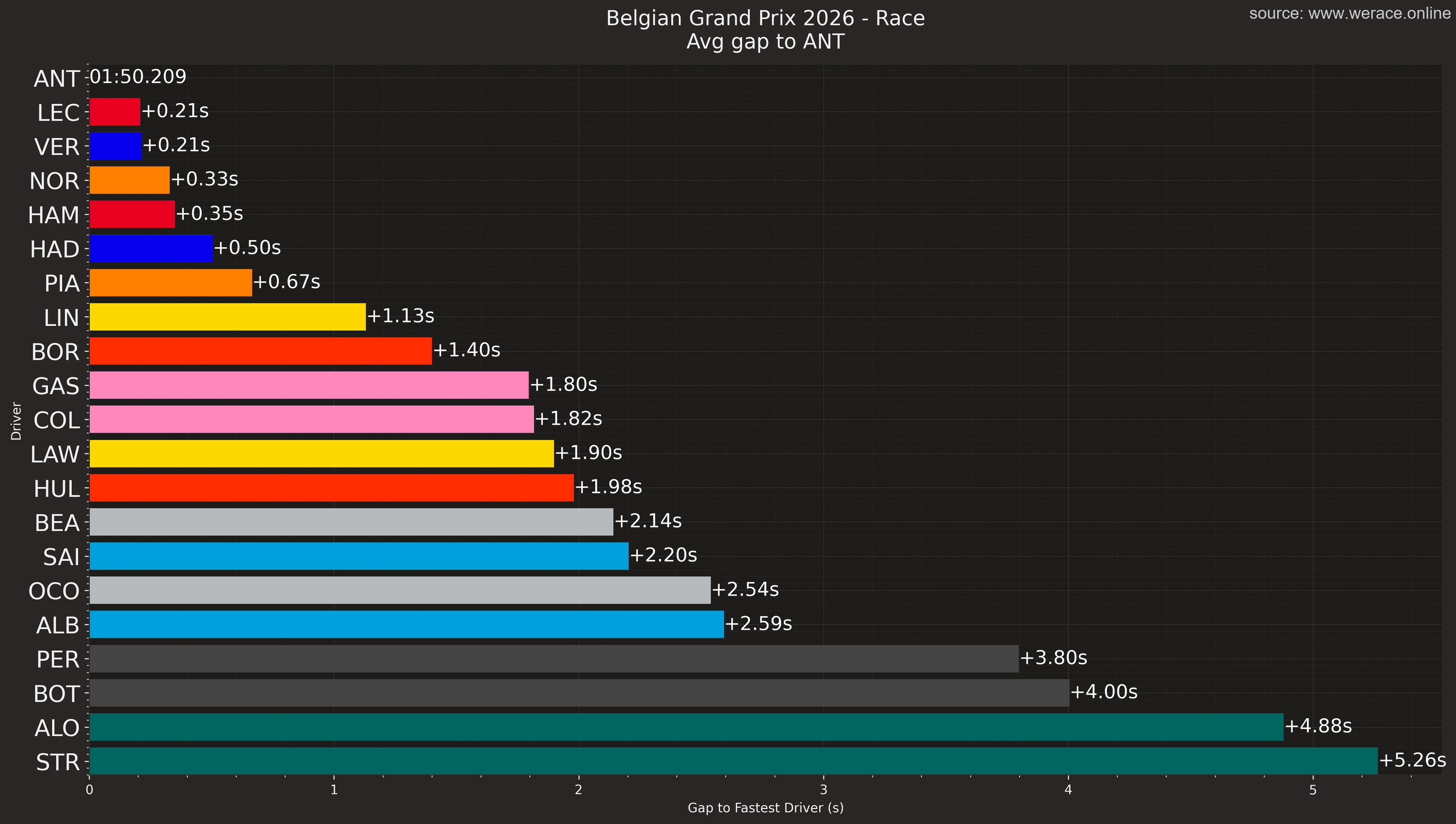
Antonelli's average lap of 1:50.209 was the class of the field. What stands out is how close the chasing pack is behind him: Leclerc and Verstappen are tied to the hundredth, both exactly +0.21s off Antonelli's average, with Norris (+0.33s) and Hamilton (+0.35s) similarly matched to each other just behind. That is two genuinely tight head-to-heads hiding inside the same table - Leclerc vs Verstappen, and Norris vs Hamilton - each pair separated by only a couple of hundredths across an entire Grand Prix distance.
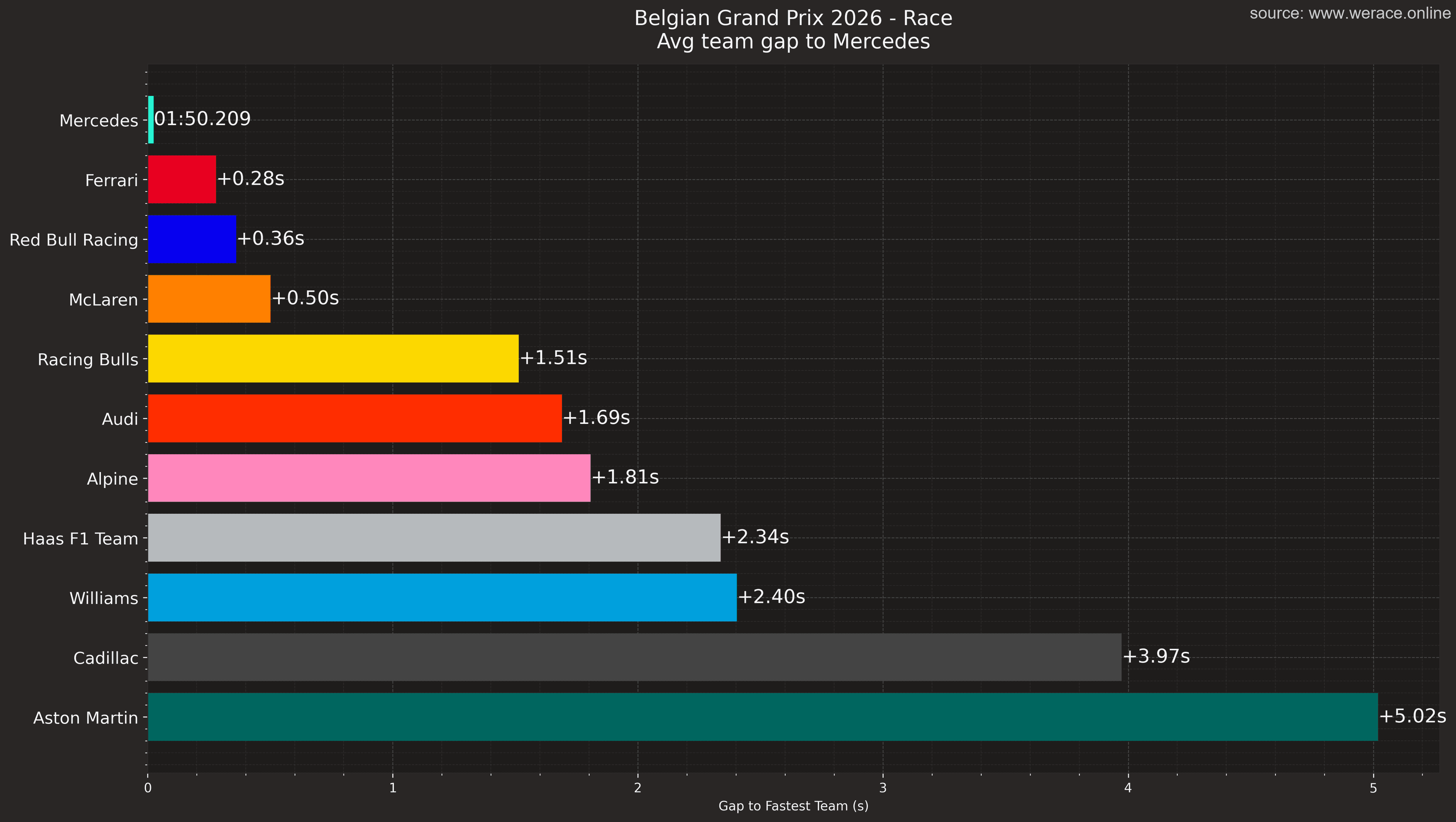
Zoom out to team level and the picture is even more telling. Mercedes' average team gap is built off essentially one representative car, and it is still 0.28s clear of Ferrari and 0.36s clear of Red Bull per lap - meaning Mercedes' single quickest driver was comfortably faster than either rival's best. McLaren sits half a second back as a team, with the rest of the grid a full second or more adrift.
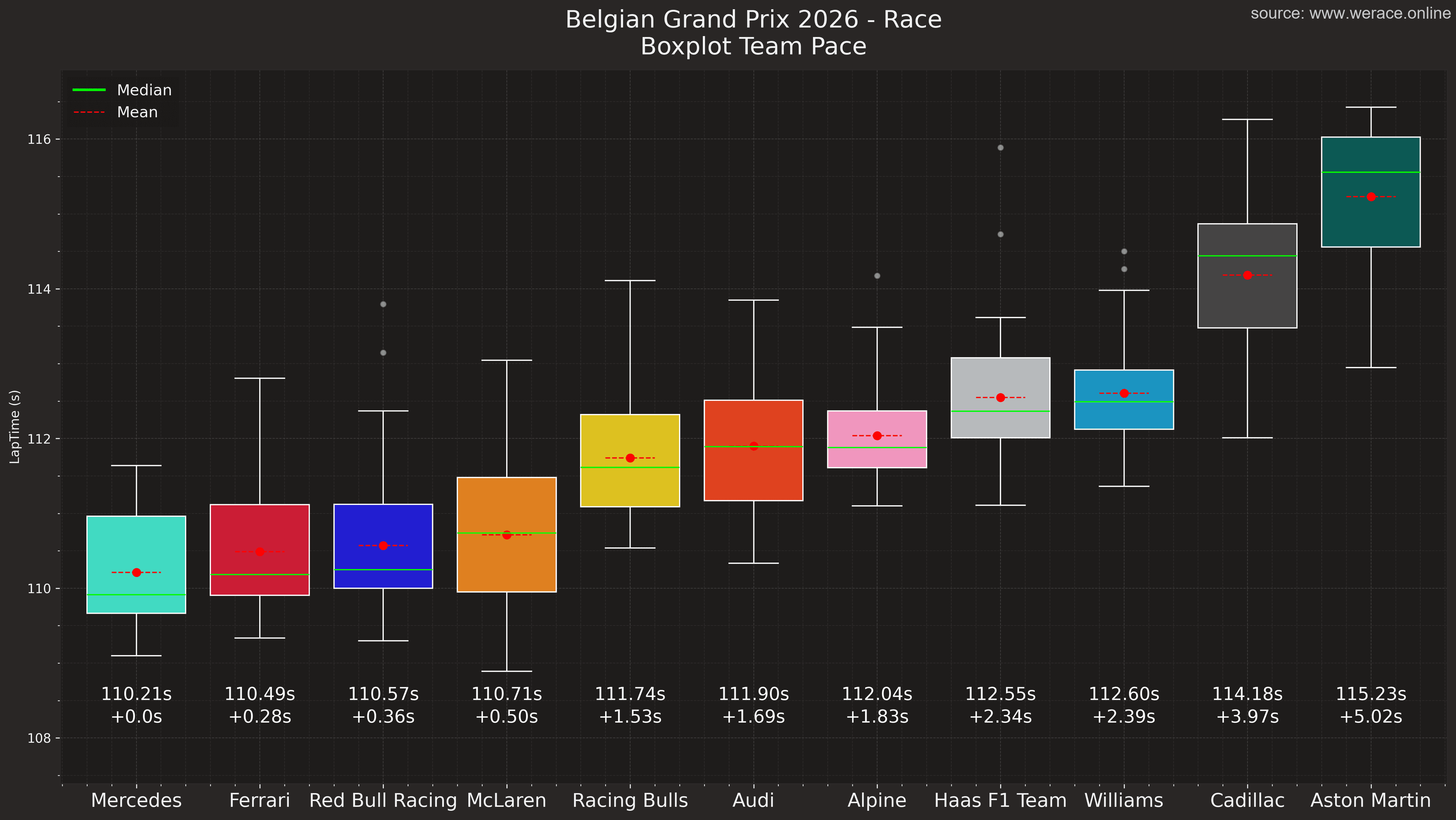
The box-and-whisker view adds one more layer: Mercedes doesn't just have the best average, it also has one of the tightest spreads on the grid, meaning Antonelli was rarely far off his own median lap. Red Bull's box is nearly as narrow, while McLaren's is visibly the widest of the front-runners - a hint at the inconsistency we'll come back to with Piastri.
3. Stint by Stint: Verstappen's Vanishing Twin-Pace, and Leclerc's Second-Stint Recovery
Split the race into its two stints and the Leclerc-vs-Verstappen tie from the average table breaks apart into something far more interesting.
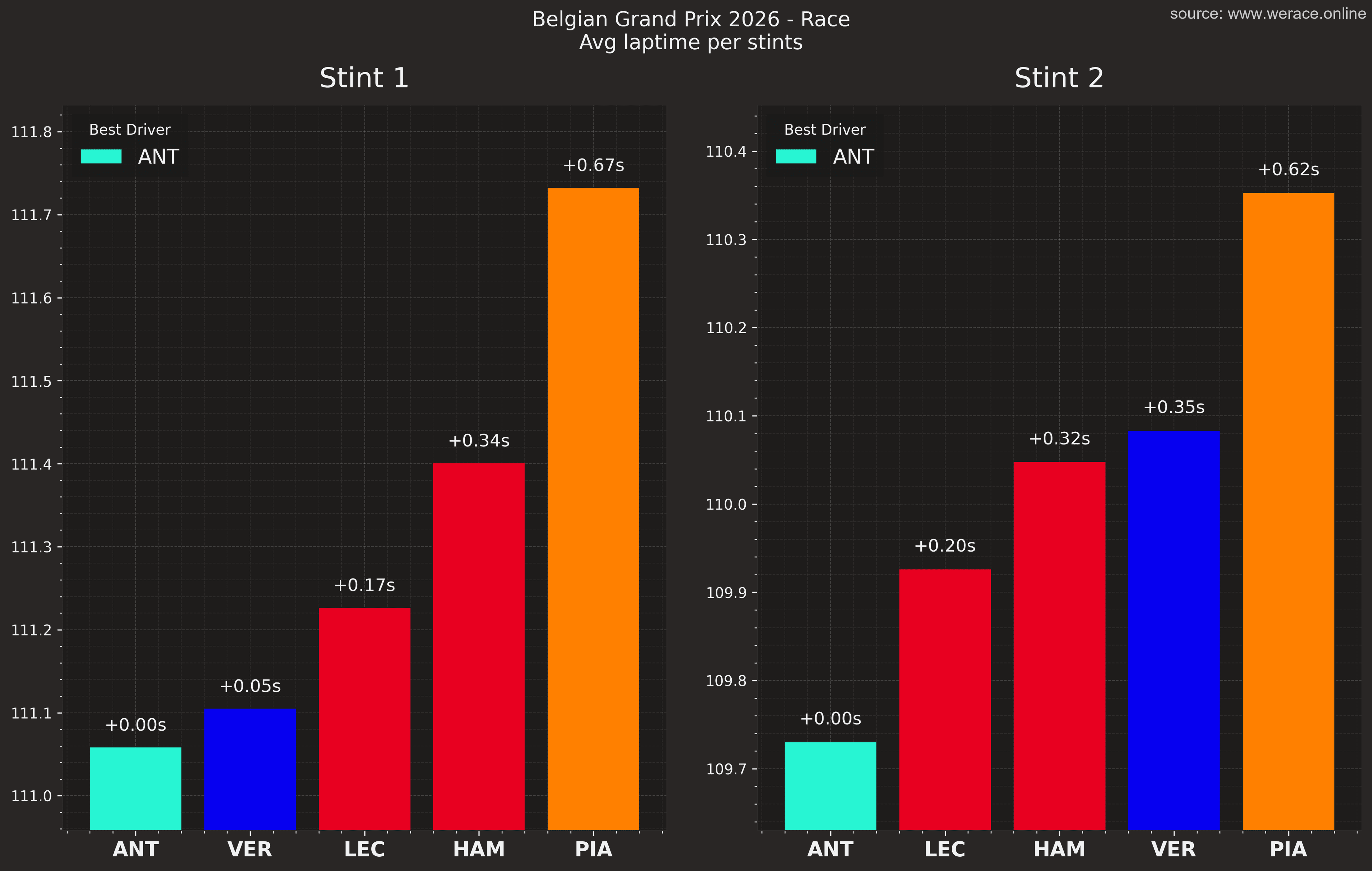
In the first stint, Verstappen was essentially glued to Antonelli's pace, just 0.05s off - as close as a driver gets to matching a rival lap after lap - while Leclerc trailed by 0.17s. In the second stint, the picture flips: Leclerc becomes the closest challenger at +0.20s, while Verstappen slips back to +0.35s, now behind even Hamilton's +0.32s. That second-stint step back lines up with what looked, from the outside, like Red Bull consciously shifting into tyre and energy management once the podium fight was effectively decided - a sensible move given how little was on offer for actually attacking Antonelli, but a clear signal all the same.
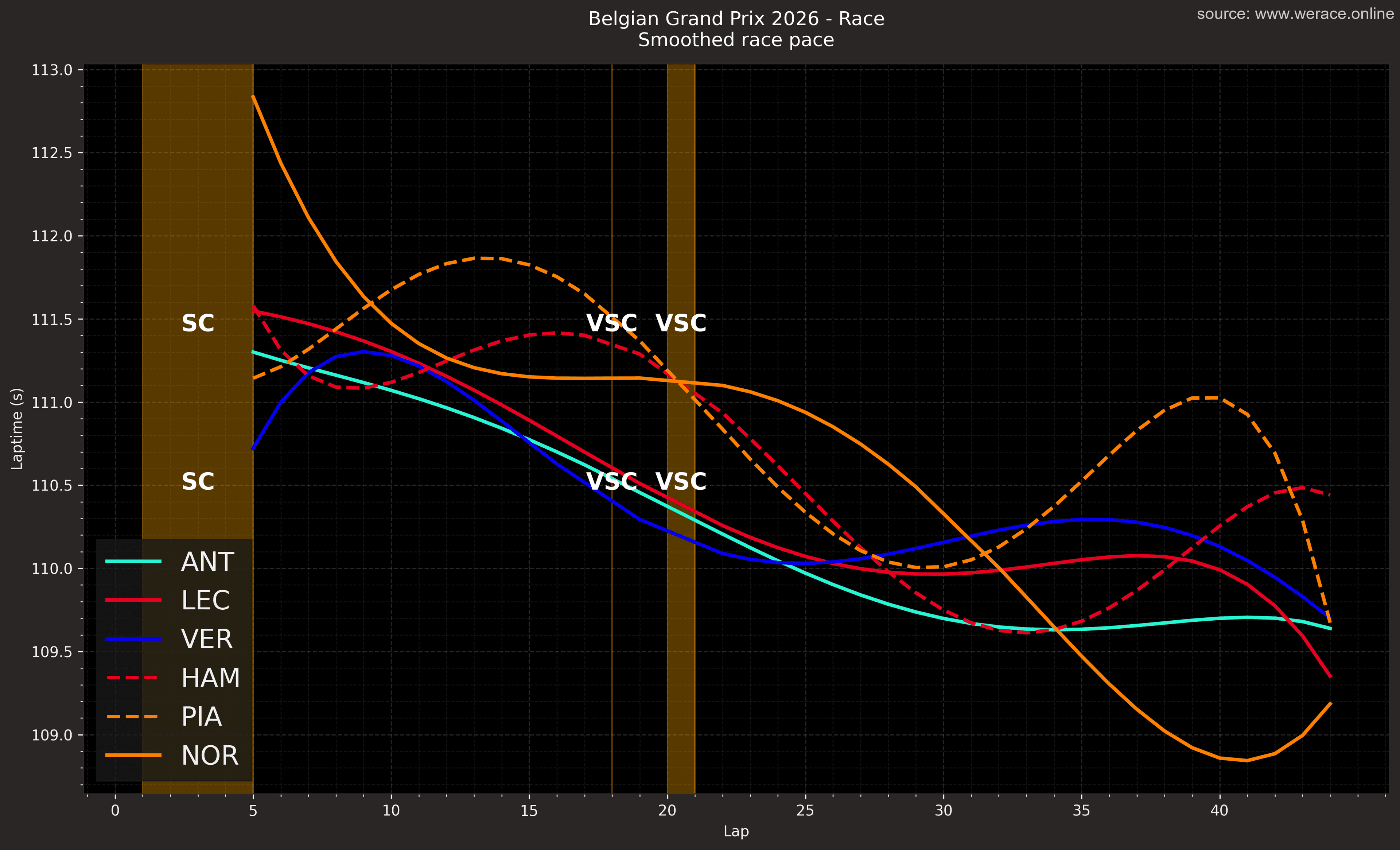
The smoothed pace trace shows this graphically: Verstappen's blue line tracks Antonelli's cyan line almost perfectly through the opening laps, then visibly detaches and flattens through the second half of the race, while Leclerc's red line keeps grinding closer to Antonelli's for longer.
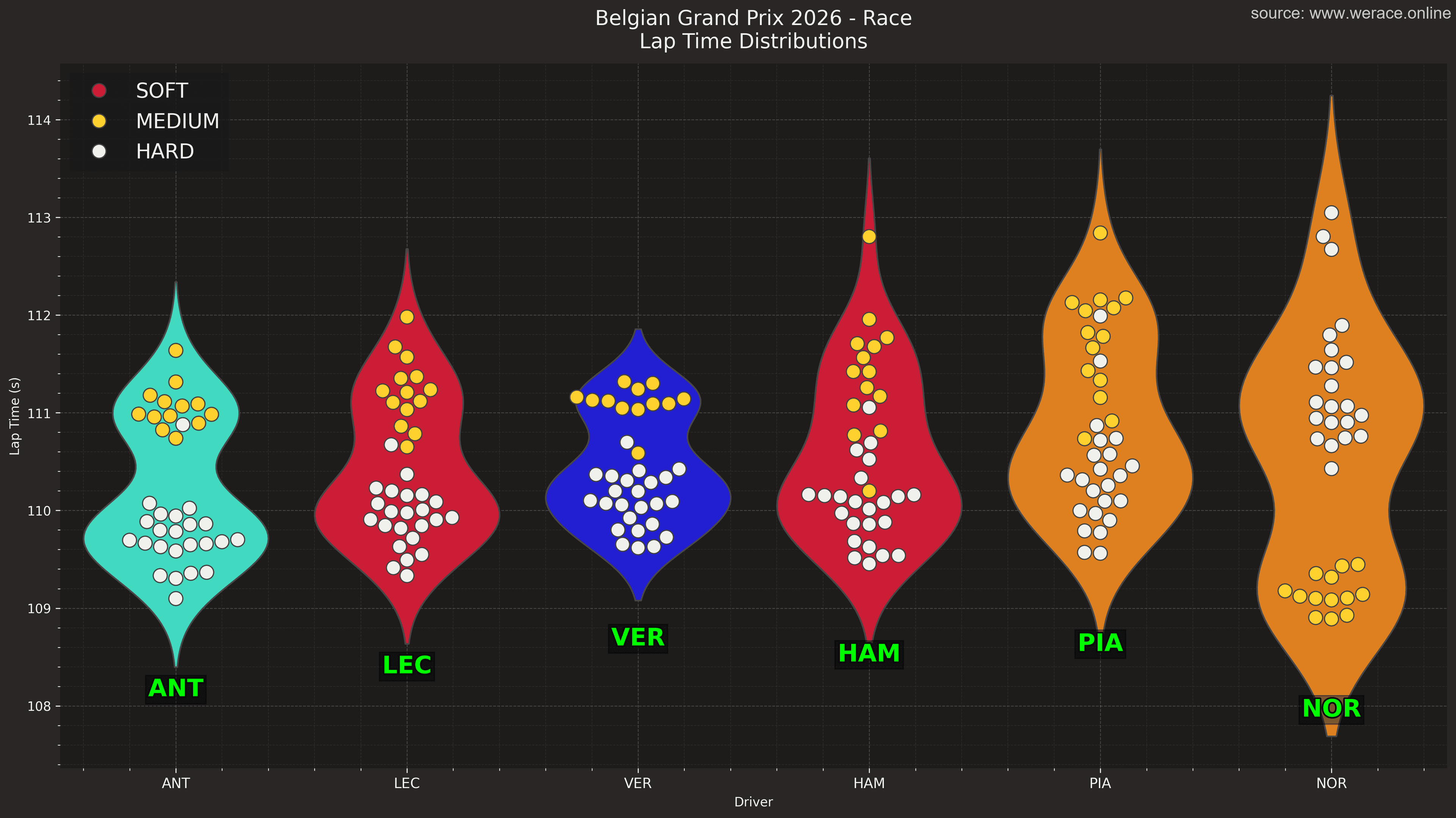
The distribution chart reinforces the same story from a different angle. Antonelli's violin is the tightest and lowest of the group - few surprises, consistently quick. Piastri and Norris show the widest spreads of the bunch, Norris in particular running a genuinely bimodal shape: a cluster of very slow laps early (safety car and a compromised strategy) and a cluster of very fast ones late, once he was running free in clean air on a well-suited tyre.
The real swing factor behind that second-stint reshuffle was the hard compound itself. None of the top teams had run it during the weekend, which turned the second half of the race into a genuine unknown for everyone. Verstappen was the first to complain about a lack of grip, Hamilton radioed in asking whether the crew had changed the front wing incidence at the stop because the car suddenly wouldn't rotate, and Leclerc struggled hardest of all - arguably a consequence of leaning too hard on the tyre in the opening laps of the stint to see off Norris around lap 23. The head-to-head with his own teammate makes the point clearly: between laps 29 and 33, Leclerc shipped roughly two seconds to Hamilton.
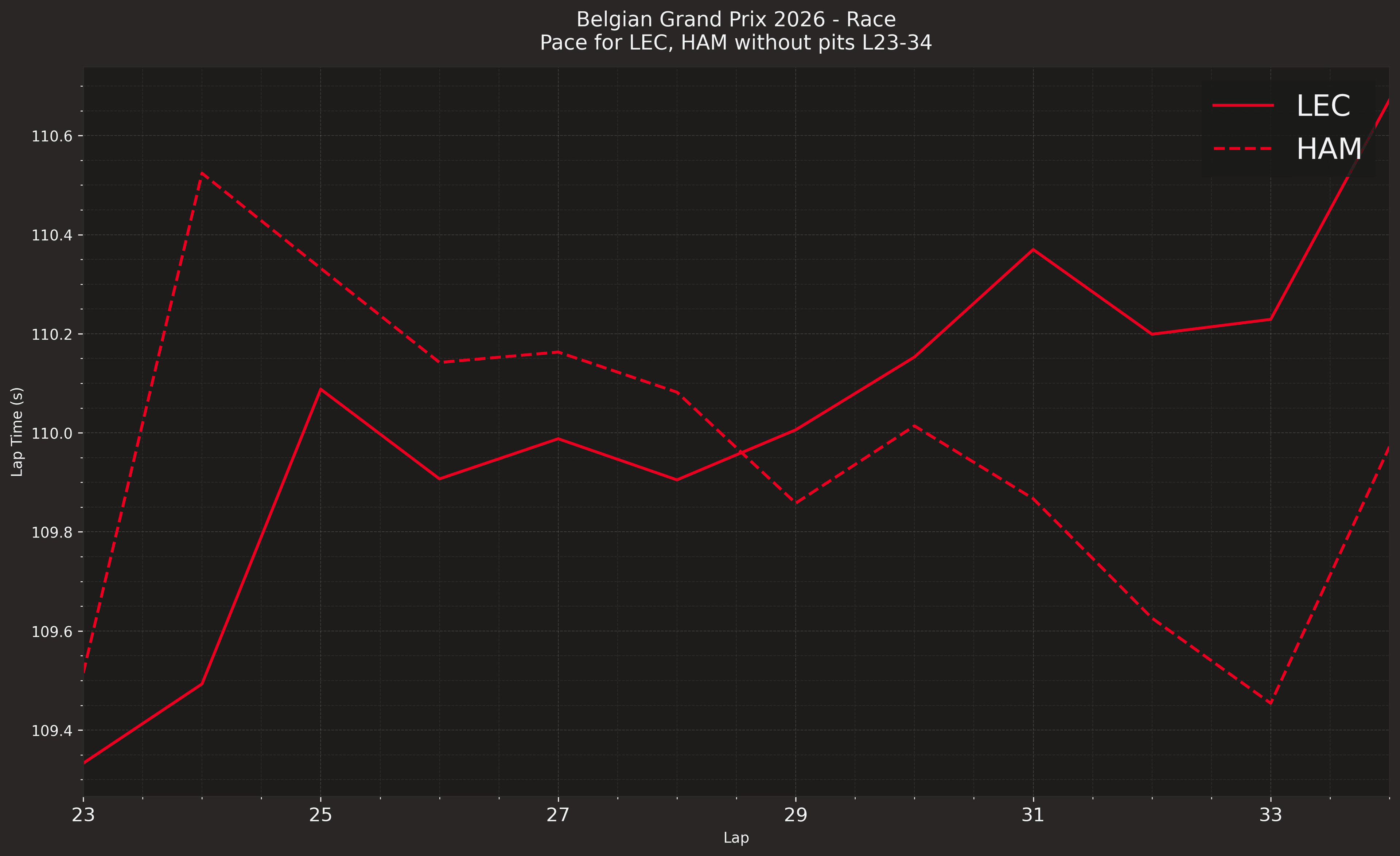
| Lap | Leclerc | Hamilton |
|---|---|---|
| 24 | 1:49.5 | 1:50.5 |
| 25 | 1:50.1 | 1:50.3 |
| 26 | 1:49.9 | 1:50.1 |
| 27 | 1:50.0 | 1:50.2 |
| 28 | 1:49.9 | 1:50.1 |
| 29 | 1:50.0 | 1:49.9 |
| 30 | 1:50.2 | 1:50.0 |
| 31 | 1:50.4 | 1:49.9 |
| 32 | 1:50.2 | 1:49.6 |
| 33 | 1:50.2 | 1:49.5 |
It's a small but telling data point: Hamilton, on the same tyre, in the same car, was still finding pace on the hard compound at exactly the point his teammate was losing it - proof that Ferrari genuinely had the pace to extend the fight with Mercedes further than the final gap suggests. Leclerc did eventually recover as the tyre came back to him in the closing laps, but the laps he spent tucked up behind Antonelli in the tow after being repassed shouldn't be read as Ferrari suddenly closing the gap for real: the chasing car in overtake mode gets access to roughly half a Megajoule of extra deployable energy, which flatters those particular lap times considerably. The more honest signal is Antonelli's own final stint, where he dropped his lap times by more than half a second in the closing laps once he needed to - clear evidence he had been managing the tyre rather than sprinting from lights to flag, with real pace still in reserve at the end.
4. Tyre Choices and the Order Rewrite
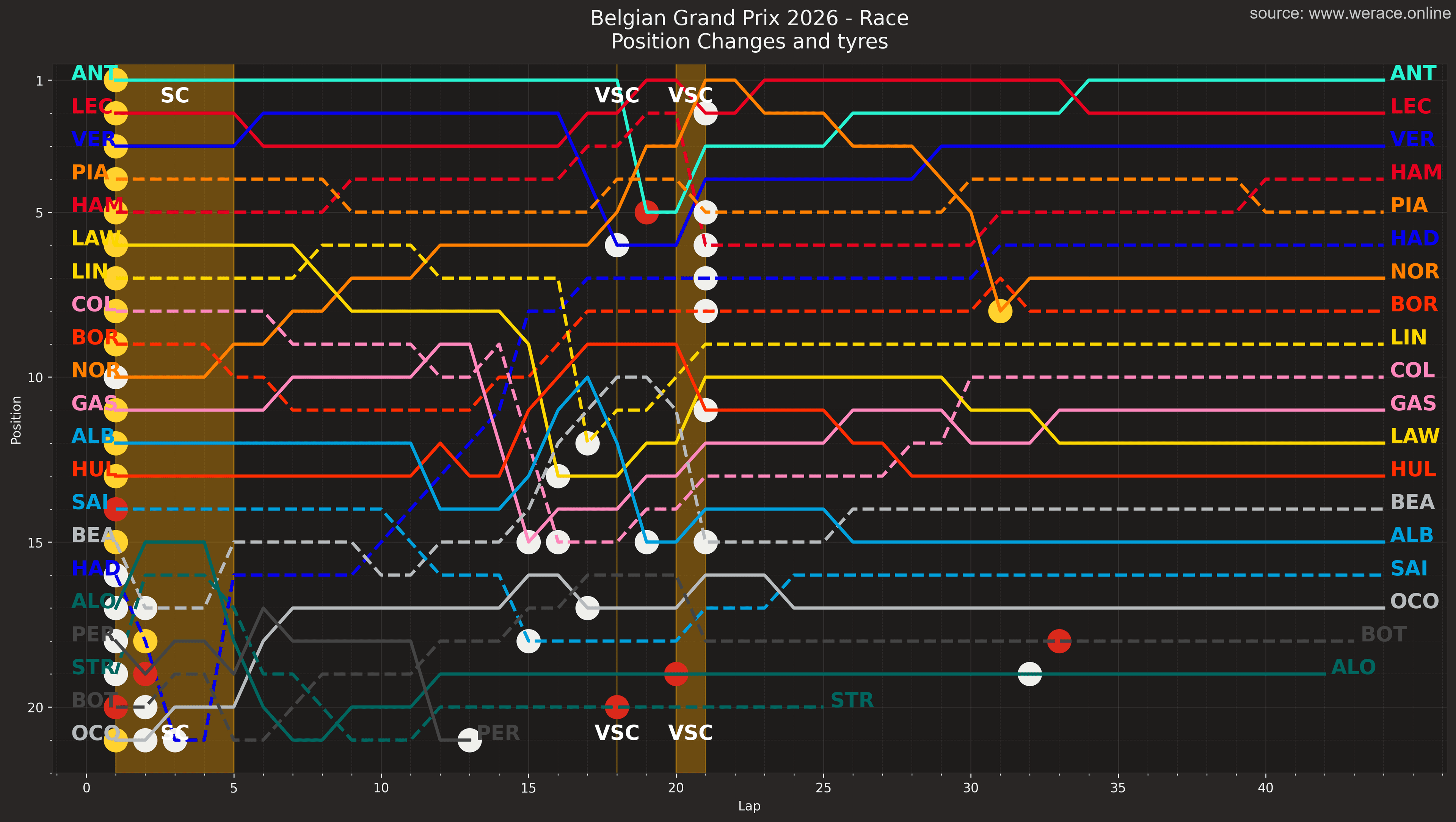
The position chart tells the strategic story end to end: Hadjar's early stop under the opening Safety Car, Norris' late and costly pit visit, and the shuffle around Antonelli's own stop under the double VSC that briefly promoted Leclerc to the race lead. By the flag the order read Antonelli, Leclerc, Verstappen, Hamilton, Piastri, Hadjar, Norris - with Hadjar's climb from the very back of the grid to P6 the single biggest mover of the afternoon.
5. Frame by Frame: How Antonelli Passed Leclerc, and How Leclerc Passed Back
The most entertaining fight of the race was the Antonelli-Leclerc duel in the opening third, and the telemetry from that battle is worth walking through in sequence.
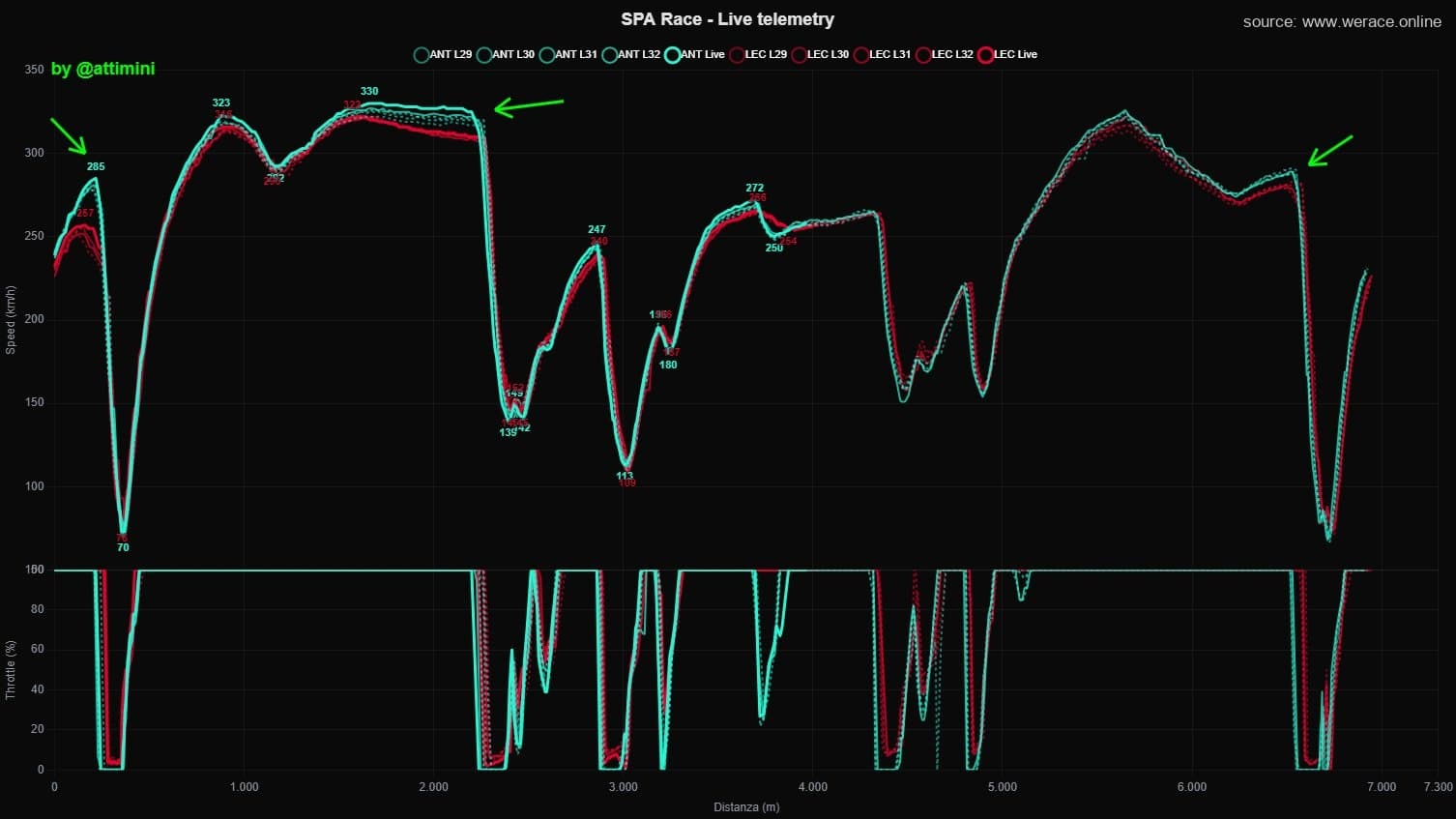
Here Antonelli is running just ahead in the tow, and the green arrows show it clearly: 285 km/h at the first braking zone against Leclerc's 257 km/h, and 330 km/h down the Kemmel Straight against Leclerc's 322 km/h. That kind of straight-line advantage on the exact car in front of you is a difficult thing to defend against for very long.
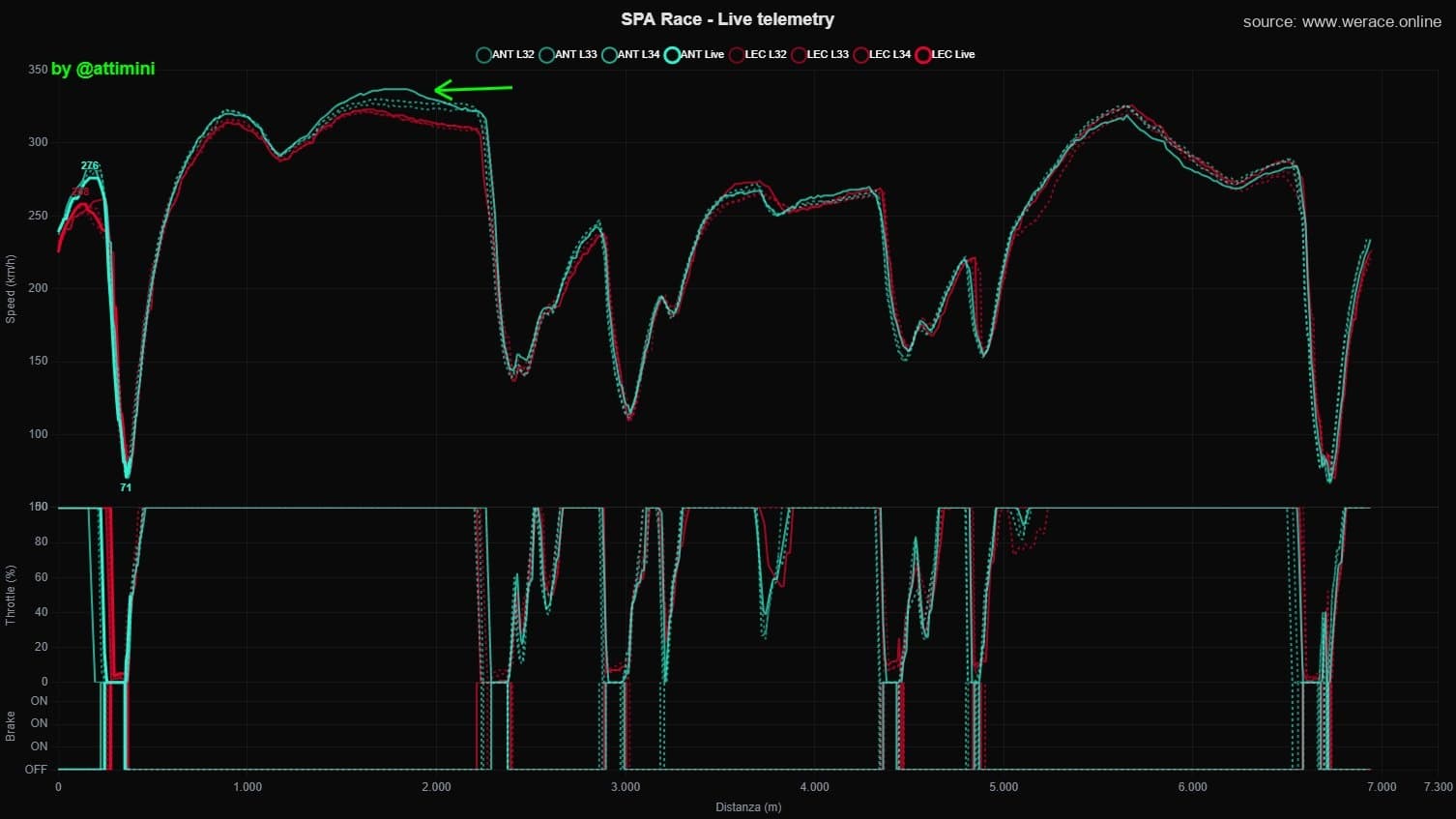
One lap on, the gap has widened further rather than closed - this is the pass itself being converted into a genuine advantage rather than a fleeting overtake.
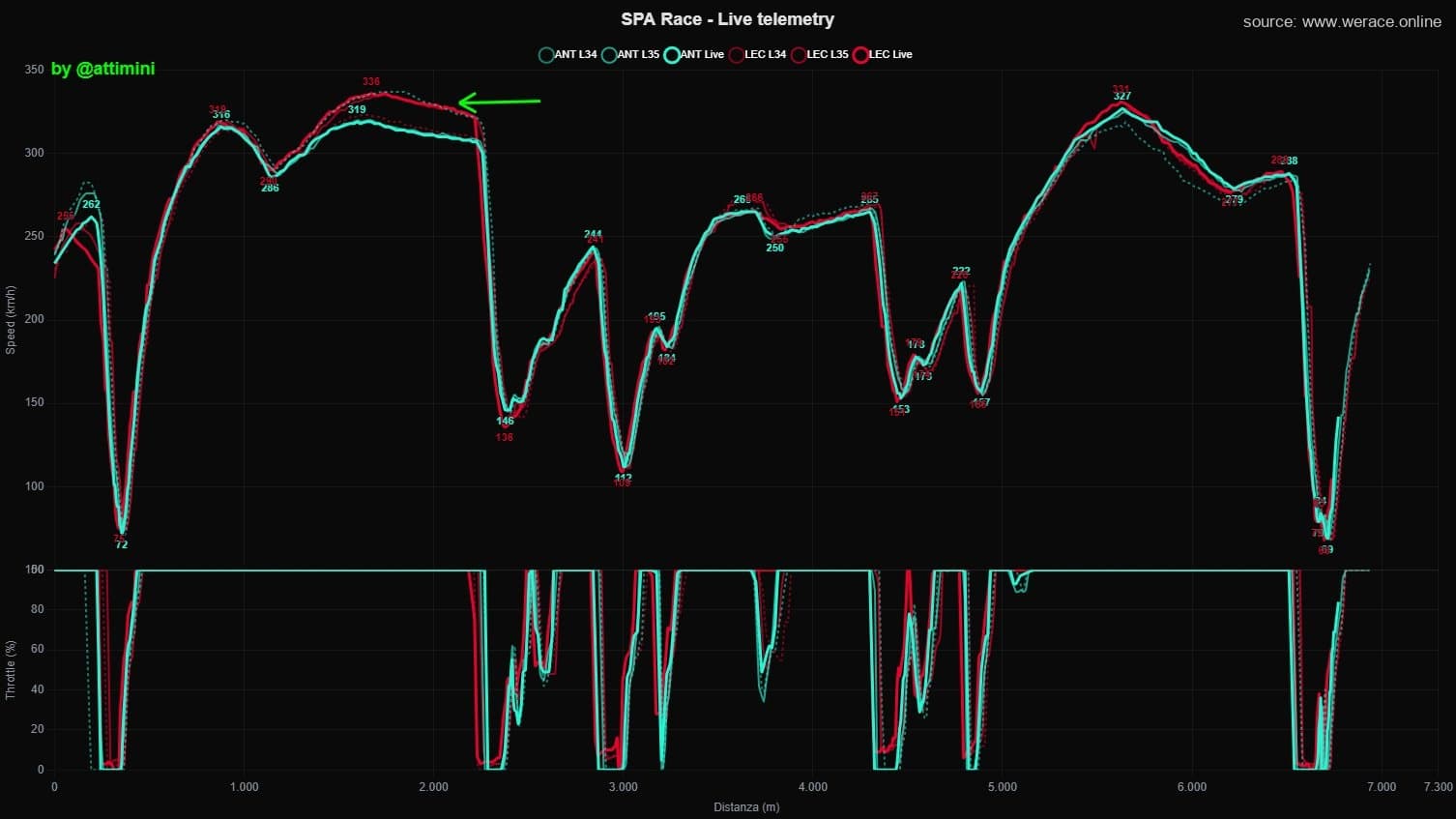
The situation then flips entirely. With Leclerc now the one benefiting from the tow and running the extra deployment of overtake mode, his line rockets to 336 km/h down Kemmel against Antonelli's 319 km/h - a near 17 km/h swing purely from track position and mode management, more than enough to get the move done.
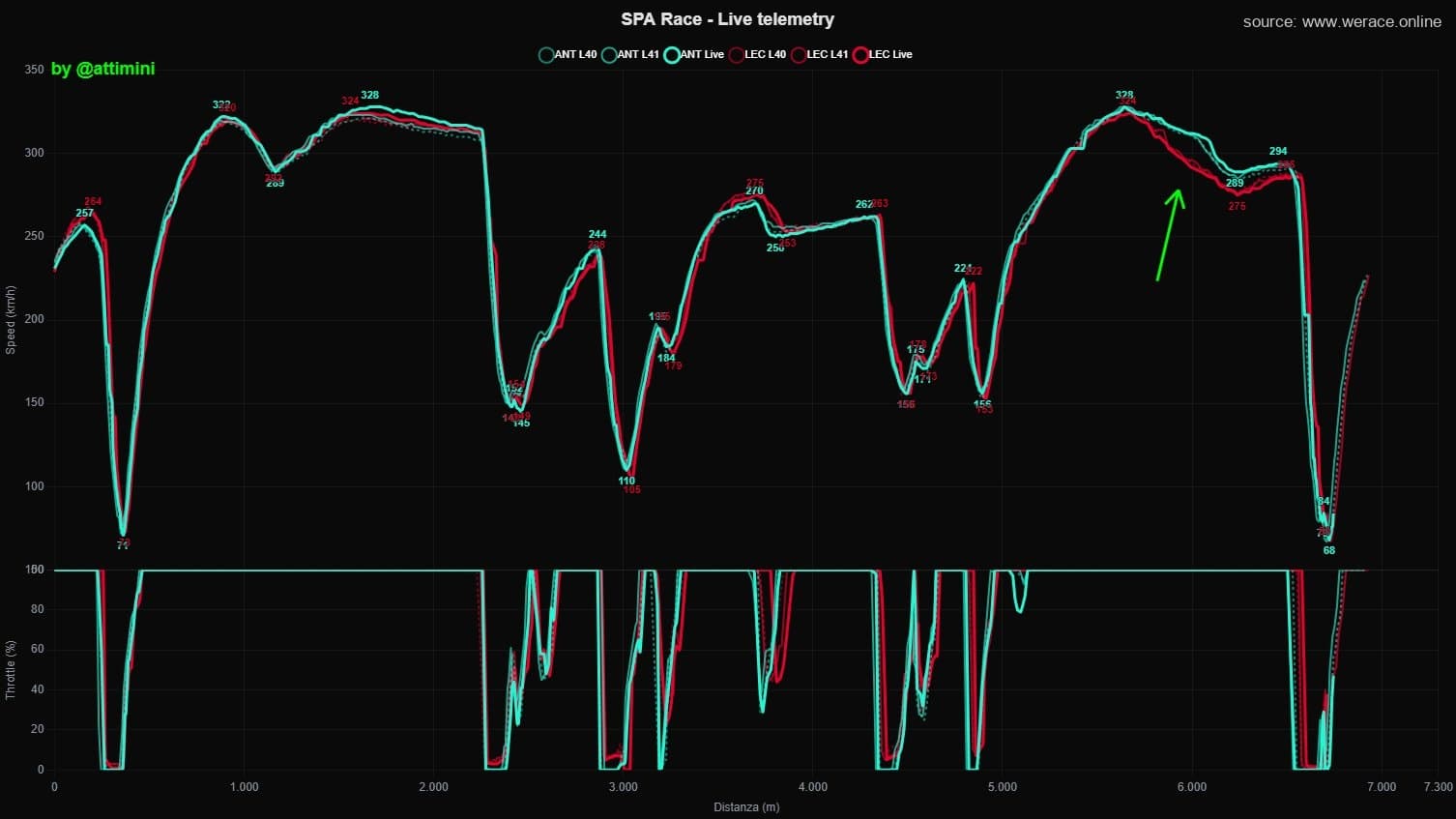
This final frame is the more instructive one, though, because it shows the pattern outside of a direct fight: once the two cars were running further apart rather than nose-to-tail, Leclerc consistently shipped speed through the Turn 16-17 (Blanchimont) area, exactly as flagged repeatedly on our live coverage during the weekend. It is the clearest single piece of evidence for where Ferrari's baseline deficit to Mercedes actually lives on this circuit.
6. Ferrari: A Lucky Break, a Damaged Car, and a Result Better Than the Numbers Suggest
Take the whole picture together and Ferrari leave Spa - one of the toughest circuits on the calendar for the SF-26's known power deficit - with a genuinely good result. Leclerc used a strong opening lap to move up to second, then inherited the lead outright when a Virtual Safety Car was triggered for a stranded car elsewhere on circuit, before eventually ceding the position back to Antonelli. Given how often the strategic dice have rolled against the team already this season, a slice of good fortune falling their way for once feels earned.
What makes it more impressive is that, on raw pace, Ferrari were not actually matching Mercedes - Leclerc's average lap was 0.21s off Antonelli's, and the frame-by-frame telemetry above shows exactly where that gap lives. The final classified gap of a few tenths at the flag flatters the pace picture considerably, and that is a testament to smart strategy calls rather than outright speed.
Hamilton's afternoon deserves real credit too. After a heavy Free Practice 3 crash left his SF-26 with extensive damage - including a completely destroyed sidepod - the mechanics rebuilt the car against the clock, and Hamilton still delivered a race that only cost him two tenths a lap to Leclerc in the first stint and just one tenth in the second, all despite a chaotic pit stop we will get to below. Losing so little pace under those circumstances is a strong recovery by both driver and crew.
Zoom out from this single weekend and the bigger picture is genuinely encouraging for Maranello. Spa is about as unfriendly a track as the calendar offers for the SF-26's known power deficit, and the gap to Mercedes still came out smaller than it could have. Two rounds that should suit the car's aerodynamic strengths far better than its power unit weaknesses are coming up on the calendar - though it's worth remembering Monaco was pencilled in as a similarly favourable weekend earlier this year and didn't convert, a reminder that results depend on flawless execution as much as raw car characteristics.
The quieter advantage Ferrari is building this season is reliability. Where Mercedes and McLaren have already eaten grid penalties for power unit changes, Ferrari's package has stayed clean, which matters twice over: it keeps points on the board race after race, and it reflects a deliberate strategic choice to prioritise a development platform with real headroom over a car that was merely quick out of the box. That approach has also preserved budget cap resources for a steady stream of aerodynamic upgrades through the second half of the year, plus a second, uprated specification of the ADUO power unit still to come. Mercedes remains the benchmark for now, but it would not be a shock if that picture looks different by the autumn.
7. Hamilton's Pit Lane Near-Miss and a Penalty Explanation That Doesn't Add Up
Hamilton's race was also complicated by a five-second time penalty applied mid-race, and by the strategy confusion that came with it. From what came across on team radio, Hamilton had gone into the race wanting to undercut rather than run a long first stint, specifically to avoid getting stuck in traffic - but the penalty forced a rethink of the whole strategy, and, in an echo of a similar communication breakdown earlier this season, he was not actually told about the penalty until he was already being called into the pits. His visible frustration on the radio before that stop suddenly makes a lot more sense in that light.
The pit stop itself then produced a genuinely alarming moment: the mechanic responsible for adjusting the front wing was still working on the car when the team gave the green light to release. As best we can piece together, the five-second penalty needed to be served stationary before the crew could touch tyres or the wing, but the wing mechanic was informed of that requirement late - mechanics are deliberately not spoken to during the penalty countdown to avoid distracting them from their job - so he only started his adjustment once the five seconds had already elapsed and the rest of the crew moved to release the car. The result was a car sent down the pit lane with a mechanic still in the process of working on it: not just costly, but genuinely dangerous, and something the team will need to review properly.
Separately, the penalty verdict itself raises an eyebrow. The stated reasoning was that Hamilton tried to leave sufficient space to avoid contact, that the collision stemmed from a front-end grip loss rather than an aggressive move on his part, and that reduced grip plus a tightly bunched field on the opening lap were mitigating factors - and the conclusion drawn from those three points was a reduced five-second penalty rather than the standard ten. Read literally, all three stated factors argue that Hamilton was not meaningfully at fault at all, which makes the decision to hand down any time penalty, let alone stop short of the usual tariff for a similar incident, difficult to reconcile with the stewards' own explanation.
8. Red Bull's Quiet Encouragement, and Hadjar's Perfectly Executed Gamble
There is a genuinely promising race pace story buried in Red Bull's Sunday. At team level they were only 0.36s off Mercedes per lap on average - just 0.08s behind Ferrari's own average gap, essentially split hairs between the two - and for the opening stint specifically, Verstappen matched Antonelli's pace almost exactly. The second-stint step back looks far more like a deliberate shift into management mode than any sudden loss of pace, which, if anything, should be read as a positive signal for Red Bull heading into the next few rounds.
There's also a nice personal angle to Verstappen's podium: with Spa sitting right on the Belgian-Dutch border, it plays as something close to a second home race for him, and he took it without even running the flexible rear wing the paddock has nicknamed the "Macarena," which the team says will return for Budapest. The RB22 still leaned heavily on strong straight-line speed to make that podium happen, with energy management remaining the car's clearer weakness relative to the two teams ahead of it. The bigger structural story, though, is the upgrade package introduced back in Austria, which has pulled Red Bull to within a few tenths of Mercedes - historically the hardest stretch of performance to find once a gap has opened up like this one had.
The real headline from the Red Bull garage, though, belongs to Isack Hadjar. Starting from the back of the grid after his qualifying power unit change, the team gambled on pitting him at the very first opportunity, during the opening-lap Safety Car, fitting a tyre that could realistically run the rest of the distance and setting up a genuine one-stop covering almost the entire race on the hard compound. It worked close to perfectly: Hadjar climbed roughly fifteen positions to cross the line sixth, comfortably the biggest mover of the day and a copybook example of turning a compromised grid slot into a strong result through smart strategy alone.
9. McLaren: The Downforce Trade-off Bites, and a Norris Recovery Undone by the Pit Wall
McLaren's weekend-long commitment to a higher-downforce setup, built around exploiting Spa's active-aero zones, came with a real cost in race trim: neither car could pass particularly easily once they were stuck in traffic. The clearest example was Piastri's fight with Leclerc, where he could find no meaningful advantage either under braking or down the straight to actually complete a move - which, incidentally, is exactly why a penalty against Leclerc for that particular battle would have been a strange call, given Piastri was the chasing car throughout.
Norris' race, meanwhile, was undone as much by the pit crew as by the grid penalty itself. A slow stop compounded the ten-place drop from qualifying, and the gap trace above shows exactly how much that single stop cost him - his line goes from building a healthy cushion to falling off a cliff in the space of a lap. The pace was genuinely there, as the late-race charge in the smoothed and violin plots both show; it just came from too far back to matter for the final result.
Underneath the frustration, there is real underlying progress at Woking. The tools Mercedes has been supplying as part of the customer relationship have visibly helped McLaren's energy-management deficit, and the team is hoping to pair that with further aerodynamic upgrades expected in Budapest. Even so, there's a clear-eyed acknowledgement inside the team that whatever arrives next won't be enough on its own to close the gap to the Mercedes-Antonelli combination, which for now continues to operate a level above everyone else.
10. Russell's Lost Afternoon, and Mercedes' Other Gremlins
It would be easy to read this weekend as a flawless Mercedes sweep, but George Russell's race tells a very different story, and it is worth pausing on before moving to the championship picture. Russell was eliminated by contact with Hamilton - and while responsibility for the incident itself sits with the stewards' verdict discussed above, part of why he was even exposed in that position in the first place traces back to a lack of electrical deployment down the Kemmel Straight, leaving him vulnerable on track rather than clear of trouble.
That energy shortfall was not an isolated glitch. Toto Wolff confirmed after the race that every Mercedes-powered car on the grid had some form of energy-management issue at the start of the race, hitting Russell noticeably harder than his teammate. It compounds an anomaly Russell has apparently been carrying since Friday practice, one that pushes disproportionate energy spend into the first sector at the expense of the third, costing him lap time all weekend independent of the race-day problem. McLaren's own Andrea Stella offered a useful piece of context on this front: these 2026 power units are making real-time decisions on energy deployment based on sensitivities the teams themselves don't yet fully understand, which makes this kind of car-to-car inconsistency within the same garage more plausible than it might sound. Wolff has been explicit that fixing this predictability problem is now a priority - and it feeds into the wider reliability picture, an area where Ferrari currently holds the edge and, in doing so, is keeping the championship fight alive.
11. The Bigger Picture: A Circuit Still Fighting Its Own Regulations
We said it after qualifying and the race did nothing to change the assessment: Spa-Francorchamps, one of the most demanding and rewarding circuits on the calendar, remains hobbled by how the current power unit rules force energy management through corners that used to be run flat-out on commitment alone. Watching sections that once demanded real bravery reduced to calculated recharge zones is still a difficult watch for anyone who loves this place for what it used to ask of driver and machine. Tellingly, it was a topic of conversation among the podium finishers themselves in the room beforehand - with Verstappen, by every visual account, finding the whole subject quietly amusing.
12. Championship Ripples
Antonelli leaves Spa leading the drivers' championship outright, with Hungary and then the summer break next up on the calendar, and there is more behind that lead than raw car pace. His driving style - deliberately minimising time spent turning rather than carrying speed through the apex - happens to line up almost perfectly with what 2026's energy rules and the current Pirelli compounds reward. But the less visible gain this year has been mental: after a chat with Roger Federer at Wimbledon a few weeks back, where the advice centred on learning to manage emotion under pressure, Antonelli has looked visibly more composed both behind the wheel and in the post-race debriefs - a genuine part of why the results have started coming so consistently.
Hamilton's recovery drive is enough to move him up to second in the drivers' championship, moving ahead of a visibly frustrated Russell, who has been increasingly open about not feeling he has the same car underneath him as his teammate, and who has flagged a suspected power unit issue of his own.
One more thread worth watching heading into the next round: as a Mercedes customer, McLaren's power unit allocation ultimately sits in Toto Wolff's hands, and Norris looked genuinely close to the front this weekend before the penalty and the slow stop ended that story. A sharp strategist in Wolff's position has every incentive to keep the works Mercedes clear of its two best-funded customers rather than let them close in - worth keeping an eye on as the season moves into its second half.
That's the wrap from Spa. Back with the next full breakdown as soon as the paddock reconvenes.