
A Muzzled Spa: Antonelli's Ruthless Pole as the 2026 Regulations Strangle Francorchamps
We are back on the calendar's most storied ribbon of tarmac, and once again it is time to dissect a Belgian Grand Prix qualifying session. Except this year, "Spa" does not quite mean what it used to.
Anyone who grew up loving this circuit for what it demanded from driver and machine will find this year's version bittersweet. The 2026 power unit regulations have reshaped the place completely, and the numbers make the point far better than any adjective could.
1. The Regulation Reality: 2025 vs 2026, Lap for Lap
Start with a straight overlay: Lando Norris' 2025 pole lap against Kimi Antonelli's 2026 pole lap.
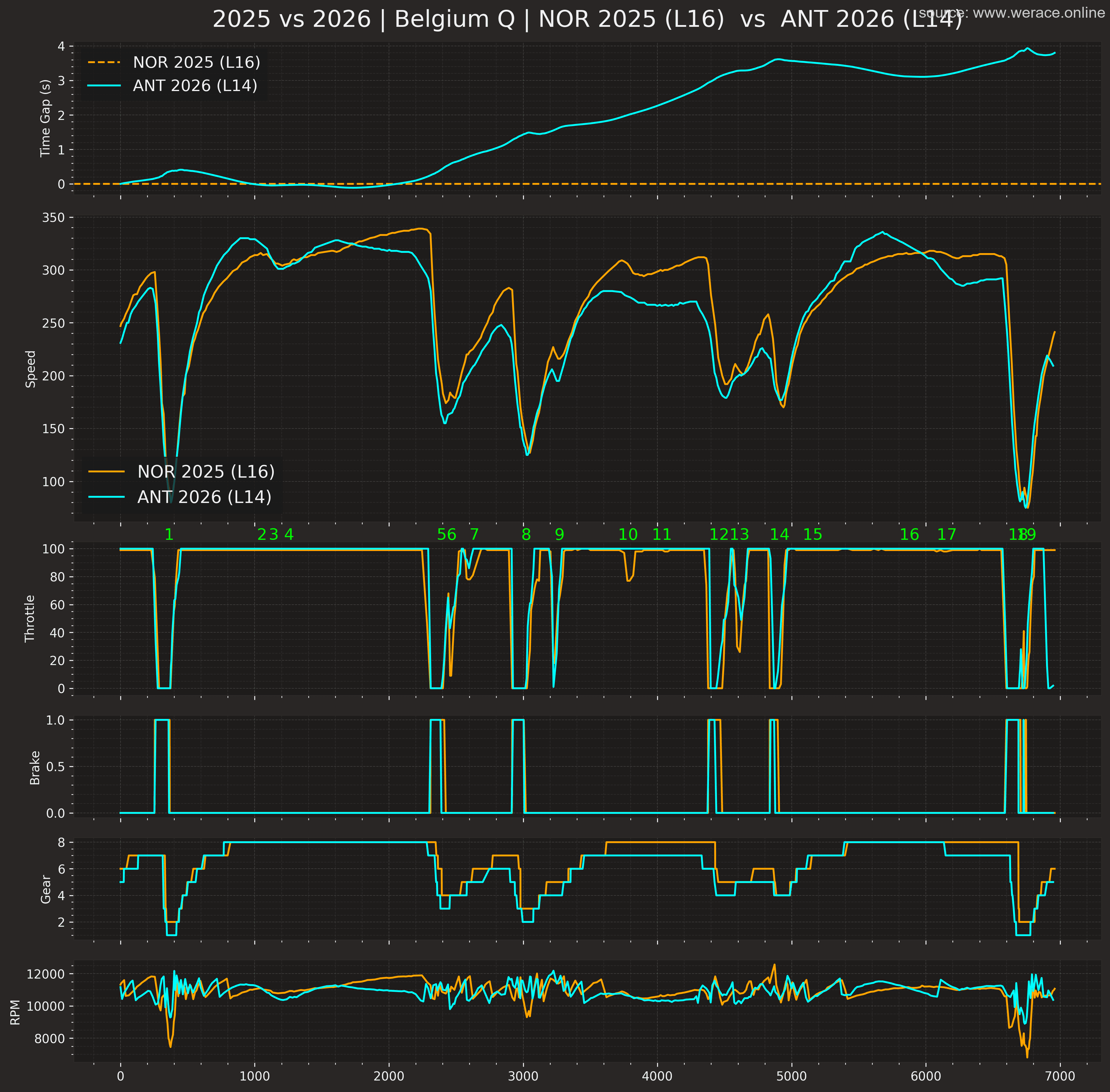
The two traces sit almost on top of each other for the opening sector, then the gap opens relentlessly and never looks back, ballooning to nearly four seconds by the flag. Where the old package used to go flat-out through Kemmel in a glorious wail of internal-combustion noise, that stretch of tarmac is now a managed "clipping zone": the electric motor cuts out to protect its deployment budget, the combustion engine is left to do the recharging on its own, and the driver has to lift and downshift where he would once have stayed pinned to the floor. The same story repeats through the old flat-out sequence around Turns 10-11, once a single, uninterrupted arc taken at full commitment, now broken up by a 50 km/h chop and a gearshift down to seventh purely to top up the battery. Blanchimont, unsurprisingly, tells the identical tale: a clear speed trough and another downshift, all in the name of energy husbandry.
As someone who genuinely loves this track, there is a strange, guilty relief in knowing Spa now only appears on alternate years. Watching Formula 1 reduced to this kind of stop-start energy accounting around a circuit built for commitment is a difficult watch.
2. Two Clipping Zones, Two Very Different Pecking Orders
Since we have to live with it, it is worth actually quantifying where the energy is being clawed back. There are two clear clipping zones on this lap: the Kemmel Straight ahead of Turn 5, and the long run down to Turn 18.
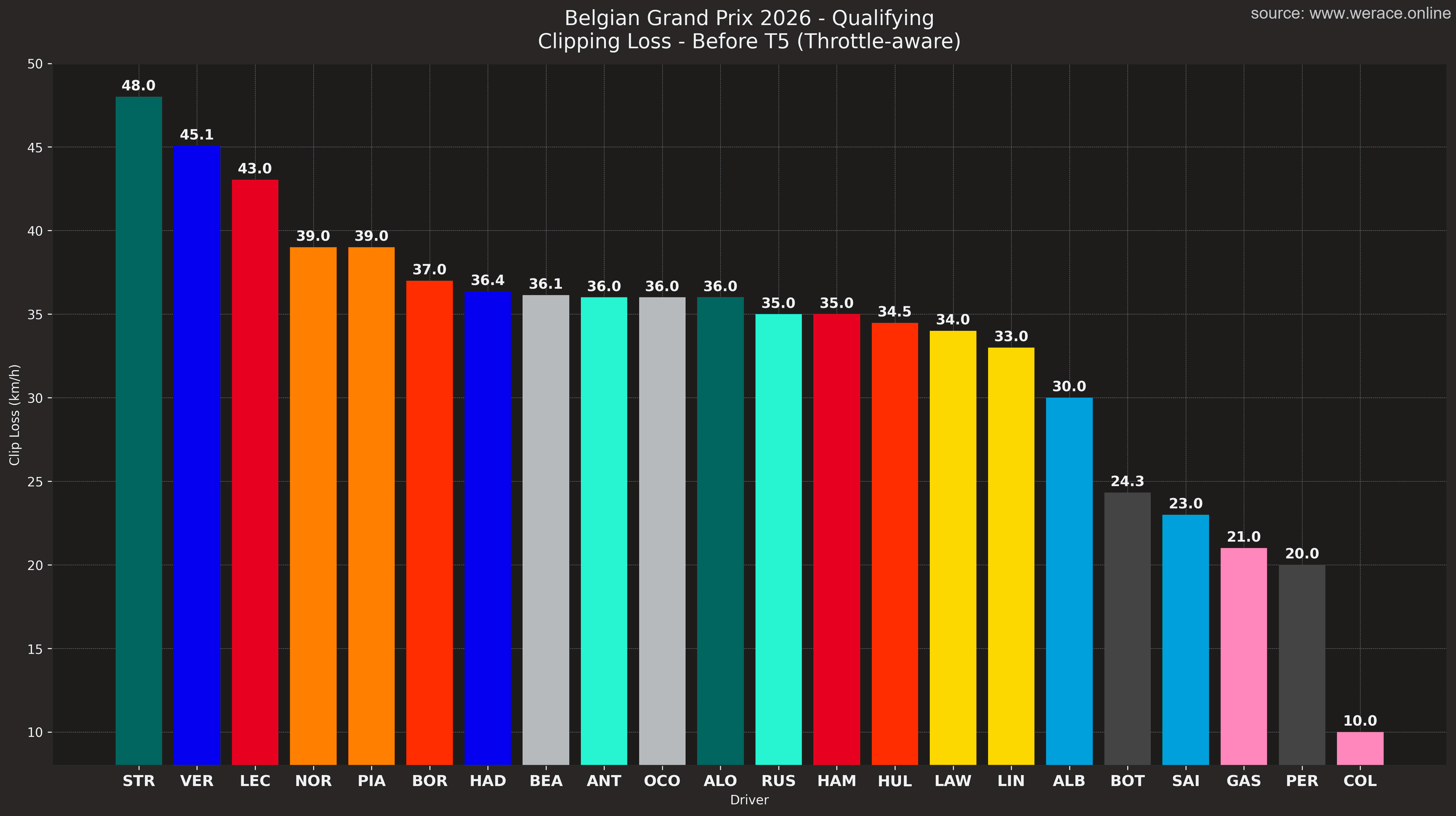
Through Kemmel, Aston Martin's Stroll loses the most speed of anyone to clipping, a full 48 km/h shaved off his straight-line peak. Behind him, the order is genuinely revealing: Verstappen (45.1 km/h) and Leclerc (43.0 km/h) bleed more speed here than almost the entire field, with both McLarens close behind at 39 km/h. Mercedes, by contrast, sits in the more moderate midpack band around 35-36 km/h for both Antonelli and Russell.
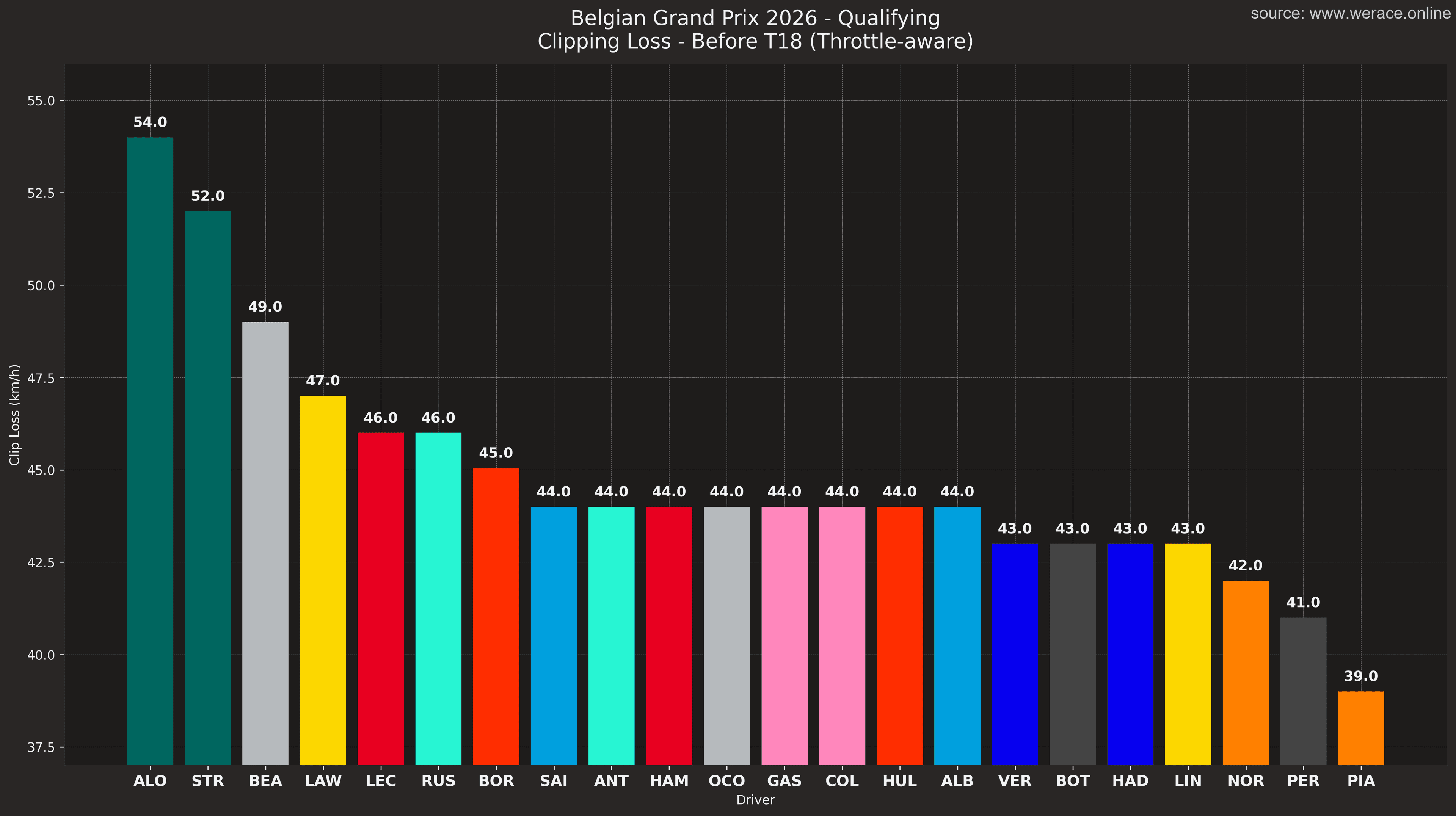
On the run to Turn 18, the picture flattens out considerably. Aston Martin (Alonso 54 km/h, Stroll 52 km/h) and the Haas of Bearman (49 km/h) remain the clear outliers, but from Racing Bulls through to Red Bull most of the grid is clustered in a tight 42-47 km/h band. Ferrari and Mercedes drivers alike sit almost shoulder to shoulder here, which tells you the top teams have converged on broadly similar energy-deployment philosophies for this particular section, even if Kemmel still separates them.
3. Team by Team: Who Is Recharging, and Who Refuses To
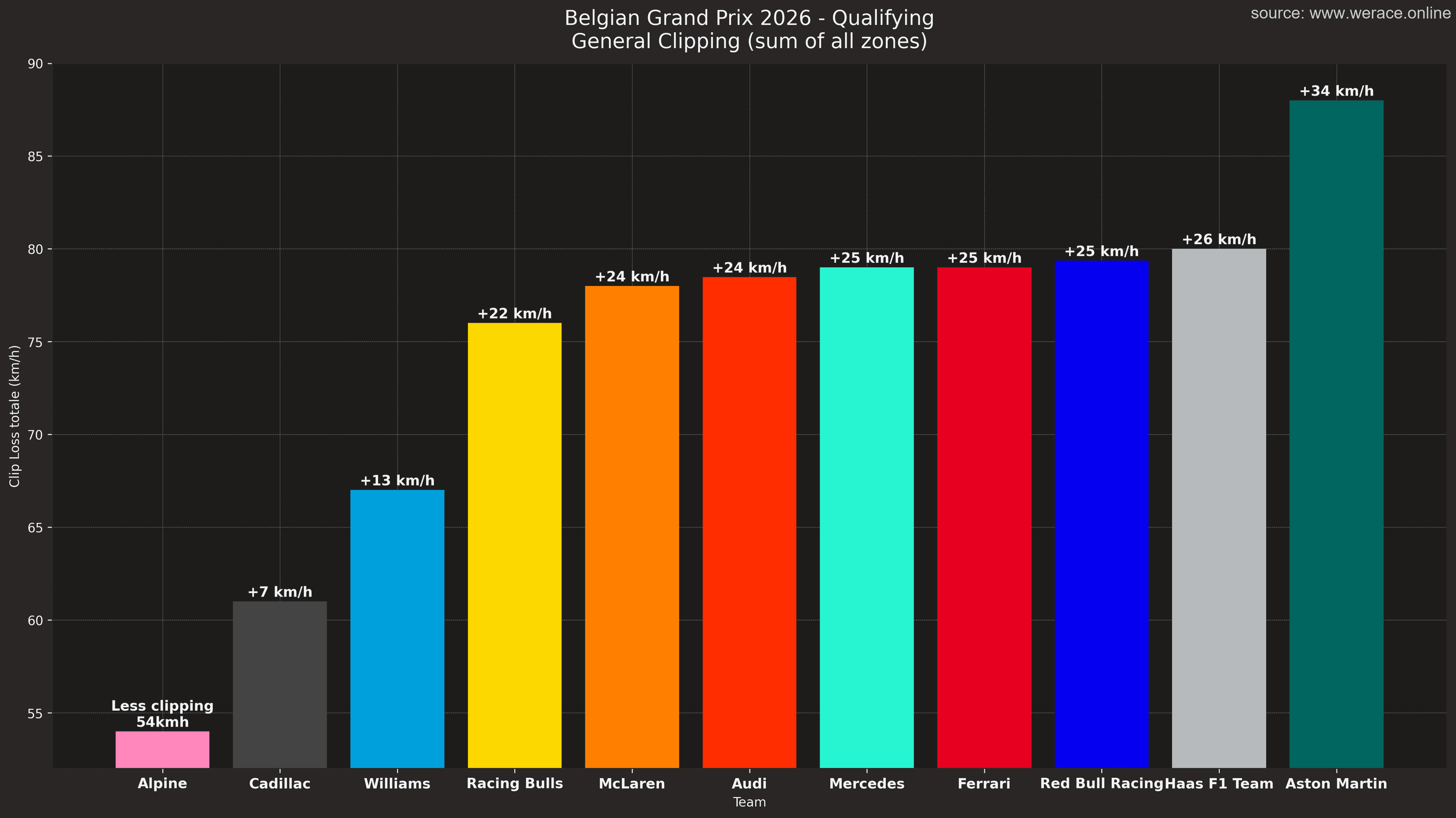
Aggregating clipping losses across every zone on the lap produces the clearest picture yet of each team's energy strategy.
Alpine stands alone at the bottom of the chart, the team that clips the least of anyone on the grid. That is not an accident: Alpine committed from Friday practice to a completely different energy-management philosophy, deliberately recharging very little on the straights and instead accepting more compromise through the corners. It is a bold, contrarian call, and whether it pays off in race trim remains to be seen.
At the opposite extreme, Aston Martin's clipping losses tower over the rest of the field, worst of anyone by a distance. Every other top team - McLaren, Audi, Mercedes, Ferrari, Red Bull - has essentially converged on the same ballpark, all bunched together with roughly 24-25 km/h more clipping loss than Alpine's baseline. Aston Martin, on the other hand, is losing something closer to 34 km/h above that baseline, which lines up with a power unit that, in a word, leaks performance everywhere.
4. The Season Scoreboard: Belgium 2026 vs Belgium 2025
Zoom out to the full-lap picture and compare every team's qualifying pace this weekend against their equivalent lap twelve months ago.
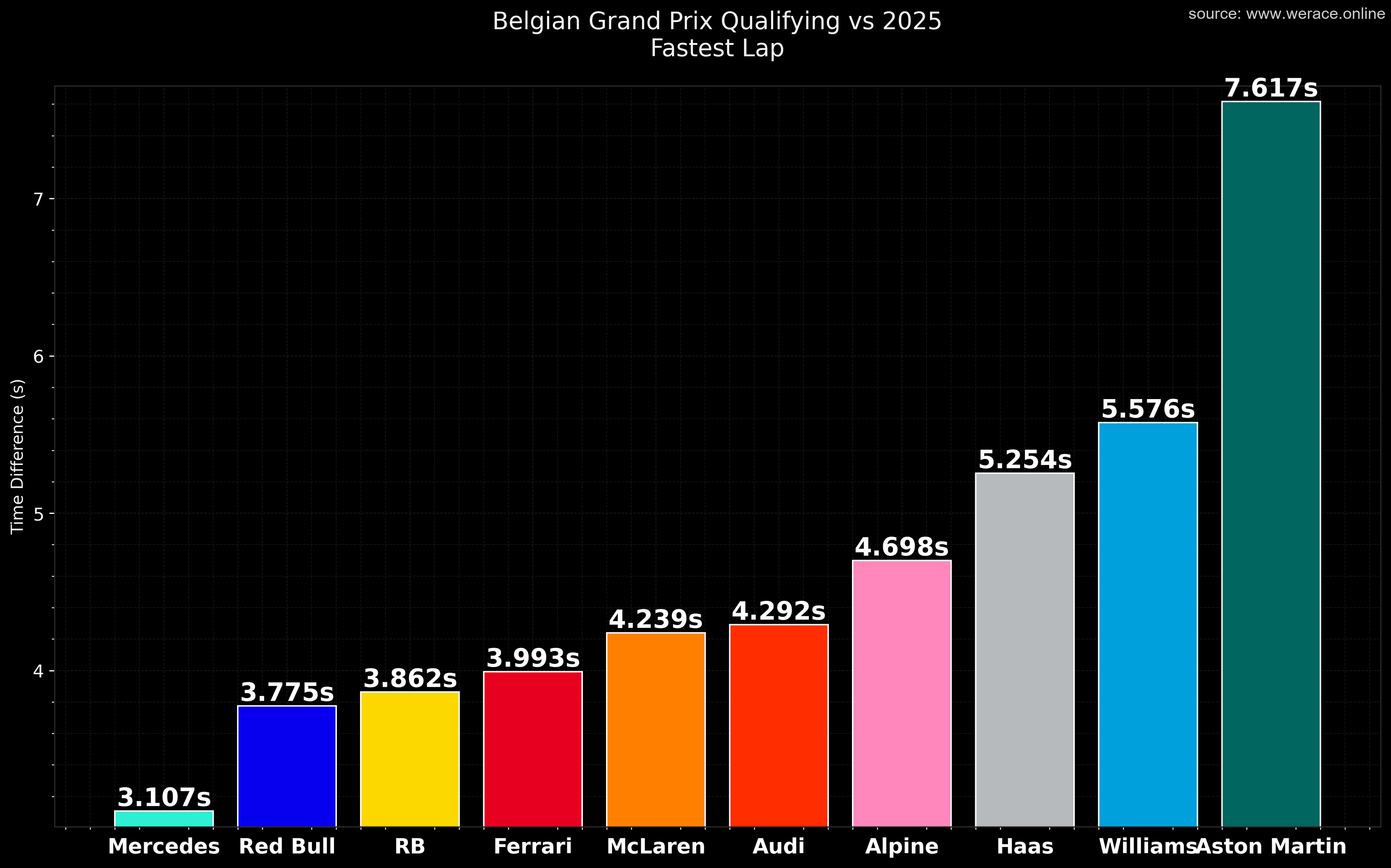
Mercedes is the outstanding performer of this comparison, losing only 3.107 seconds compared with last year's time - by far the smallest regression on the grid, and a number we have been tracking since the start of the season as a proxy for how well each manufacturer has coped with the new rules. Red Bull (3.775s) and Racing Bulls (3.862s) follow, then Ferrari at 3.993s.
Aston Martin sits at the very bottom of the table with a brutal 7.617-second deficit to their 2025 pace - a season-high regression that we have now been monitoring since the opening race, and which simply confirms what the clipping data above already suggested: this is a power unit that is bleeding performance in every single phase of the lap.
5. Mercedes' Route to Pole: A Session-Long Demolition Job
This is where the story turns properly toward the front of the grid. Mercedes did not arrive at Saturday's pole by accident - they overcame a genuinely rocky Friday, when the team overestimated how much grip the track would offer and turned up with a setup that was too low on downforce. They course-corrected without abandoning the new low-drag package, instead sharpening front-wing incidence and a handful of steering-wheel settings, including the differential, to get the balance back.
Q1 itself was still shaky: Antonelli was on the radio complaining about balance, not helped by a rising wind, and it is a pattern worth watching across the whole grid this year - as every team's aero platform is tuned to an increasingly narrow operating window, even small shifts in wind or a five-degree drop in track temperature between sessions are enough to reorder the entire pecking order. It took Kimi a couple of attempts to find his footing, but once he did, nobody else got remotely close.
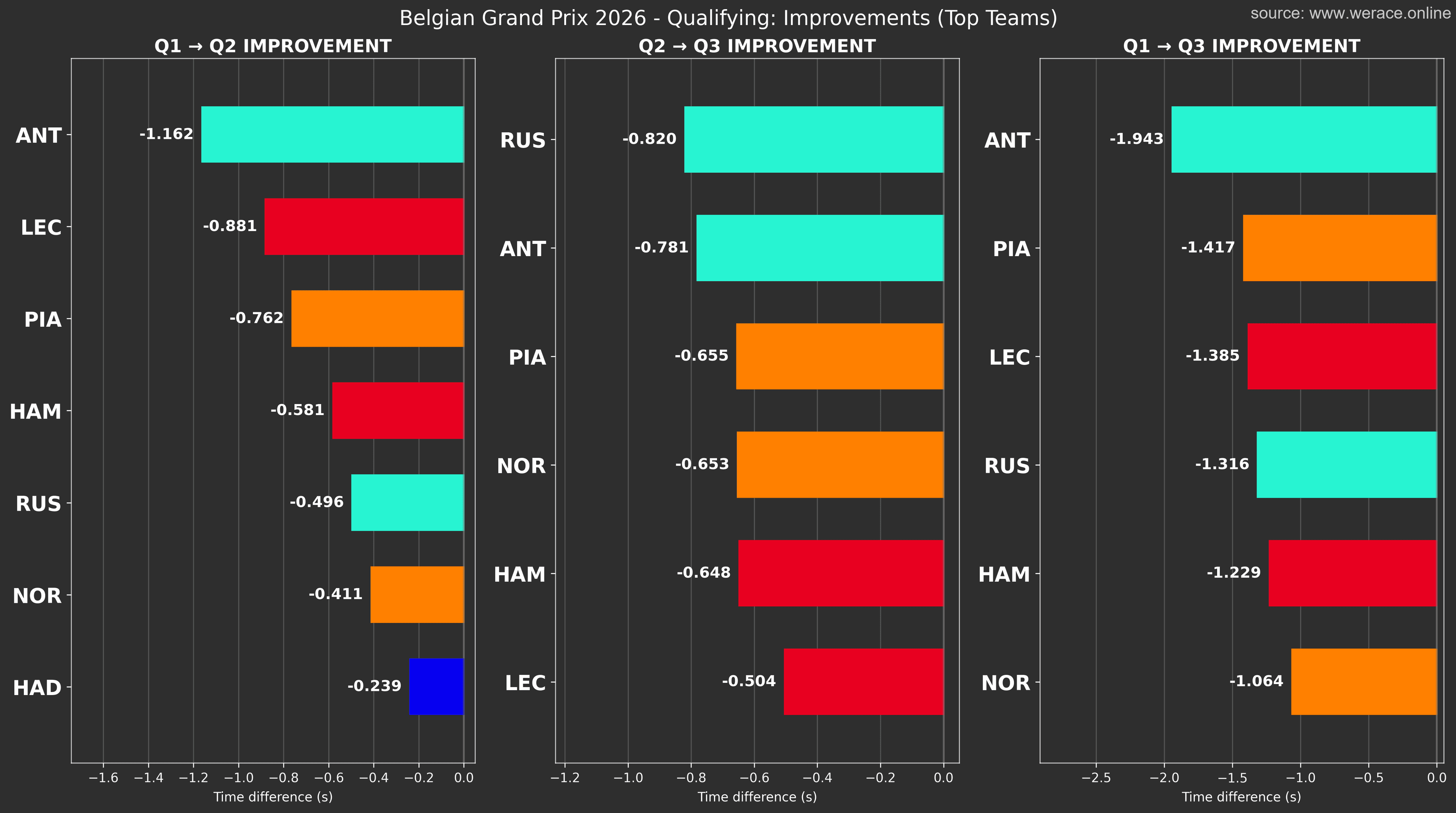
The trajectory from Q1 to Q3 tells the story on its own: Antonelli improved by a staggering 1.943 seconds across the session, comfortably the biggest gain of anyone in the top order, ahead of Piastri (-1.417s), Leclerc (-1.385s), Russell (-1.316s) and Hamilton (-1.229s). Interestingly, it was not all Antonelli in isolation - from Q2 to Q3 specifically, it was actually Russell who found the most time of anybody (-0.820s), with Antonelli a close second (-0.781s), suggesting the whole Mercedes garage was still finding a meaningful setup step deep into the session.
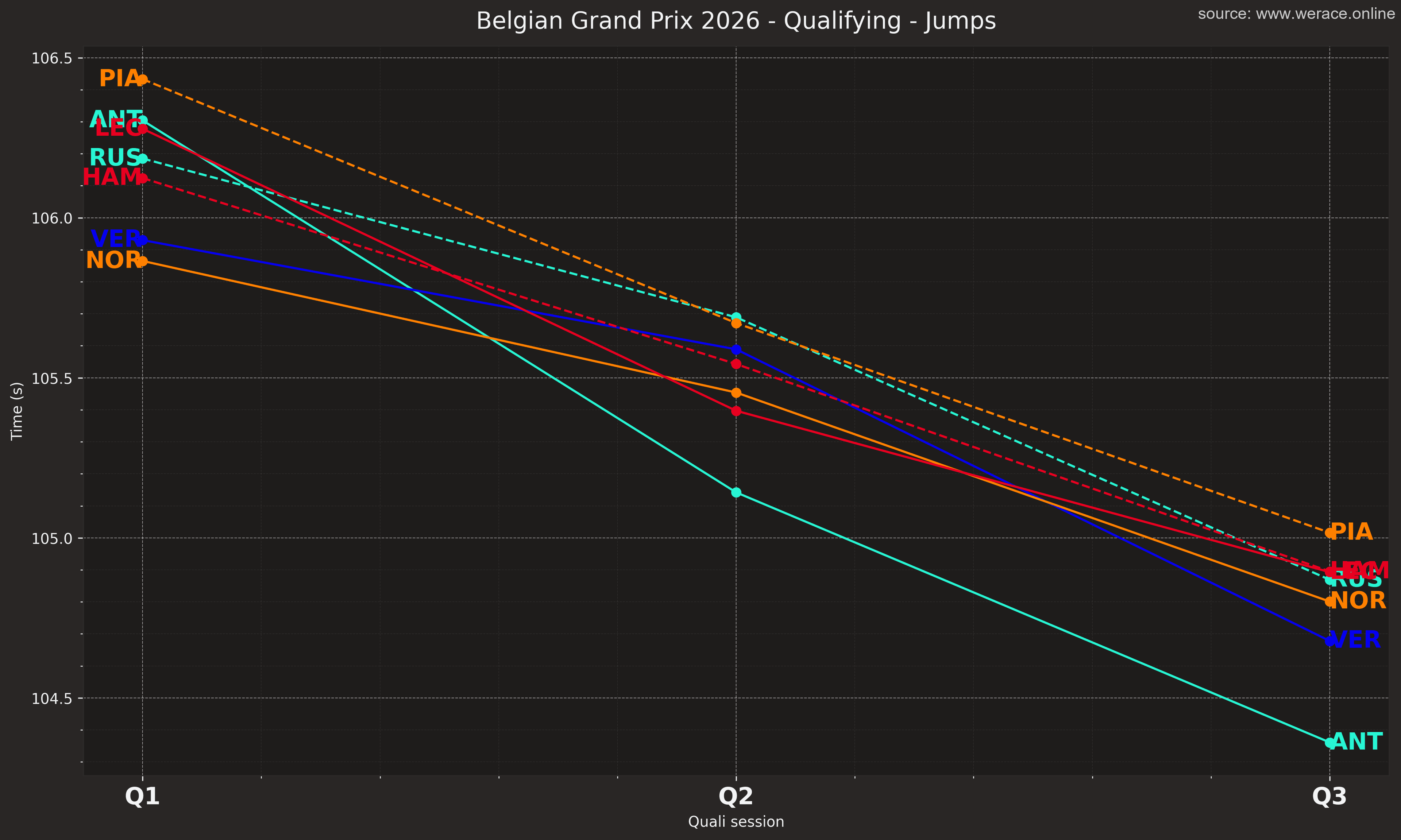
Plotted lap by lap across all three segments, Antonelli's line is the one that visibly detaches from the pack after Q1, diving away from Verstappen, Norris, Leclerc, Russell and Piastri to finish the session more than a tenth clear of the chasing group's Q3 average.
Break that same progression down sector by sector and a small but telling detail emerges: Verstappen actually went backwards in Sector 1 between Q1 and Q2, losing three hundredths before recovering it in Q3, while Antonelli chipped away at all three sectors in every single segment without a single step backwards.
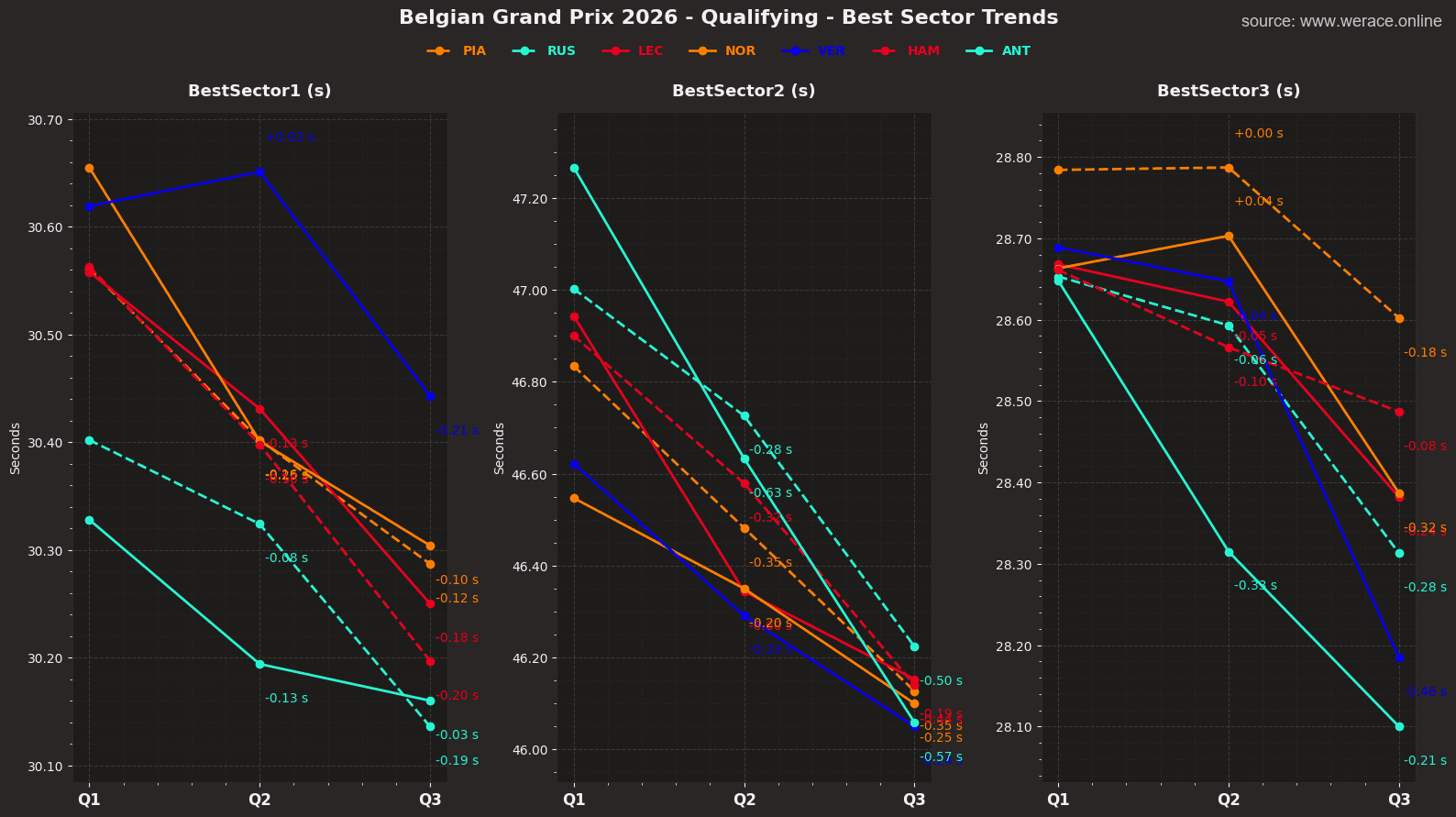
Where exactly did that time come from? The sector-by-sector picture is the clearest answer.
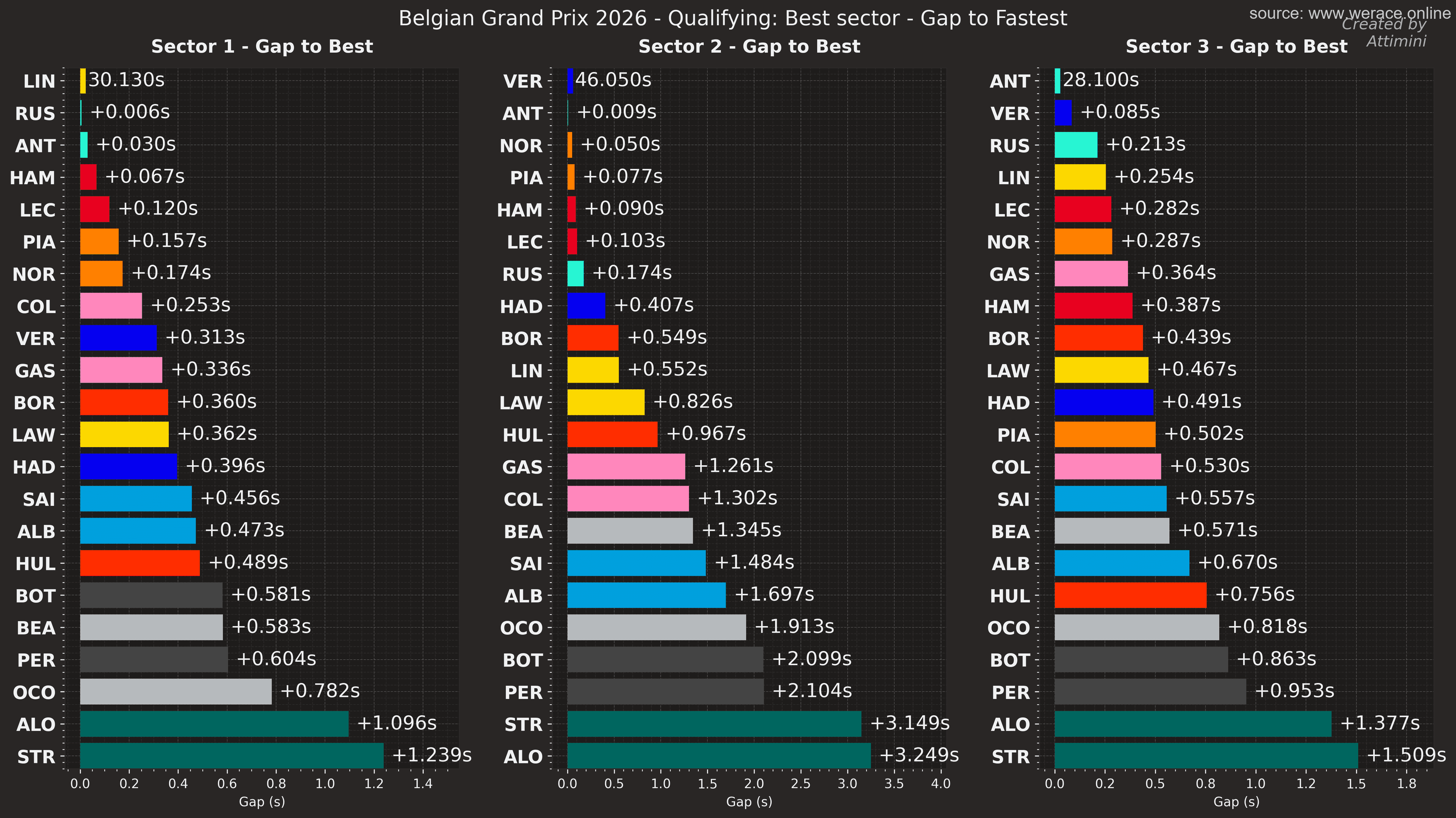
Verstappen actually set the outright best time in Sector 2 (46.050s), with Antonelli a mere 0.009s behind - genuinely a rounding error. But Antonelli comprehensively owned Sector 3 (28.100s), with Verstappen 0.085s adrift and everyone else more than two tenths back. Kimi himself flagged this on the radio during the session, asking for a wing adjustment that specifically helped in that final portion of the lap - and the data backs up exactly how much that tweak was worth. Combine that dominant final sector with a Sector 1 that was only 0.030s off the outright pace, and the picture of the pole lap becomes obvious: Mercedes did not need to beat Red Bull everywhere, they just needed to not lose to them anywhere, and then win comfortably where it mattered most.
Zoom in on Antonelli's own Q1-to-Q3 trend and the biggest single chunk of that time, roughly half a second, came specifically out of the central sector once he found the confidence to lean on the car. Pushing harder there is not free: it forces the control electronics to intensify clipping and recharge phases to keep the energy budget balanced, which in turn shifts the braking reference points a driver has to work with lap after lap. Kimi adapted to that moving target about as well as anyone could, and the same half-second swing is roughly the margin by which he beat his own teammate. Russell's version of the same lap looked visibly more defensive, matching Antonelli's cornering speeds in isolation but never quite matching him for outright commitment on the straights - which, on a power-sensitive lap like this one, is where the real time is hiding.
It is also worth noting how little was left on the table. The gap-to-ideal-lap chart shows Antonelli leaving just 0.042 seconds unclaimed on his personal best sectors - about as clean a pole lap as you will see under this much pressure.
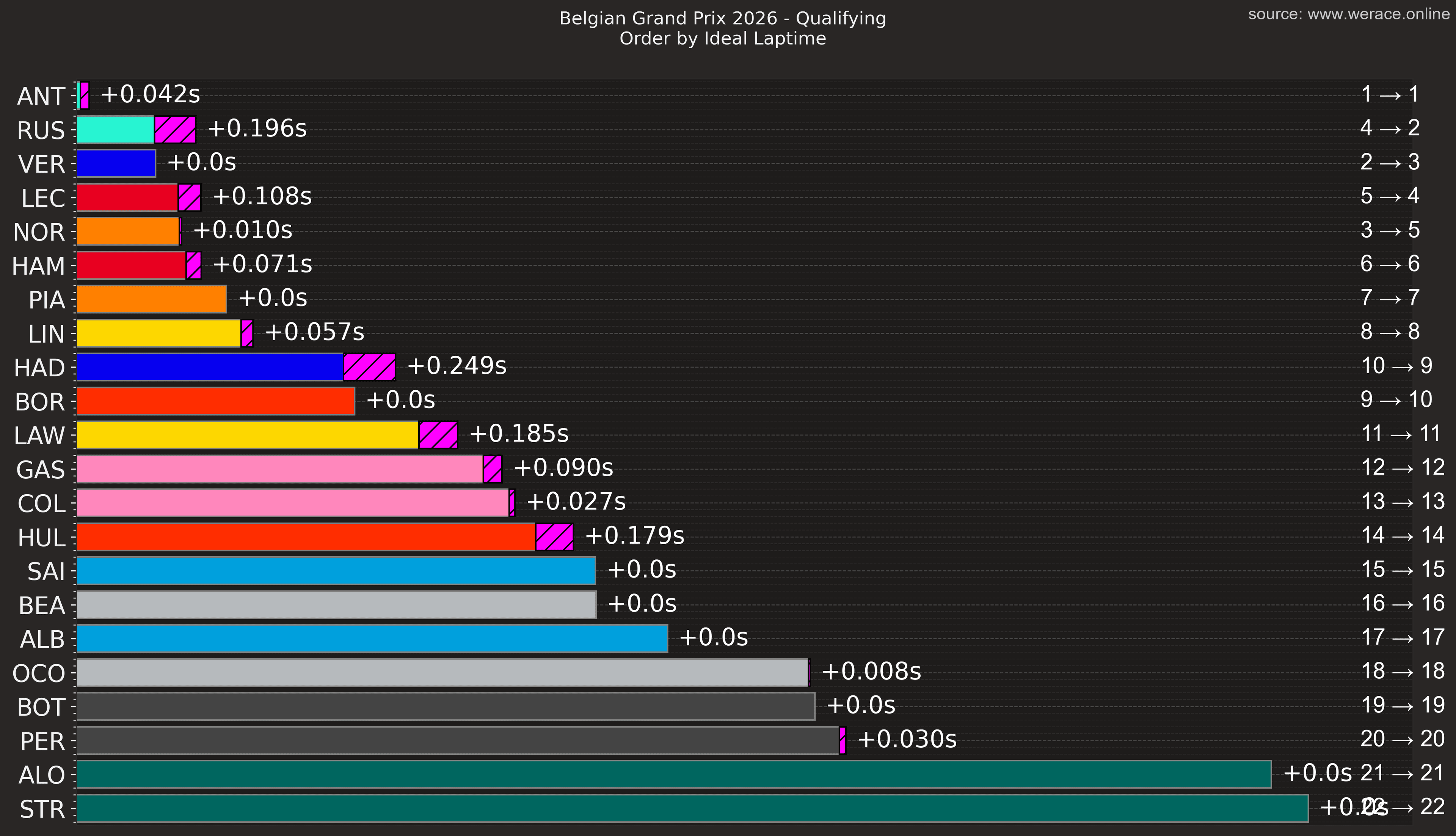
Russell, by contrast, left 0.196s on the table according to that same metric - theoretically enough, on paper, to have jumped Verstappen for the front row had he strung his best sectors together on one lap. It didn't happen, but it is a reminder of just how much depth Mercedes had in the car this weekend.
6. Verstappen's Charge-and-Discharge Puzzle, and Hadjar's Sacrifice
Red Bull's own route to second place is a different story entirely, and the high-frequency telemetry makes it visually obvious.
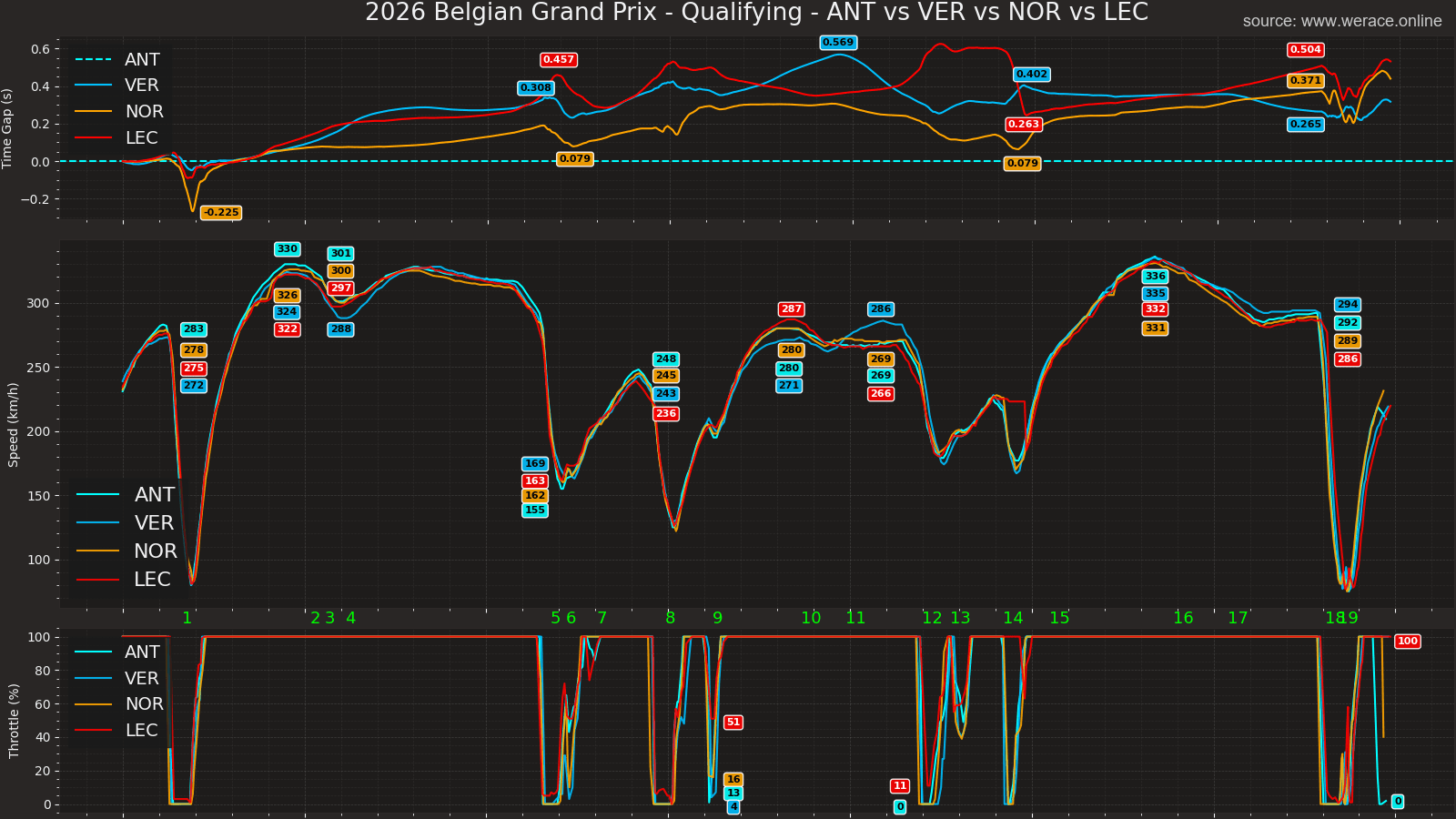
Verstappen's energy deployment map through the Turns 10-11 sequence is genuinely the opposite shape of everyone else's: where the rest of the field recharges heavily on the run toward Turn 10 and deploys more heavily out toward Turn 12, Verstappen inverts it, recharging less into 10 and pushing harder out toward 12. It is a distinctive strategic choice, though it is worth noting the gap between his approach and the rest of the field had already narrowed considerably compared with what was visible in Friday practice, where the difference was far starker. Red Bull ran a genuinely different harvesting-and-deployment philosophy all weekend, most visible through Pouhon, and paired it with a strong reading of the fresh tyre that delivered that Sector 2 benchmark outright.
What really supercharged his final push, though, was a tow. Isack Hadjar produced one of the more selfless slipstream assists you will see all season, sitting up and towing Verstappen down the final straight in a way that simply is not seen very often on a qualifying lap - clearly a pre-planned team play, worth something in the region of two to three tenths by Red Bull's own estimate. The added benefit went beyond the raw slipstream, too: knowing that tow would let him recharge quickly through the super-clipping zone around Blanchimont gave Verstappen license to spend more energy through the middle of the lap than he otherwise could have risked. The cost to Hadjar was total: he never set a representative time of his own in Q3, though it barely mattered, since he starts tomorrow's race from the back of the grid regardless following a power unit change.
Verstappen himself was candid afterwards that he does not expect to have the outright pace to live with Mercedes over a full race distance, and without Hadjar's help he reckons he would have been looking at third row rather than the front row. The one genuinely encouraging sign for Red Bull is how comfortable he felt in the car all weekend, praising the balance from the very first runs - even if he described the car as somewhat capped in how much more it had to give lap on lap, at one point suggesting some corners were almost too easy to take flat. Expect Red Bull to at least discuss trimming the aero package further before the next outing.
That tow, however, is also what put Hadjar directly in the middle of the session's most controversial moment.
7. Racing Bulls' Quiet Rise
Away from the very front, Red Bull's junior squad deserves its own mention: Racing Bulls will start Sunday's race from seventh and ninth on the grid, with Lindblad the stronger of the two after out-qualifying his teammate. That form earned him first access to a substantial upgrade package that landed in Belgium, including some chassis-level changes. It caps a mid-season surge for the team, built on a floor upgrade introduced back in Canada and consolidated with strong race pace through the Austrian and British rounds - and it puts Faenza within a single point of Alpine for fifth in the constructors' championship, a target that looked well out of reach only a month ago.
8. The Pit Lane Yellow Flag: A Briefing Nobody Really Listened To
Hadjar's slow return down the pit lane triggered a yellow flag that was clearly visible from out on the circuit right as Leclerc was arriving at speed - and Leclerc, uncertain whether there was a genuine hazard, backed out of his lap out of caution.
Two things are worth flagging here. First, the practical question: what was the point of displaying that yellow so prominently to the whole circuit, when waving it lower, aimed specifically at the pit entry, would have removed any ambiguity for drivers on a flying lap elsewhere on track? Second, and more troubling: post-session interviews revealed that race control had actually briefed the drivers before the weekend that a yellow flag confined specifically to the pit lane entry might be shown under exactly this scenario. Apparently nobody in that briefing room thought to ask where, precisely, that flag would be positioned, at what height, or - crucially - whether it would be visible from out on the racing line during a hot lap. It is a small but telling illustration of how little attention some of these mandatory briefings actually receive, despite being some of the most operationally important minutes of a driver's entire weekend.
The silver lining is that the damage was contained: Leclerc lost, at most, a single grid position because of it - and realistically even that is close to academic, given how much the running order at Spa typically gets reshuffled on the opening lap anyway, all the way down the Kemmel Straight. And regardless, the Ferrari qualifying lap that followed was excellent.
9. Ferrari: The Right Car for the Wrong Regulation
Spa is a track that ruthlessly exposes any aerodynamic or power deficit, yet Ferrari still walk away with what amounts to a partial second row: Leclerc P4 and Hamilton P5 on the final grid, once Norris' penalty is applied. On a circuit built almost entirely around its two long straights, where there is nowhere left to hide a horsepower shortfall, simply staying attached to the leading group already counts as a small win.
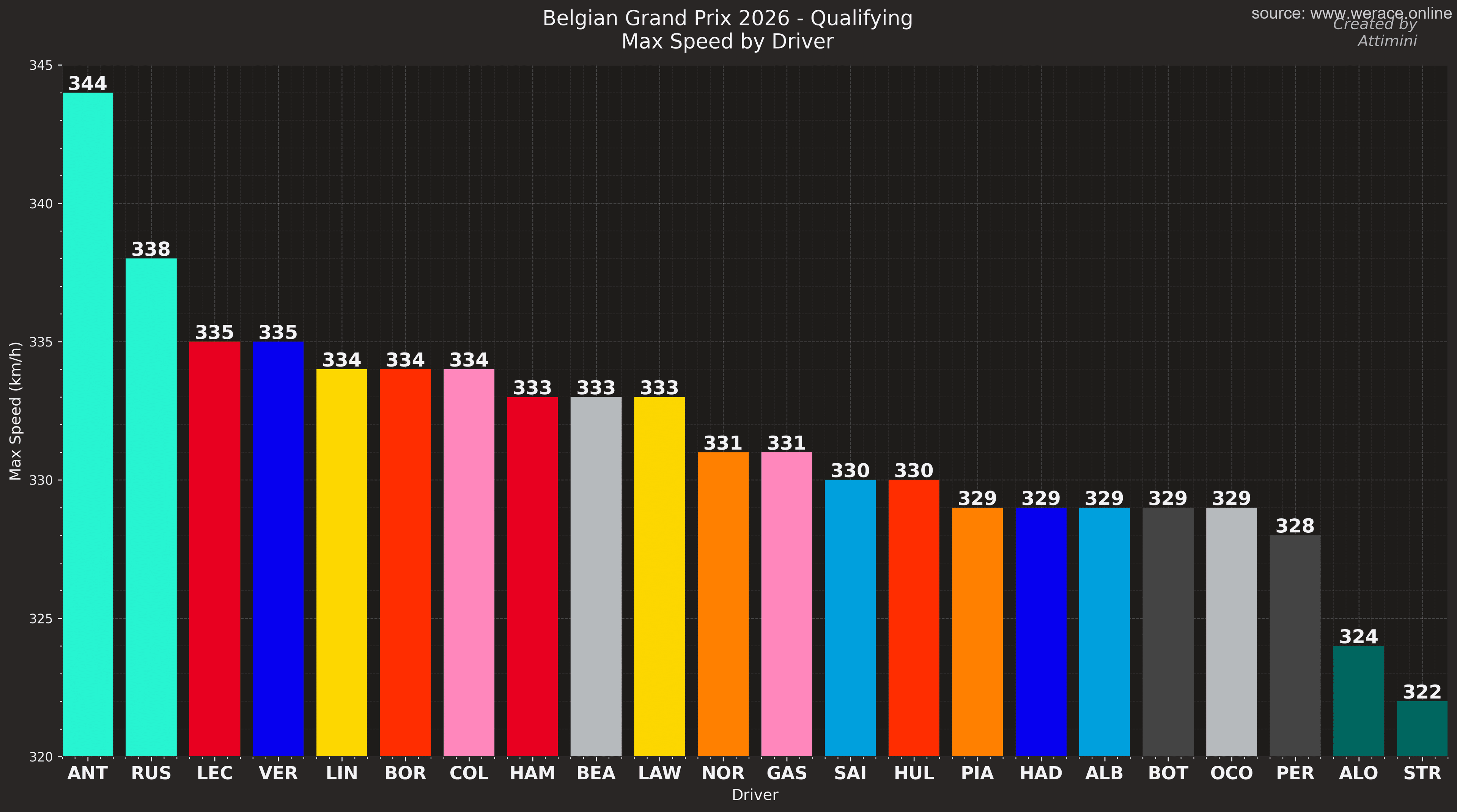
The raw top-speed numbers tell part of the story - Antonelli tops the chart at 344 km/h, Russell close behind at 338 km/h, with Leclerc and Verstappen tied at 335 km/h - but the more interesting detail is how Ferrari clawed the gap back through the middle and final sectors, mixing energy deployment between phases of the lap in a way that, by their own admission internally, could easily have backfired. On the final-straight-only comparison, Leclerc is giving up just three tenths to Antonelli, which is a genuinely strong result for a chassis with a known low-speed deficit, even if across the straights as a whole he was still shipping something closer to half a second to the Mercedes.
That Saturday step did not come only from the driving. Ferrari's Friday running had actually gone the other way: an experiment leaning more heavily on the electric side through the first and third sectors cost them too much through the middle of the lap, and had to be unwound. There is also a reasonable suspicion, unconfirmed by the team, that the usual power unit rotation put an updated engine specification in both cars for Saturday, worth a handful of extra horsepower on top of the recalibrated energy strategy.
Hamilton's session deserves a mention of its own. After a heavy FP3 crash forced the crew to rebuild his car against the clock, there was an understandable trace of caution in his driving throughout qualifying - yet he still ended up separated from Leclerc by mere thousandths. Credit to both the mechanics and the driver for getting a compromised weekend back on track.
Looking ahead to Sunday, Ferrari have genuine reasons for optimism, starting with encouraging tyre degradation numbers out of their long-run practice simulations. The SF-26 remains, in the eyes of most of the paddock, the best-handling chassis in the corners - it is simply that Spa, more than almost anywhere else on the calendar, does not reward that particular strength. Pouhon is the clearest example: under the previous generation of cars it was a genuine corner to be respected, and this year it has effectively become a flat-out curve, erasing exactly the kind of high-speed cornering advantage that let Ferrari punch above its power-unit weight at Silverstone. It leaves Ferrari looking every bit like the right chassis built for the wrong set of regulations - one that will need every ounce of that cornering ability, and a competitive tyre window, to convert Saturday's grid slot into a Sunday podium.
10. Norris' Penalty, McLaren's Real Gain, and the Trick Only Kimi and Lando Share
Lando Norris will start Sunday's race from P13 after a ten-place grid penalty for a power unit change, but the qualifying lap itself was genuinely strong - by his own admission one of the best of his career, and hard to see him beating even without a small error costing his second attempt. It was fast and confident through the corner-heavy sections, and notable for one small, technical detail on the run to the line: he lifted the throttle in the final metres before the finish, deliberately bleeding off stored electrical energy before crossing the beam. It is a trick Antonelli also used, actually a touch earlier in his own lap, and looking at the throttle traces, the two of them are the only drivers on the grid doing it. It is a small margin, but it shows the level of granularity teams are now working at just to extract the last few hundredths from the regulations. Take the grid penalty out of the equation and that lap was genuinely worth third on the timesheet.
The interesting part is where that step actually came from. Rather than trimming for the straights, McLaren doubled down on downforce all weekend, leaning on Spa's five active-aero zones - the sections where the flap can open to cut drag - to offset the extra drag a heavier wing package brings. It is close to the mirror image of what worked at Silverstone a few rounds ago, where far fewer of those zones existed and low-drag setups were rewarded instead; here, with so much more of the lap eligible for the flap to open, carrying more load through the corners looks to have been the right call all weekend. On top of that baseline, McLaren also brought a genuinely new, lower-drag rear-wing specification, worth on its own an estimated one to two tenths in a straight line - so the car gained on both fronts at once rather than trading one for the other. There is also a quieter factor behind McLaren's broader recovery: as a Mercedes customer team, they have reportedly been given new tools from Brackley to simulate and fine-tune power unit control strategies, which appears to be helping close the energy-management gap that hurt them earlier in the season.
Oscar Piastri's session was a different story, and a noticeably flatter one than his teammate's. Part of it traces back to a quantifiable energy-management anomaly worth a couple of tenths, but the driving style question is also worth asking out loud: both Piastri and Russell have, in the past, found it harder than most to adapt when grip is scarce, and this generation of car rewards exactly the kind of smooth, patient inputs that low-grip conditions have always demanded. Russell himself pointed to lost time on the straights, specifically in the final sector, as his main frustration afterwards - which lines up neatly with the clipping and top-speed data above.
11. Race Day Outlook
For Sunday, the soft compound looks like a legitimate option, though the opening lap in particular will need careful handling given how exposed this circuit remains to any early contact or wheel-to-wheel drama - with this much of a speed and energy differential between cars, almost anything can happen on the run from La Source down to Les Combes.
Kimi Antonelli starts as the clear favourite, but neither Ferrari should be written off, and both Leclerc and Hamilton will fancy their chances of mixing it with Verstappen and Russell for the podium. Both red cars have looked genuinely strong through the corner-heavy sections all weekend, and that trait tends to matter more in race trim - where you can't afford to sandbag a lap purely to save battery for one qualifying push - than it does over a single flying lap. Expect the race pace picture to look considerably more balanced than Saturday's grid suggests.
Keep an eye, too, on Max Verstappen's energy management across a full race distance - by his own admission he does not expect to have the pace to live with Mercedes once the laps stack up - and on Oscar Piastri, who starts further back than his pace deserves and looked a little off the ultimate rhythm this weekend, but who, in a chaotic first lap at a circuit like this, could easily cause headaches for whoever is running just ahead of him.
We will be back after the chequered flag with the full race debrief!! Bye Bye and good race to everyone!