The ADUO Paradox: Mercedes Dominates, Yet Red Bull Is the Benchmark
Yesterday’s ADUO leaks may have completely changed the narrative surrounding Formula 1’s 2026 power unit hierarchy.
According to the information that surfaced through AutoRacer, Red Bull Ford Powertrains currently sits at the top of the FIA’s ADUO evaluation system, effectively becoming the benchmark internal combustion engine for the new regulation cycle. Mercedes follows closely behind, while Ferrari and Audi appear further back with additional development allowances available. Honda and Aston Martin reportedly close the field with the largest package of concessions.
If these numbers are confirmed, the implications are enormous.
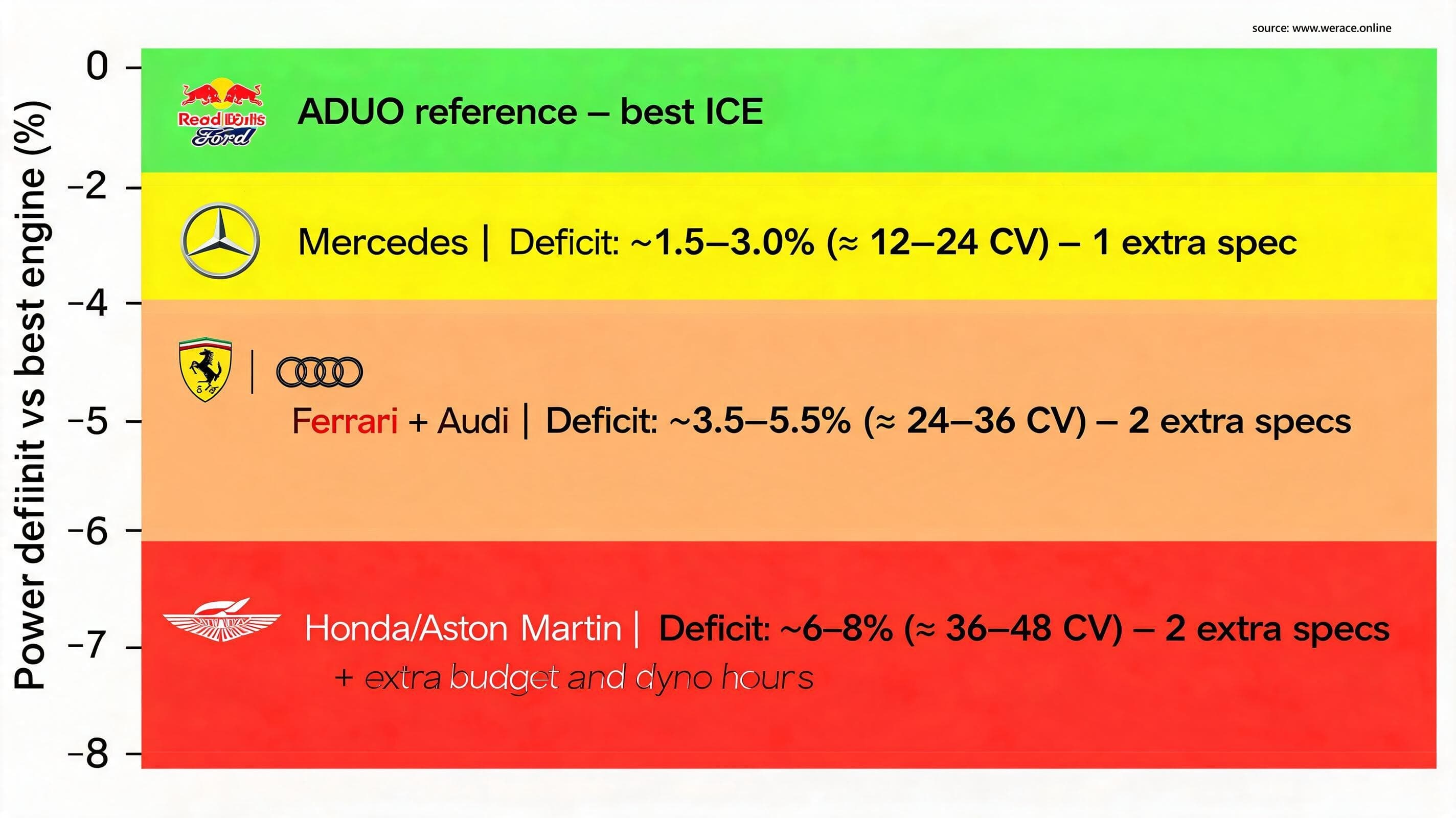
For months, the general paddock perception had been relatively clear: Mercedes was widely considered the engine benchmark, Red Bull close behind, Ferrari improving but still trailing the leaders. Yet the first ADUO measurements now suggest a very different picture - one where Red Bull’s ICE is considered the strongest reference point despite Mercedes overwhelmingly dominating the championship on track.
And that is where the real story begins.
What ADUO Actually Measures - And What It Doesn’t
Before drawing dramatic conclusions, it is important to understand what the ADUO system is designed to do.
The FIA introduced ADUO as a mechanism intended to prevent manufacturers from being permanently trapped by a failed engine project under the new long-term engine freeze philosophy. The idea is relatively simple: identify which manufacturers are behind and provide them with additional development opportunities in order to reduce the gap over time.
This is not a traditional Balance of Performance system like GT3 racing. The goal is not to artificially equalize the field every weekend. Instead, it is a controlled correction tool meant to avoid a scenario where one manufacturer remains uncompetitive for four or five years.
However, the critical detail is this:
ADUO primarily evaluates the internal combustion engine under a specific measurement framework. It does not directly rank the overall competitiveness of an entire Formula 1 power unit package across a race weekend.
That distinction matters enormously!!
A modern F1 power unit is not just raw ICE horsepower. Overall performance depends on:
- electrical deployment efficiency
- energy recovery systems
- battery management
- thermal efficiency
- drivability
- aerodynamic integration
- cooling architecture
- fuel usage strategies
- chassis interaction
In other words, a manufacturer can theoretically possess the strongest combustion engine while still losing out in the complete competitive package.
And that may be exactly what we are seeing.
The FIA Wanted a More Complex System
One of the most fascinating aspects of the ADUO story is the political background behind how the measurement system itself was created.
Originally, the FIA reportedly explored a more sophisticated methodology capable of evaluating multiple dimensions of engine performance rather than relying primarily on weighted ICE power measurements collected over representative laps.
The idea was to create a more nuanced system - one capable of accounting for varying operating conditions, deployment windows, and secondary efficiency factors.
Instead, manufacturers pushed for a significantly simpler framework.
The final ADUO structure became far more linear and far easier to interpret politically: measure the combustion engine output, weight it around the lap, and derive the ranking from there.
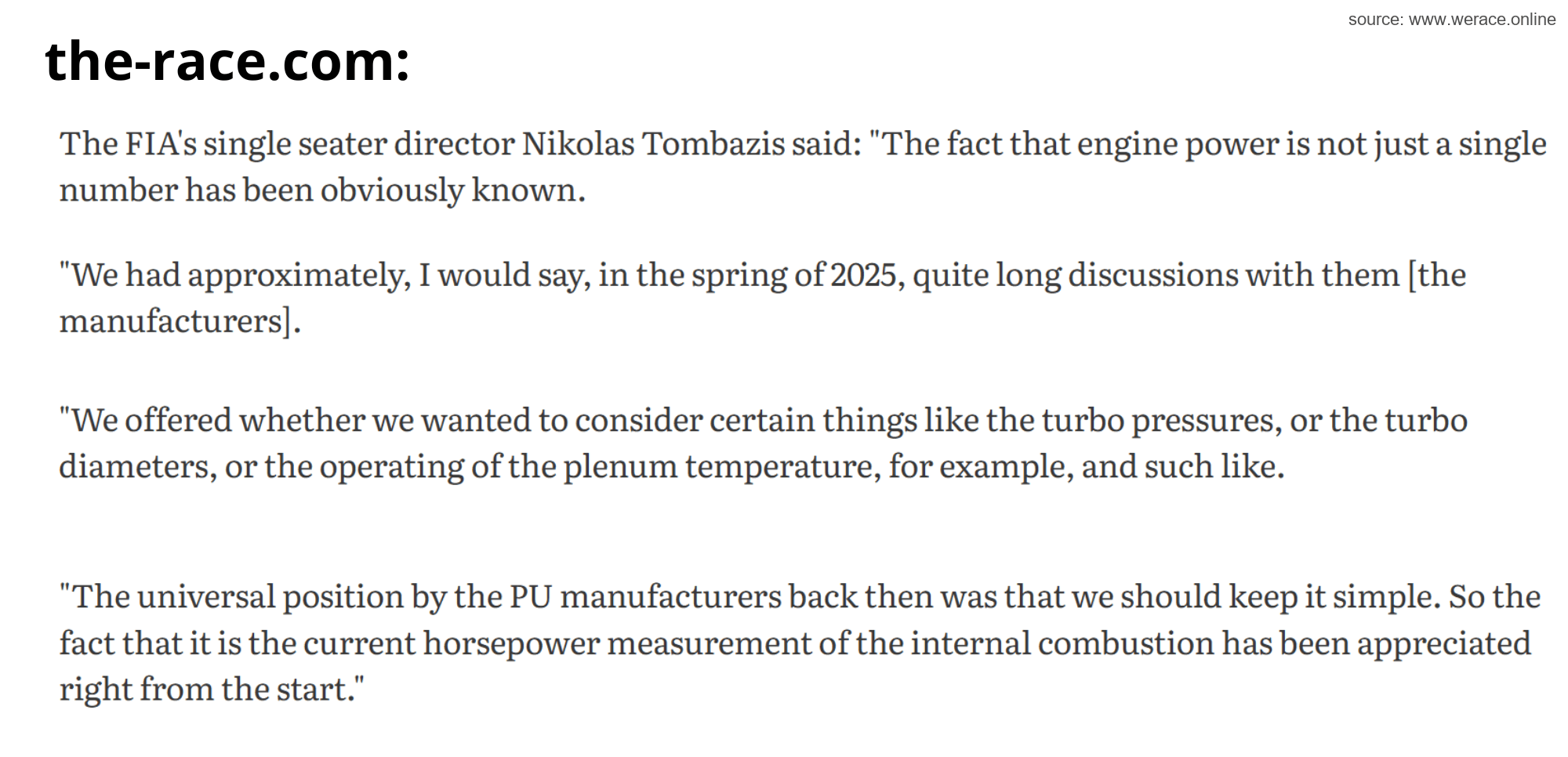
The quote from Nikolas Tombazis is crucial because it reveals something fundamental about modern Formula 1 governance: the participants themselves had significant influence over how they would ultimately be evaluated.
That does not automatically mean the system is flawed. But it does mean the current ADUO values are not simply objective truth. They are the result of technical compromise, regulatory negotiation, and political balancing between the FIA and manufacturers.
The Numbers on Track Tell a Completely Different Story
If the ADUO ranking reflects the strength of the combustion engine alone, the championship standings reflect something much broader: total competitive execution.
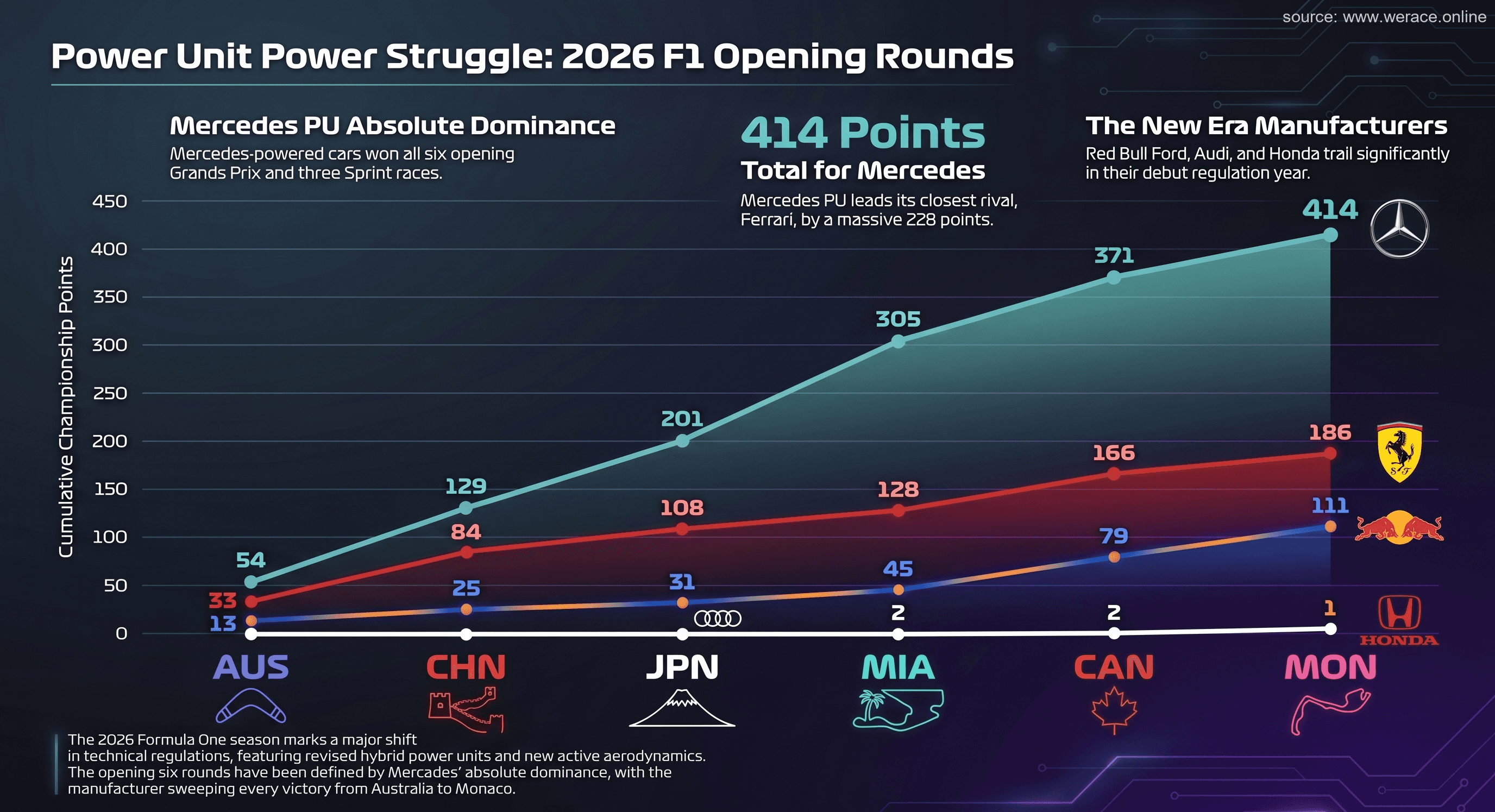
And so far, Mercedes-powered teams have dominated the season.
Up to Monaco 2026, including Sprint events:
- Mercedes power units have achieved 17 total podiums, including 11 podiums in Grand Prix races and 6 podiums in Sprint events
- Ferrari power units have achieved 8 total podiums
- Red Bull Ford power units remain significantly behind despite being the ADUO benchmark
This is where the contrast becomes impossible to ignore.
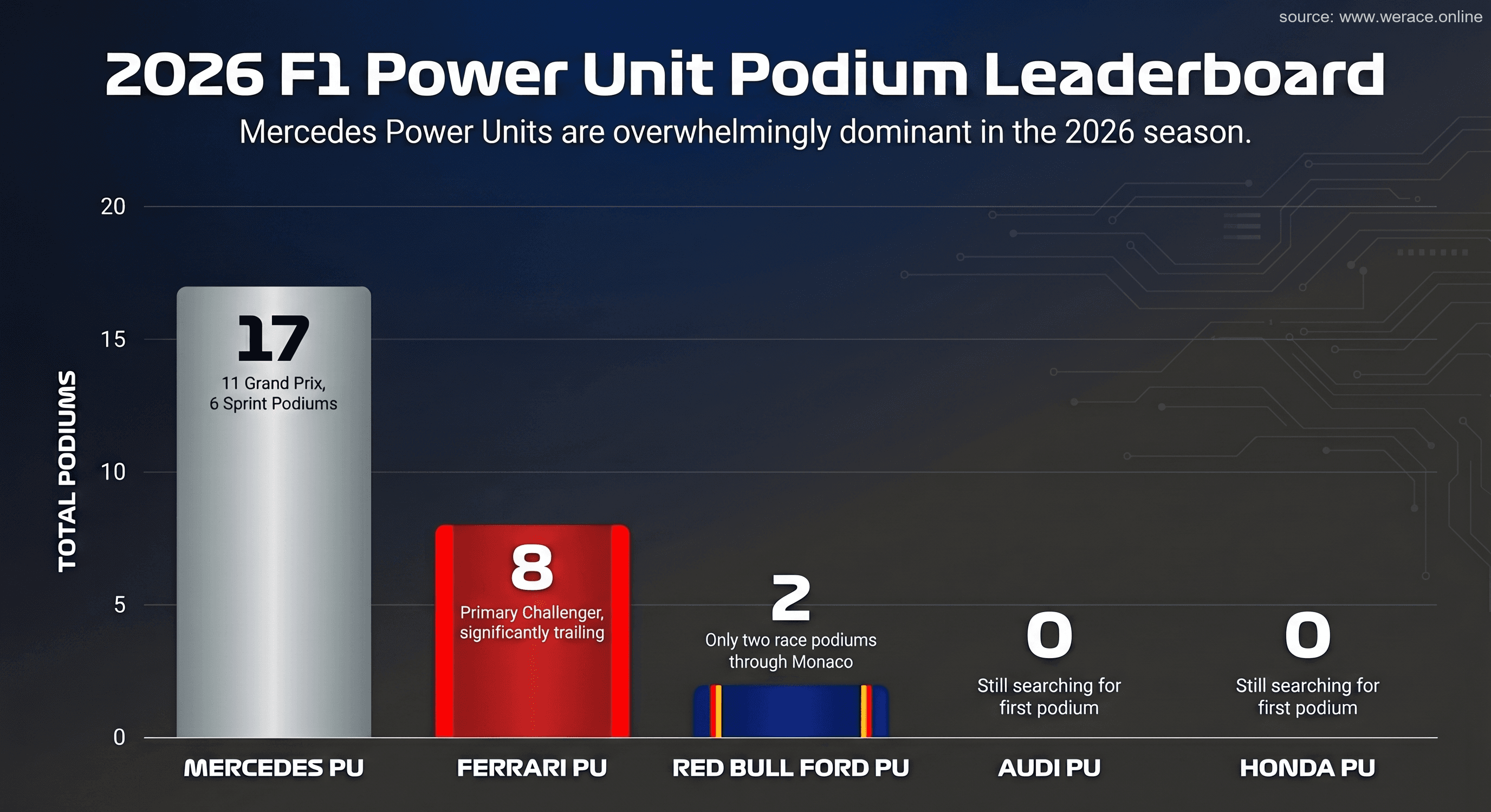
The podium distribution paints a completely different competitive hierarchy from the one suggested by the ADUO leaks.
The same pattern emerges when looking at total points scored by each power unit family across all customer and factory teams.
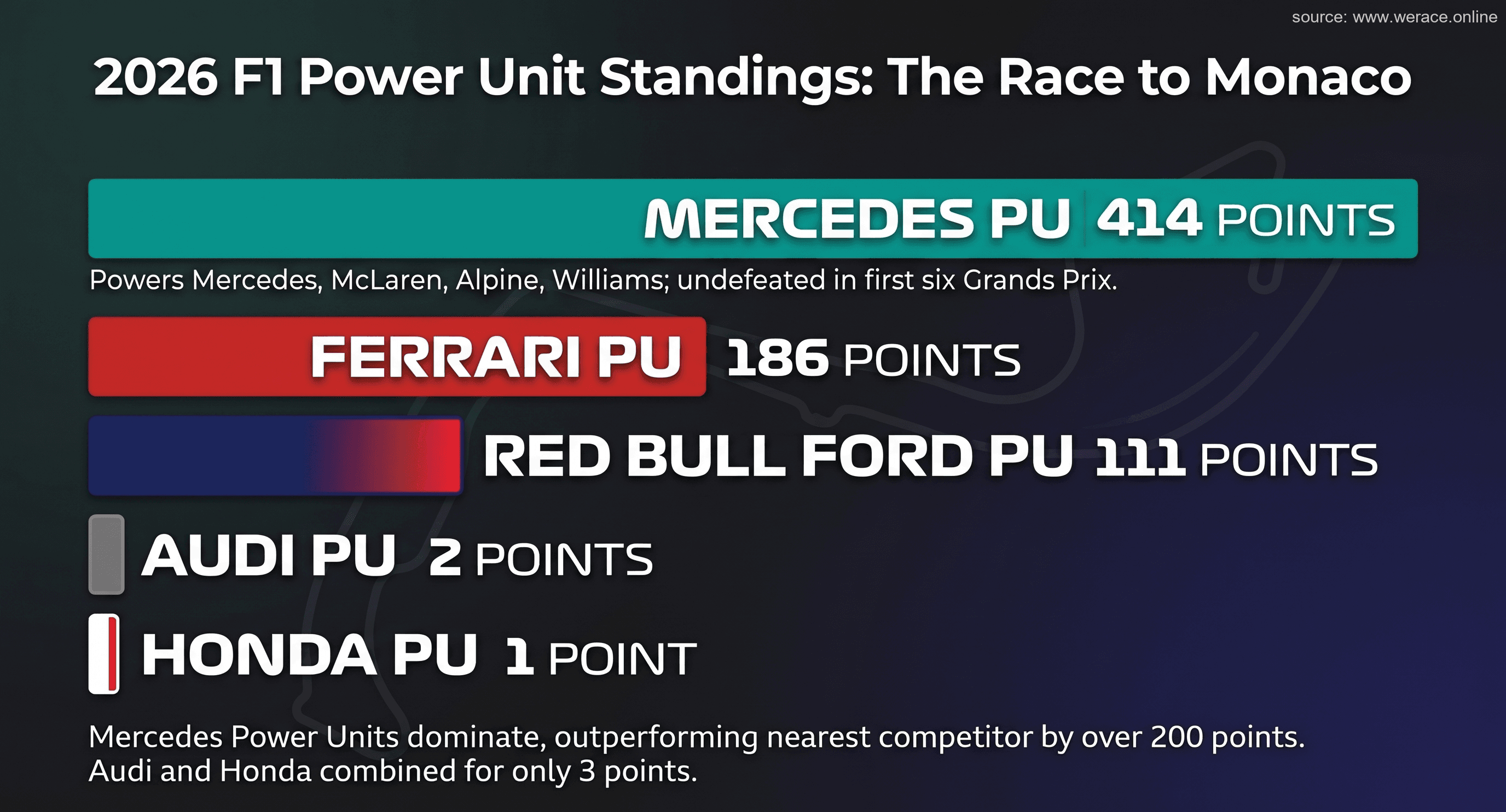
Mercedes-powered teams have established a massive championship advantage through a combination of factory dominance and strong customer performance from teams like McLaren, Williams and Alpine.
Meanwhile, Red Bull Ford’s overall sporting return has not remotely matched the status implied by its ADUO ranking.
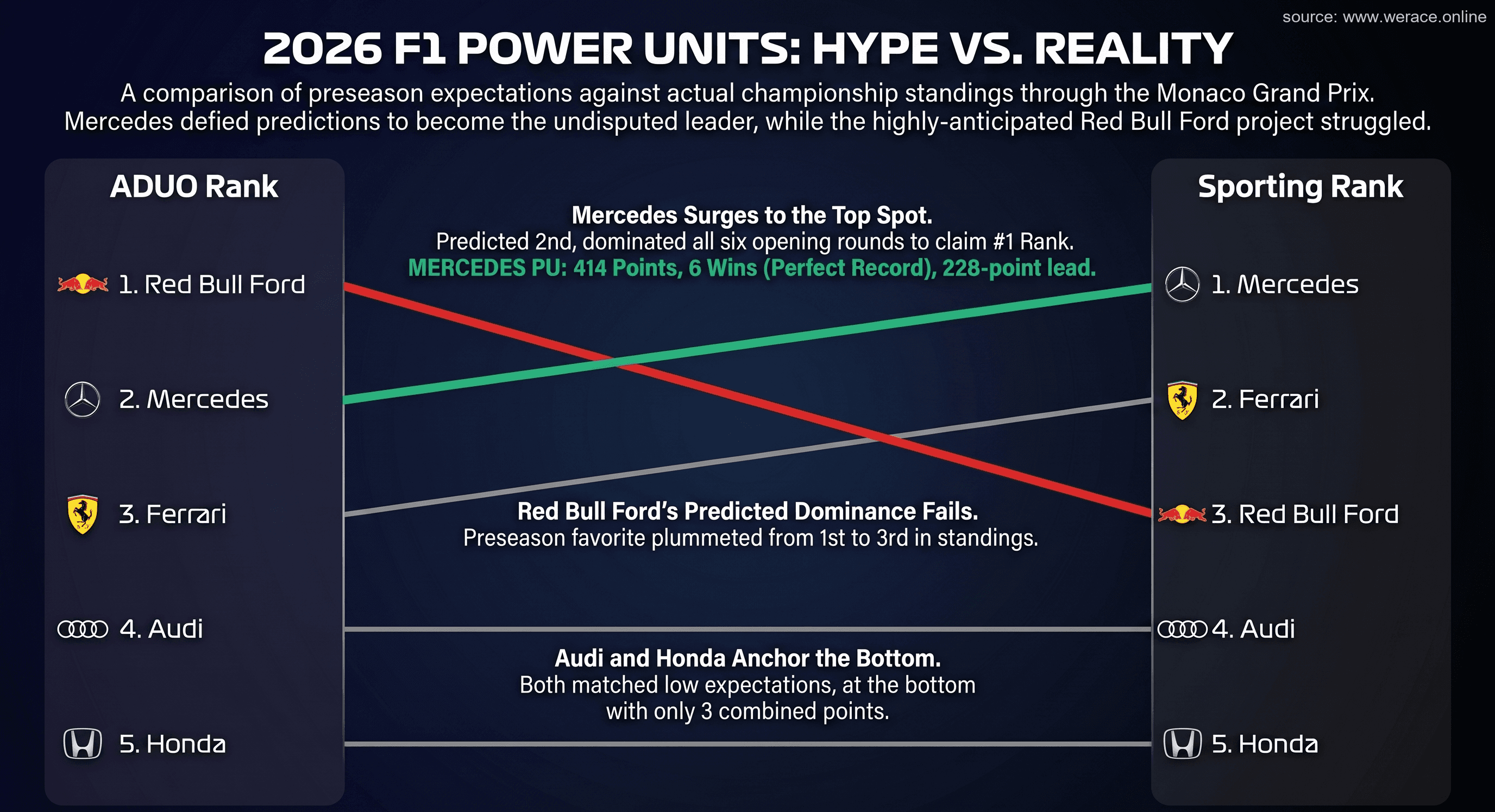
The Most Important Graph of the Entire Article
At the center of this discussion lies the true ADUO paradox.
This comparison probably explains the situation better than any paragraph could.
On one side: the FIA’s apparent technical ranking based on ADUO measurements.
On the other: the actual sporting hierarchy produced by victories, podiums and points.
And the disconnect is striking.
According to ADUO:
- Red Bull Ford
- Mercedes
- Ferrari
- Audi
- Honda
According to results:
- Mercedes
- Ferrari
- Red Bull Ford
- Audi
- Honda
This immediately raises a difficult question:
Is ADUO measuring the best engine, or simply the engine that performs best under the specific methodology chosen by the regulations?
Why Mercedes May Still Have the Best Overall Package
One mistake would be to interpret this situation as proof that the ADUO system is necessarily wrong.
A more realistic interpretation may simply be that Mercedes has built the best complete ecosystem rather than the strongest standalone combustion engine.
That distinction is extremely important in Formula 1.
Red Bull Ford may indeed have discovered exceptional ICE performance under the ADUO framework, while Mercedes may possess superior integration between:
- hybrid deployment
- energy harvesting
- cooling efficiency
- drivability
- chassis packaging
- aerodynamic efficiency
- race management
If that is the case, then both realities can simultaneously be true:
- Red Bull may own the strongest ICE concept
- Mercedes may still have the fastest overall race car package
By keeping the ADUO focused on a simplified ICE metric, the regulations inadvertently left the massive performance differentiation of the 2026 ERS and active aerodynamics integration completely out of the equalization equation.
And Formula 1 has always rewarded the second category more heavily.
Ferrari: Between Embarrassment and Opportunity
For Ferrari, the situation creates both pressure and opportunity.
On one hand, there is obvious reputational damage.
A manufacturer with decades of Formula 1 engine heritage now finds itself behind a newly created Red Bull Ford project that barely existed as a standalone powertrain structure only a few years ago.
After struggling through parts of the previous hybrid era, Ferrari entering another regulation cycle already trailing its rivals would be difficult to ignore.
But the other side of the equation may actually be more important.
Because Ferrari is not the benchmark, the ADUO framework grants additional development opportunities.
More development freedom. More dyno time. Additional ICE specifications. Greater recovery potential.
Paradoxically, being behind today may become an advantage tomorrow.
This is exactly why the system was created.
It also explains the cautious optimism from Maranello—with Lewis Hamilton himself recently suggesting that under this new framework, recovering performance deficits to his former team (Mercedes) could be a matter of months rather than entire regulation cycles.
Customer Teams Reveal Another Layer of the Story
One of the most revealing datasets may actually come from comparing manufacturers against their customer teams.
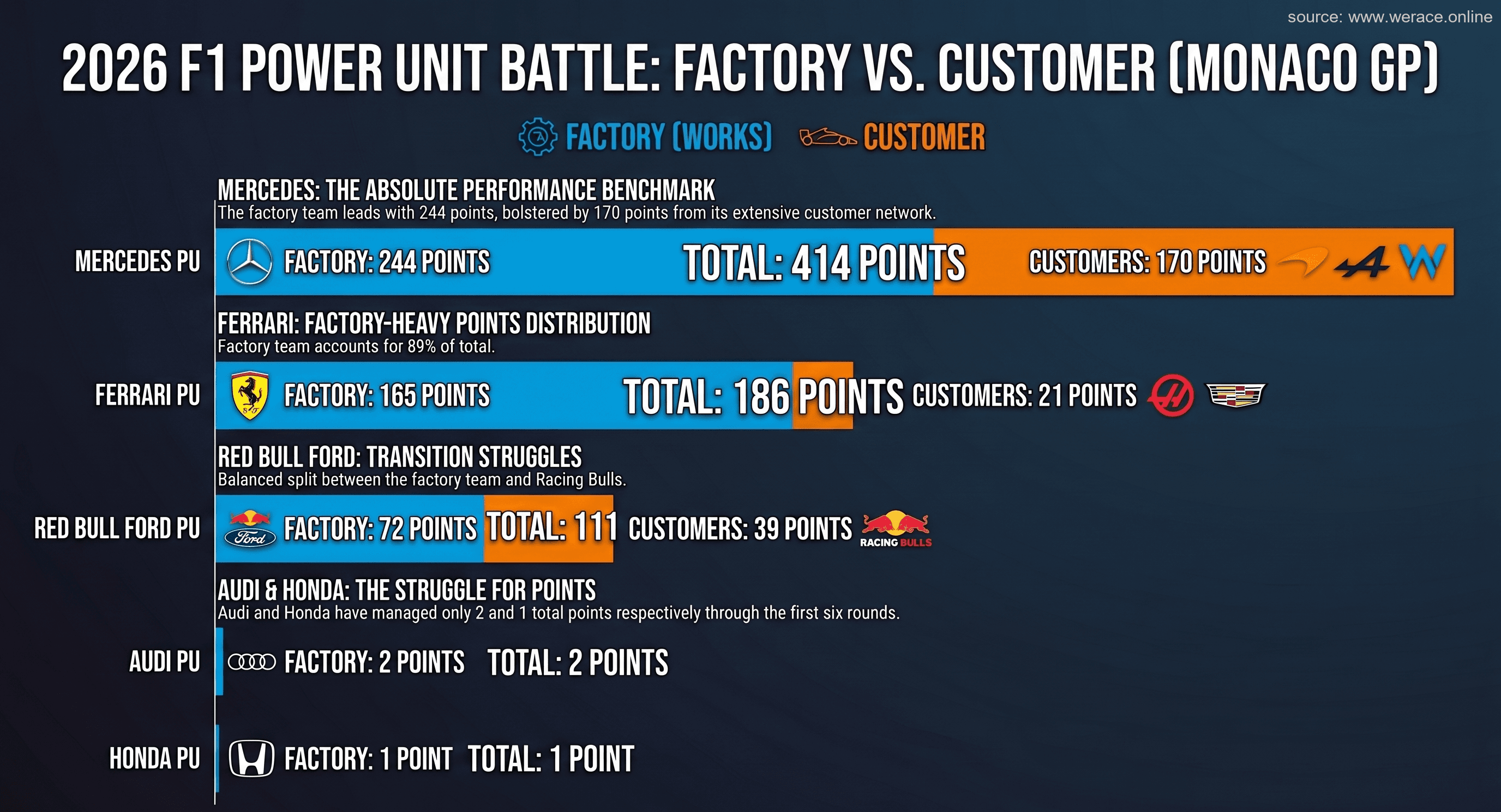
This graph helps isolate something extremely important:
How much of a manufacturer’s success comes from the factory team itself, and how much comes from the competitiveness of the wider power unit ecosystem?
Mercedes-powered customer teams have consistently contributed strong points finishes, reinforcing the idea that the package works across multiple chassis concepts.
That is a major indicator of overall PU adaptability.
Meanwhile, the gap between Red Bull Ford’s factory performance and its broader ecosystem remains far more inconsistent.
This is another reason why raw ADUO ranking alone cannot fully explain real-world competitiveness.
The Dynamic Nature of ADUO
Another critical misunderstanding surrounding the leaks is the idea that the current ranking guarantees future dominance.
In reality, the opposite may happen.
The entire philosophy behind ADUO is dynamic correction.
The stronger your measured performance is, the fewer freedoms you receive. The further behind you are, the more aggressively you are allowed to recover.
That means Ferrari, Audi and Honda could theoretically close the gap far faster than under previous engine freeze eras.
The benchmark manufacturer does not simply gain an advantage forever. In some ways, becoming the benchmark can actually limit future flexibility.
This is another reason why the current leaks should not be interpreted as a final verdict on the 2026 engine cycle.
The Bigger Question: Who Should Define the Measurement System?
Ultimately, the most interesting part of the entire ADUO discussion may not be whether Red Bull or Mercedes currently possesses the stronger engine.
The deeper question is whether Formula 1 should allow manufacturers such direct influence over the structure of the system used to evaluate them.
Because that is effectively what happened.
Manufacturers preferred a simpler, more politically manageable measurement model over a more sophisticated FIA proposal.
And now Formula 1 finds itself facing an uncomfortable paradox:
The power unit dominating races is not the one officially identified as the benchmark.
Perhaps that does not mean the system is broken. Perhaps it simply reveals how impossible it is to compress the complexity of a modern Formula 1 power unit into a single number.
Conclusion: ADUO Is a Lens, Not a Verdict
The biggest mistake would be treating ADUO as a definitive ranking of engine superiority.
It is not.
ADUO is a regulatory lens - a technical instrument designed to guide development concessions, not to crown a champion.
And yet, the leaks have already exposed something fascinating about the 2026 Formula 1 landscape:
- Red Bull Ford may possess an extremely strong combustion engine concept
- Mercedes may have created the best overall competitive package
- Ferrari has both a serious problem and a major opportunity
- Honda and Audi still face a steep climb, but no longer an impossible one
Perhaps the real ADUO paradox is that the system may be doing exactly what it was designed to do:
not telling us who is winning today, but identifying who could dominate tomorrow.