
Anatomy of a Masterclass: How Antonelli Subjugated Monaco and the Technical Sifis That Broke His Rivals
The Monaco Grand Prix is rarely a race of pure, unadulterated pace differentials. Typically, the narrow street circuit forces a processional dynamic where management trumps raw velocity. However, the 2026 edition completely shattered this paradigm. Kimi Antonelli did not just win; he executed a tactical and mechanical demolition of the field, exposing deep setup flaws in rival teams and leaving even his seven‑time world champion rival, now at Ferrari, looking for answers.
Through a comprehensive review of telemetry data, lap-time distributions, and late-breaking power unit technical developments, we can finally piece together the engineering masterclass behind Mercedes’ dominant weekend, the operational chaos that followed, and the strategic undercurrents that will alter the rest of the 2026 technical development cycle.
1. The Macro View: Unprecedented Pace Dominance
To comprehend the scale of Antonelli’s supremacy, one must look at the overall race metrics. In modern Formula 1, finding a tenth of a second per lap on street circuits is considered a massive achievement. Antonelli operated in an entirely different zip code.
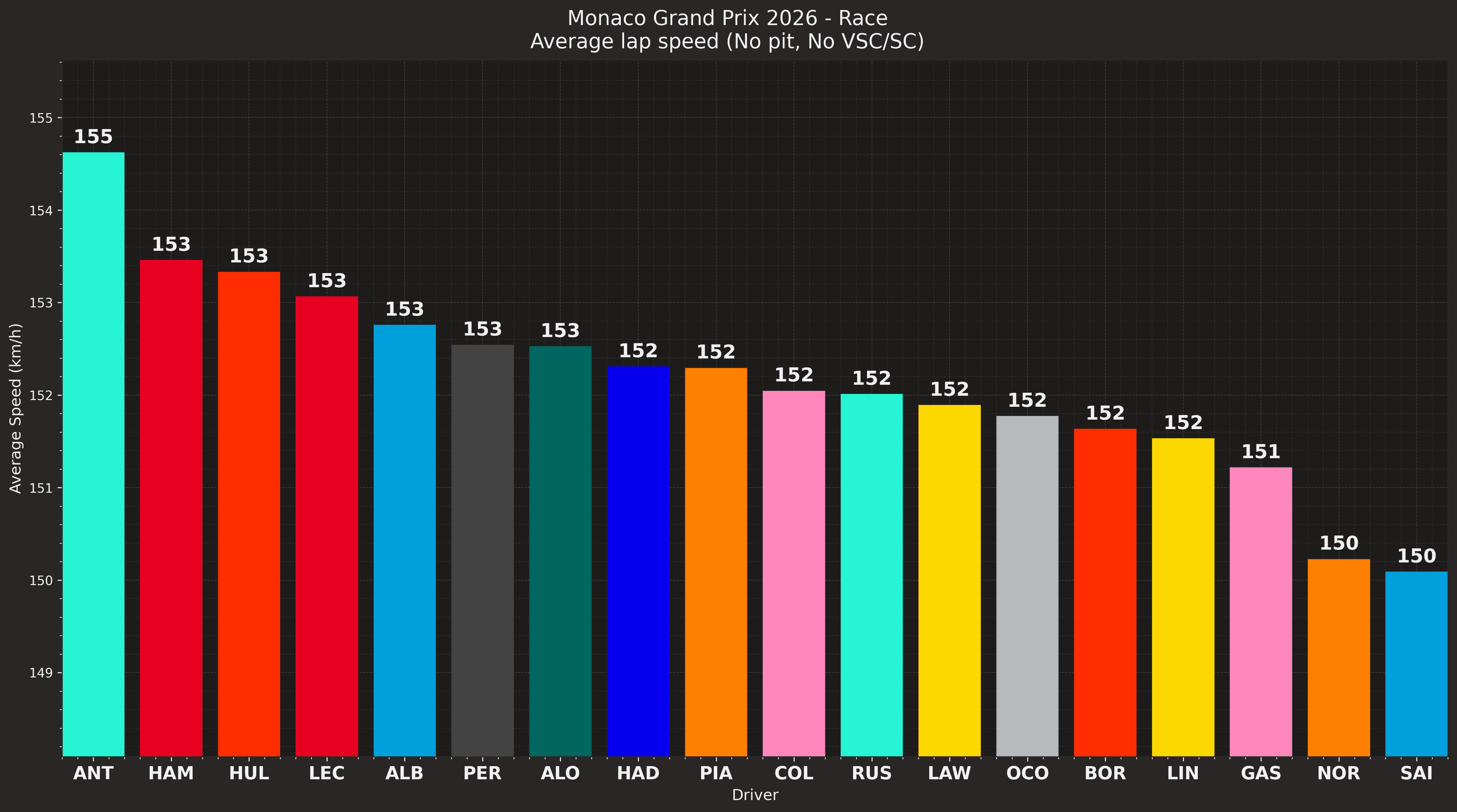
Antonelli maintained an astronomical average lap speed of 155 km/h throughout the non-neutralized phases of the Grand Prix. To put this in perspective, his closest pursuers - Lewis Hamilton, Nico Hülkenberg, and Charles Leclerc - could only muster an average of 153 km/h. On a tiny, tight layout like Monte Carlo, a 2 km/h delta in average speed over an entire race distance is an absolute eternity.
This structural advantage is further crystallized by the average gap chart.
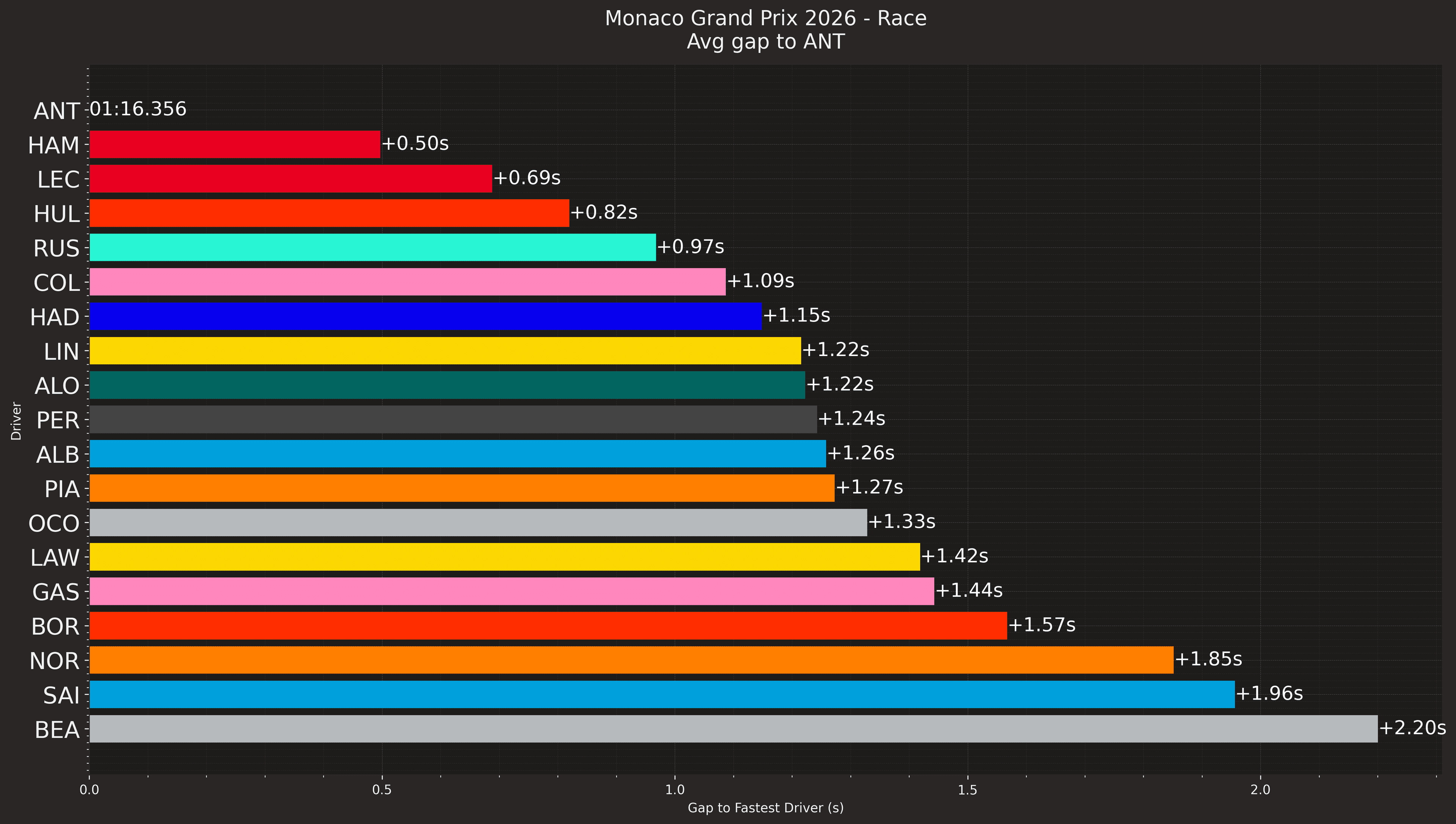
Over the course of the Grand Prix, Antonelli built an average gap profile that read like a historical anomaly:
- Hamilton (P2): +0.50s average gap per lap.
- Leclerc (P3 before retirement): +0.69s average gap per lap.
- Russell (P5): +0.97s average gap per lap.
This massive pace differential meant that by lap 20, Antonelli had checked out, opening up a 20-second cushion over the third-place car, effectively destroying any tactical undercuts before the pit window even matured.
2. Mechanical Empathy: Suspension Compliance vs. Street Bumps
The foundation for this historic stint was not found in aerodynamic downforce, but rather in a radical setup pivot executed on Saturday morning.
During Friday practice, Mercedes rolled out an incredibly stiff baseline mechanical platform. The simulation data from Brackley had suggested that a rigid floor and stiff damping would yield maximum responsiveness through the swimming pool section and rapid changes of direction. In reality, the car became a violent, unpredictable handful over Monaco’s undulating street surface. The limit arrived too abruptly, destroying driver confidence.
Recognizing the dead end, the engineering team completely reversed course for FP3, softening the anti-roll bars, heave springs, and damper rates. This completely transformed the W17.
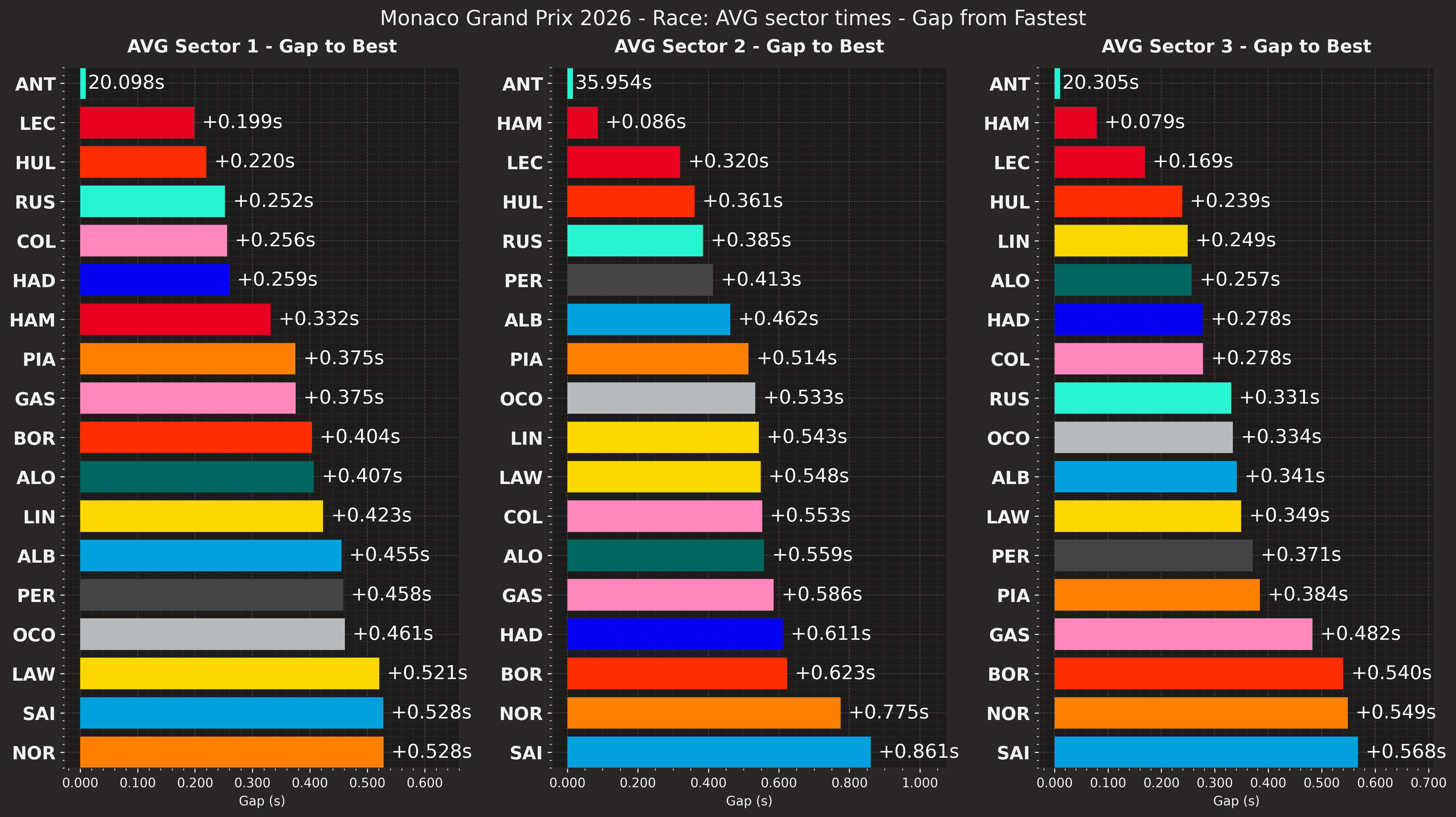
Look at the average sector breakdowns.
Antonelli’s primary execution zone was Sector 1, where he was a staggering two-tenths faster than Charles Leclerc and over three-tenths faster than Hamilton on average. Sector 1 at Monaco requires maximum mechanical compliance over the bumps heading up to Massenet, a compliant front end into Casino, and superb traction out of Ste Devote.
By running softer suspension, Antonelli could literally launch the car over the kerbs at the chicane du Port without unsettling the rear axle. This compliance paid dividends at the low-speed apexes of Loews, Portier, and Rascasse. When a car transitions smoothly out of these tight corners with minimal wheel spin, the tire surface temperature remains perfectly stable. Antonelli experienced essentially zero thermal degradation, allowing him to smash purple lap after purple lap while his rivals managed rapidly fading rubber.
The Driver Divergence: Antonelli vs. Russell
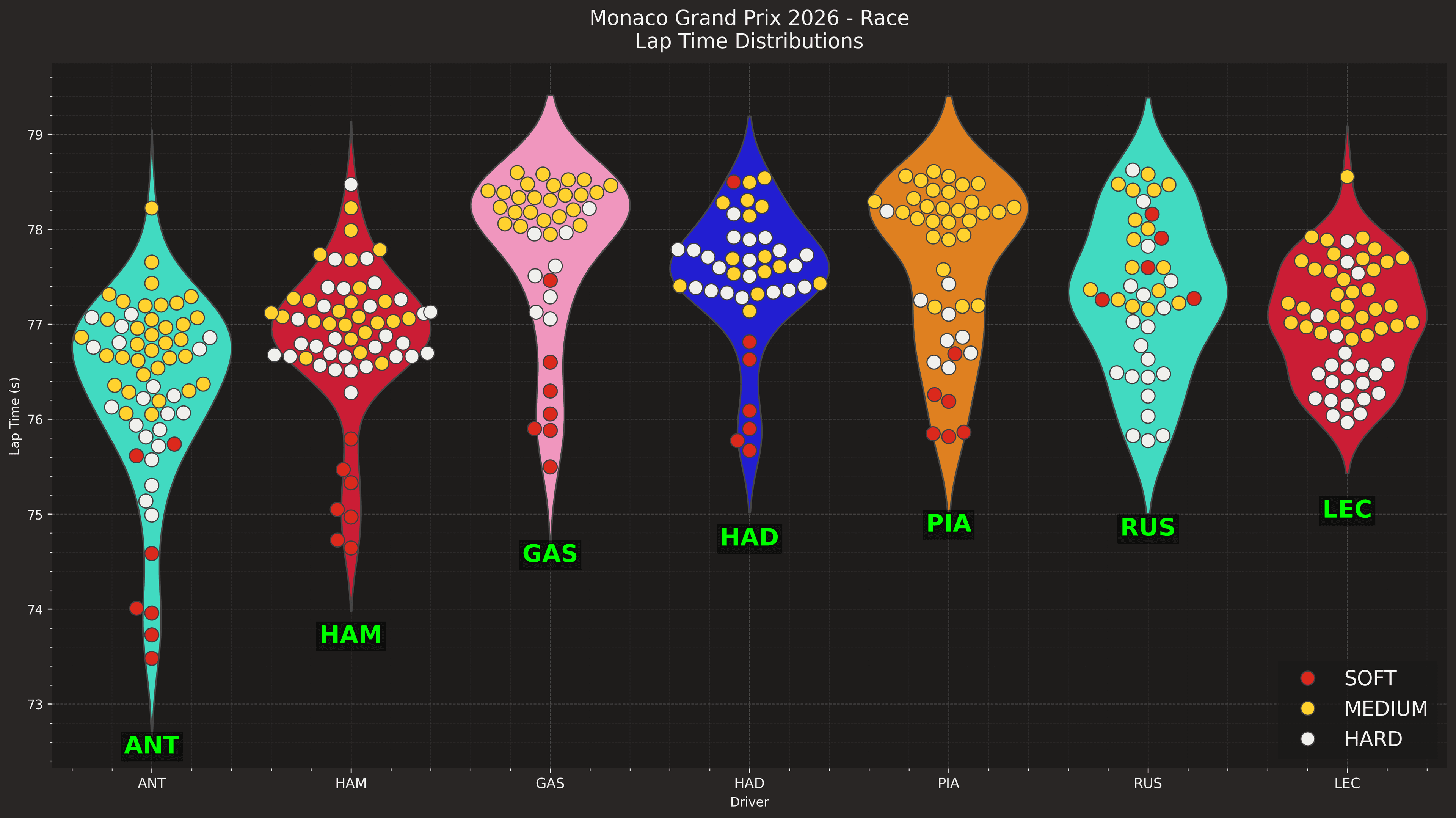
Interestingly, this mechanical philosophy worked like magic for Antonelli’s progressive, clean driving style but completely backfired on George Russell. As seen in the pace distribution and violin plots, Russell's pace was highly erratic and significantly slower. The softer front suspension provided less immediate, crisp support on turn-in, robbing Russell of the front-end confidence he needs to hustle the car. While Kimi danced over the bumps, George regressed.
3. Hamilton’s Multi-Front Battle: Tyres, Fuel, and Penalties
While Antonelli enjoyed a serene Sunday, Lewis Hamilton’s journey to second place was a masterclass in crisis management.
The Early Tyre Drop-Off
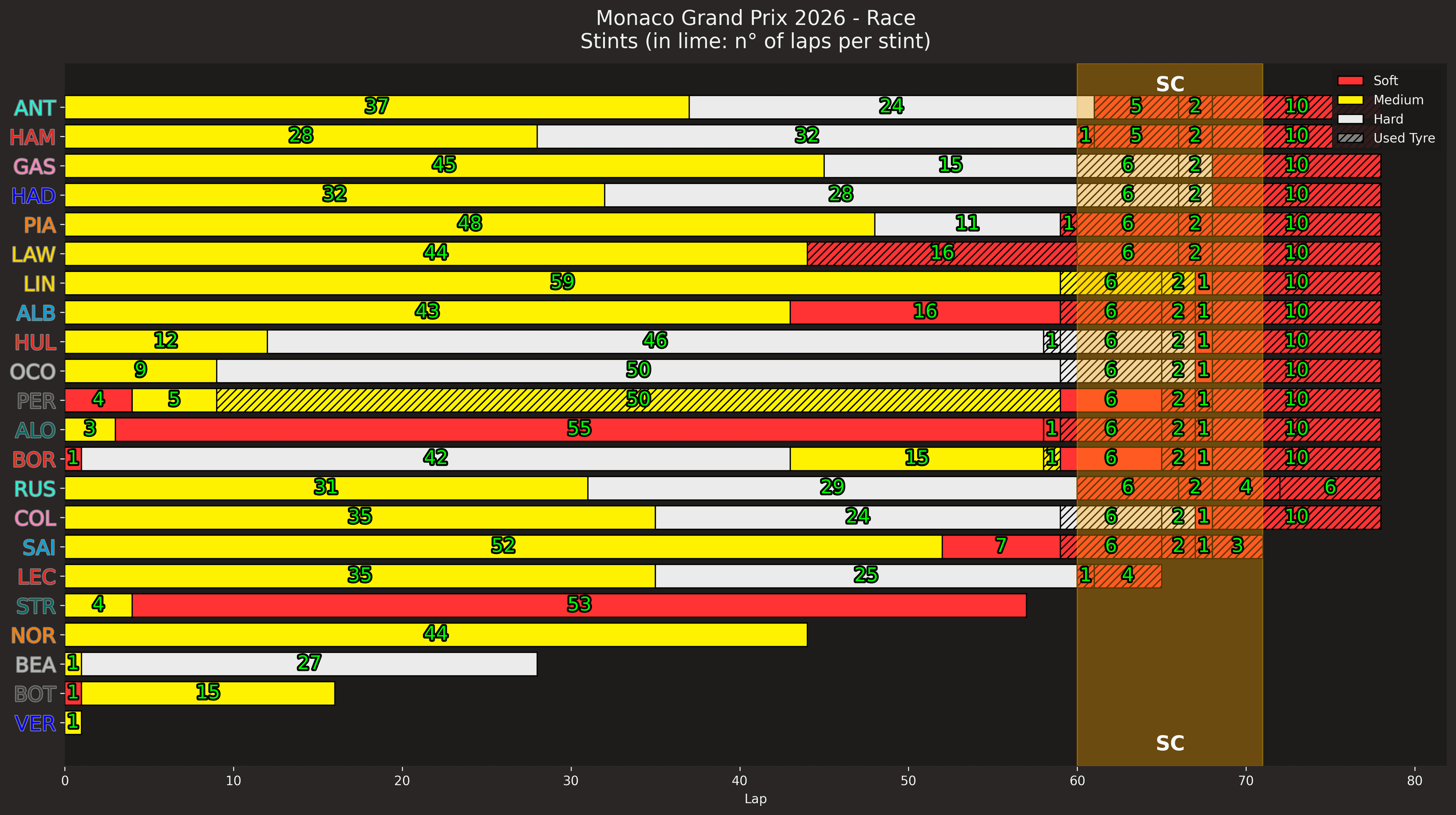
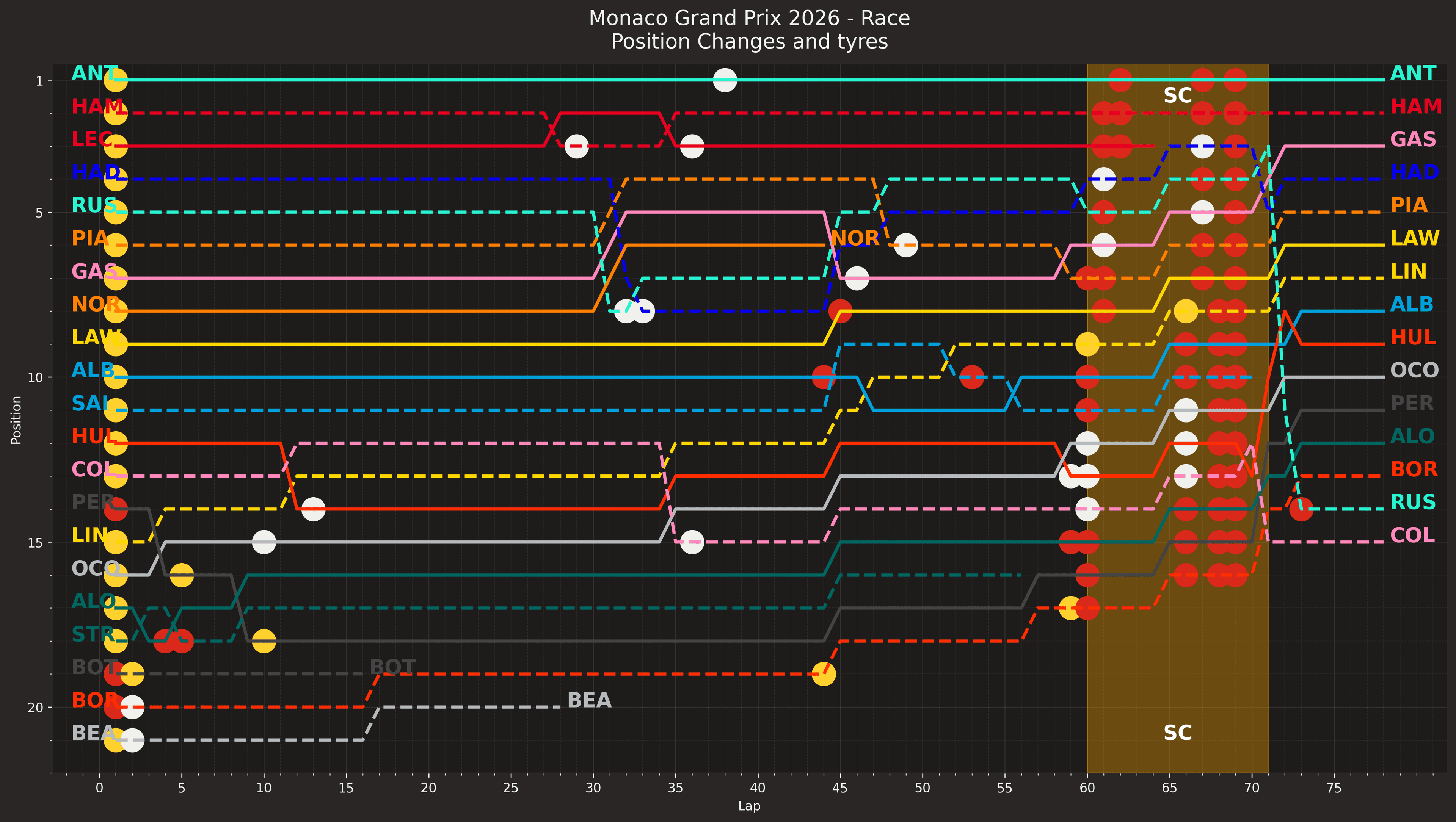
As visualized in the stint and position charts, Hamilton started on the Medium compound. By lap 15, his radio transmissions became urgent, reporting that his fronts were entirely cooked. Hamilton’s stiffer setup configuration, relative to Antonelli, caused a higher slip angle on corner exit, accelerating thermal degradation. This forced Ferrari to trigger an early pit stop on lap 28 to switch to the Hard tyre, making him one of the earliest front-runners to blink.
The Pitlane Trap and Fuel Woes
Hamilton’s stop immediately dropped him behind Charles Leclerc, compounding his issues with a 5-second time penalty for speeding in the pitlane. Once back on track, a secondary alarm emerged: fuel consumption. Forcing his way through the heavy air behind the Ferrari meant Hamilton was burning fuel at an unsustainable rate. His Ferrari race engineer, Santi, initially delivered an aggressive directive: ignore the fuel, close the gap to Leclerc first, and handle the consequences later.
Once Leclerc pitted and Hamilton overcut him to claim clean air, the bill came due. Telemetry from this phase indicates Hamilton was instructed to perform 200 meters of lift-and-coast before every major braking zone. On a micro-circuit like Monaco, lifting 200 meters early is an extreme deficit, drastically extending his corner entry phases to regenerate fuel margin.
The Strategic Safety Car Save
Just as Leclerc began erasing Hamilton's gap due to this lifting regimen, Lance Stroll hit the wall, triggering a timely Safety Car. Ferrari reacted perfectly. Knowing that a late-race Safety Car in Monaco bunches the pack and renders a 5-second penalty fatal to a podium finish, they hauled Lewis in to serve the penalty under neutralized conditions.
4. The Anatomy of Leclerc’s Meltdown
Charles Leclerc’s home race hoodoo struck again, but a technical post-mortem reveals that his crash at the final corner was a combination of emotional overdriving, asymmetrical mechanical braking, and a deeply flawed track surface.
The Setup Disconnect
Leclerc was visibly agitated as early as Saturday, a state of mind that bled into Sunday’s race. During his first pitstop, the Monégasque made the highly unusual request to take 4 clicks of front wing flap angle out of the car. In modern Formula 1, adjusting more than 1 click during a live pit stop is rare; 4 clicks represents a desperate mechanical balance shift to cure a wildly nervous rear end.
His frustration peaked during the Safety Car phase. Having to wait behind Hamilton’s penalty-serving car meant Leclerc effectively lost crucial track positioning, leading to an angry radio exchange regarding why Ferrari had brought him in at all.
The Crash Mechanism: Brake Linearity and "Mafia" Asphalt
Shortly after, Leclerc lost the front end and crashed. While critics pointed to emotional instability, Leclerc's post-race interviews revealed a deeper mechanical anomaly: non-linear brake response.
Hamilton had migrated to an updated, revised Brembo brake material assembly three weekends prior. Leclerc had opted to retain the legacy specification due to a preferred initial bite feel. However, under high thermal soak and low-speed modulation at Monaco, his legacy system suffered a non-linear pressure drop, locking the front axle unpredictably. Following this shunt, Leclerc confirmed he will immediately transition to Hamilton’s braking architecture.
Furthermore, the track surface itself was shockingly substandard. Telemetry from multiple cars highlighted severe track delamination at the final corner. A large patch of asphalt had improperly bonded after an overnight repair job. Television feeds captured an internal FIA delegate making frantic hand gestures to camera crews to hide a massive chunk of loose asphalt that had ripped away.
This surface failure didn't just claim Leclerc; it followed the exact same dynamic that caused Lance Stroll’s terminal understeer moments earlier. The uneven, broken tarmac stripped away mechanical grip instantaneously, catching out anyone operating on the absolute limit.
5. The Post-Safety Car Separation
Any hope of a late-race battle after the Safety Car restart was immediately extinguished by Antonelli.
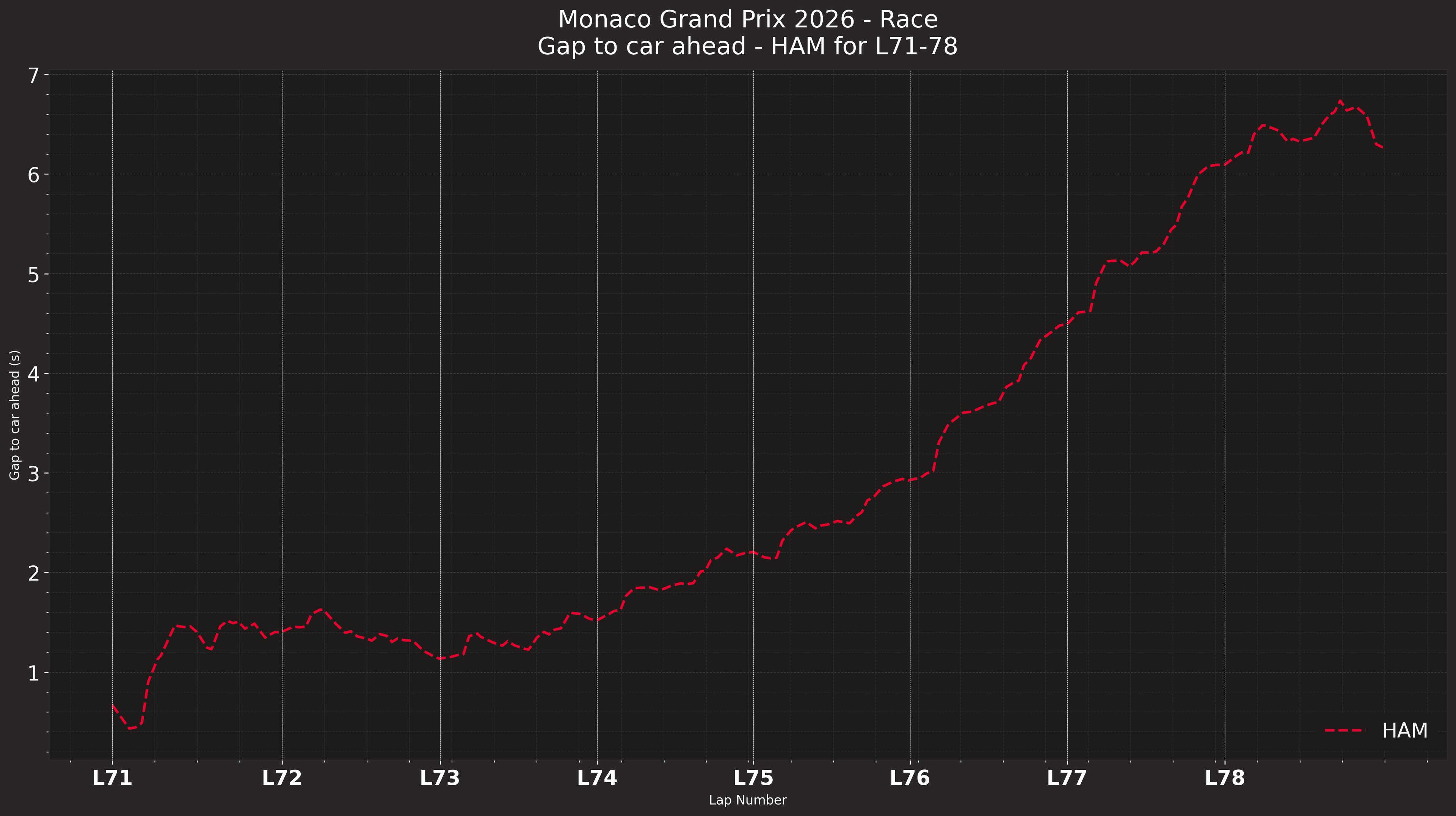
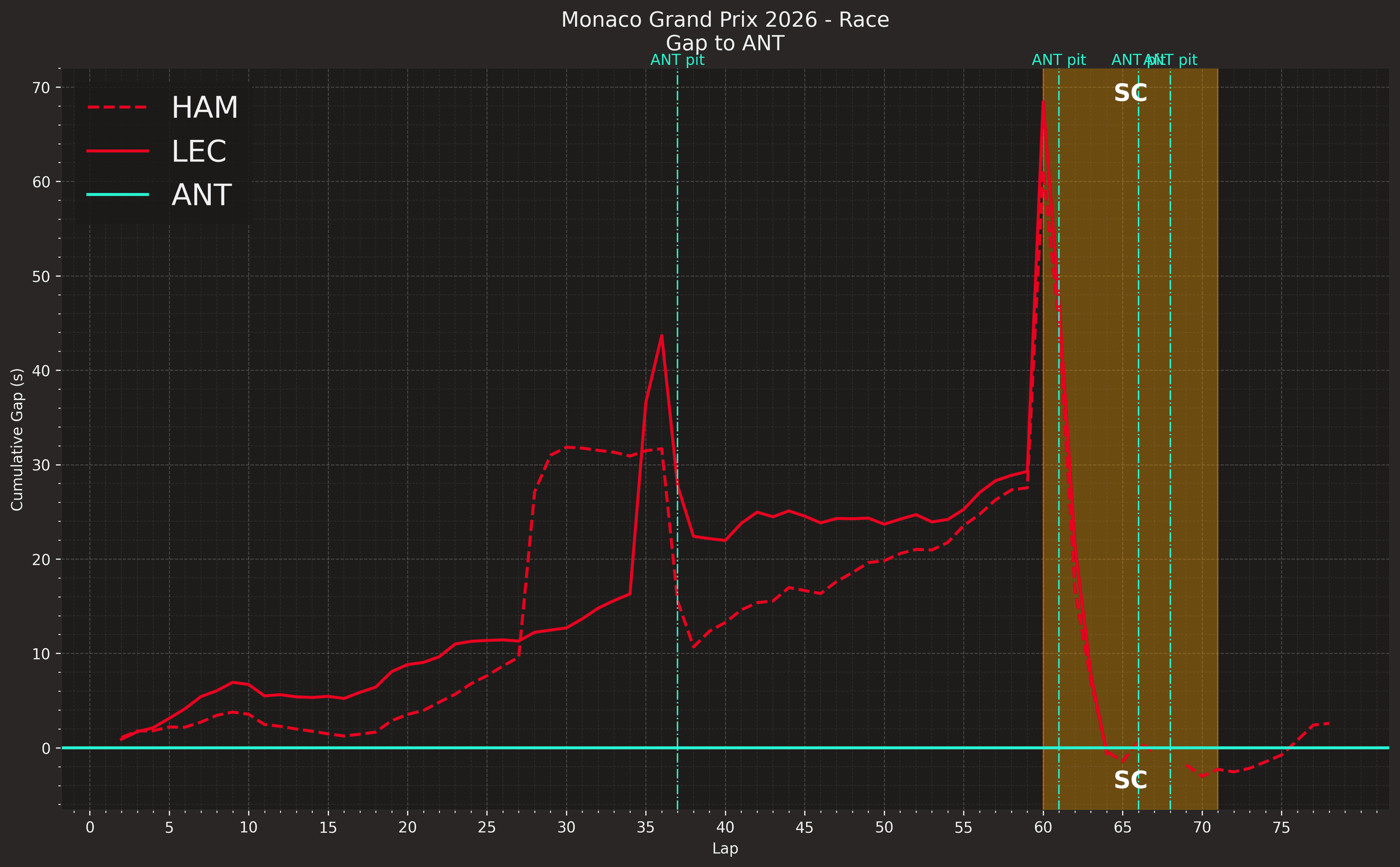
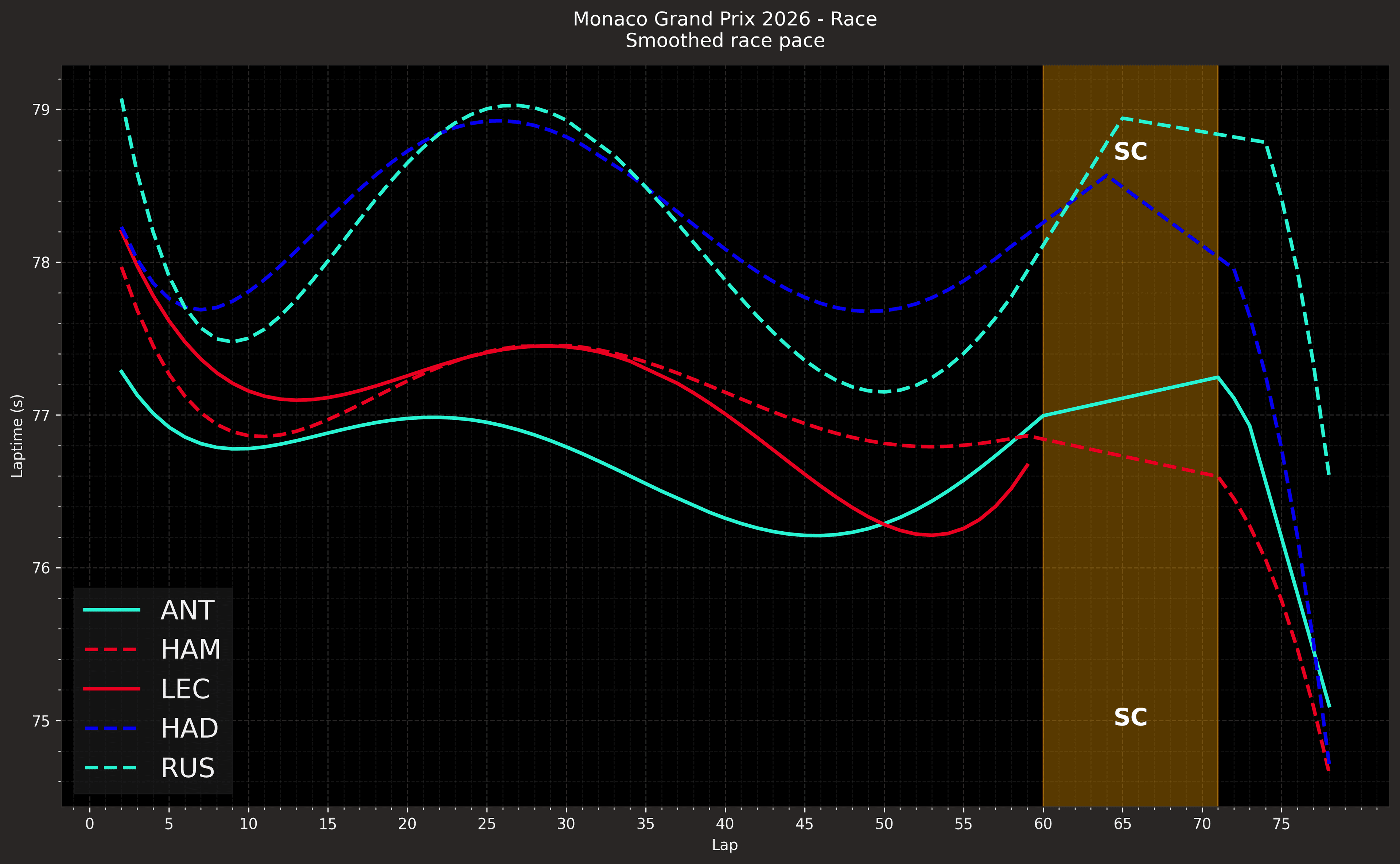
The final sprint from lap 71 onwards was a masterclass in cold-blooded execution. In a mere 7 laps, Antonelli opened up a 6.2-second gap over Hamilton.
As the red line in the gap chart shows, while Hamilton's tyres were dying, Kimi was setting continuous personal bests on zero-degradation rubber, pulling away at a steady, brutal rate of over one second per lap.
6. Technical Shockwave: The ADUO Engine Leak
While the action on track was mesmerizing, the biggest talking point for the rest of the 2026 season unfolded in the paddock just after the checkered flag. Highly confidential leaks regarding the ADUO engine equalization metrics emerged, completely upending the political and technical landscape of the sport.
Under current power unit regulations, the ADUO framework monitors thermodynamic and electrical power output parity across all manufacturers. The leaked data revealed a shocking hierarchy:
- Red Bull Powertrains: confirmed as the baseline, gold-standard internal combustion and ERS package on the grid.
- Mercedes: registered a 2% performance deficit relative to Red Bull, granting them the immediate right to introduce a mechanical performance upgrade.
- Ferrari: registered a staggering 4% performance deficit, giving the Scuderia the right to introduce two comprehensive engine upgrades and specialized development concessions.
Strategic Outlook
This revelation is a double-edged sword. On one hand, it explains how Antonelli was able to dominate so effortlessly while knowing that the Mercedes chassis still has a 2% power unit performance buffer yet to be unlocked via upcoming tokens.
On the other hand, it represents a catastrophic winter development failure for Ferrari. Entering a highly restrictive regulations loop with a 4% engine deficit - especially when a newcomer like Red Bull nailed the brief - places massive pressure on Maranello. Ferrari now has the structural allowances to upgrade, but they are starting from deep inside a technical hole.
Conclusion
The 2026 Monaco Grand Prix will be remembered as the day Kimi Antonelli truly asserted his authority over Formula 1. By executing a flawless setup adaptation, displaying masterful throttle application on corner exit, and remaining completely unflappable through a storm of safety cars and fuel saving, the young Italian re-wrote the rules of engagement for street circuits.
With Mercedes sitting on an incoming ADUO engine upgrade token, the rest of the grid should be deeply, deeply concerned.