
Mamma Mia, Kimi! A Sensational Monaco Pole and the Thermal Trap that Broke Ferrari's Heart
What a qualifying session we have just witnessed! What an absolute thriller on the streets of Monte Carlo! If you watched the previous analysis covering FP3, you already knew that something fundamental shifted inside the Mercedes Brackley garage on Saturday morning. But honestly, absolutely nobody expected that shift to yield a breathtaking pole position for Kimi Antonelli!
The Italian teenage sensation has completely torn up the Monaco script, keeping a relentlessly chasing Max Verstappen at bay by the slimmest of margins.
1. The Top-Line Picture: Millimeters at the Front, Gulfs Behind
When we dig straight into the official classification data, the immediate takeaway is just how razor-thin the margin is at the absolute peak of the field, contrasted against a massive gulf to the chasing pack.
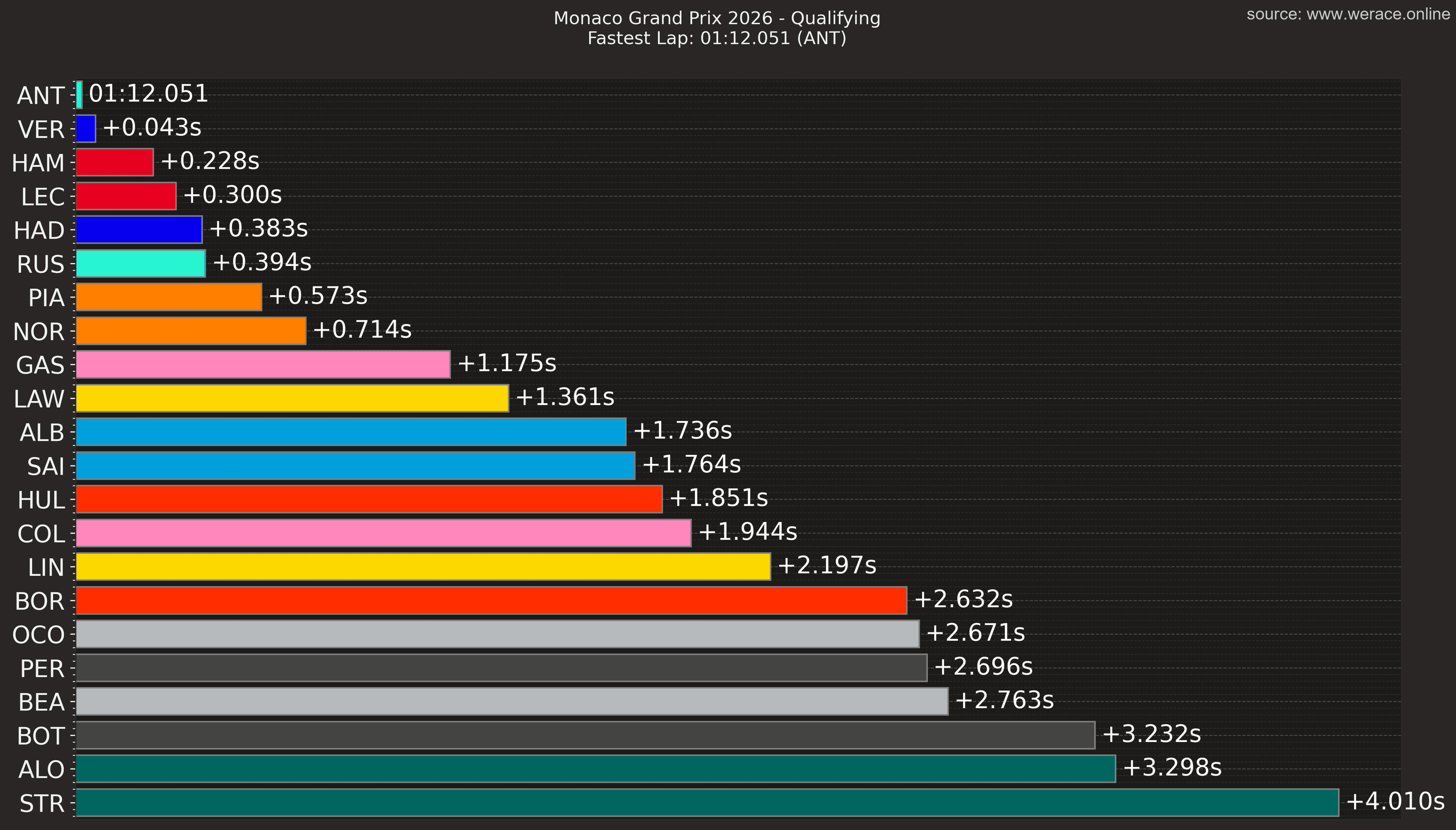
Kimi Antonelli claimed pole position with a stellar 1:12.051. Max Verstappen is breathing down his neck, sitting a mere +0.043s behind. From there, the gaps open up significantly:
- Lewis Hamilton (Mercedes): +0.228s
- Charles Leclerc (Ferrari): +0.300s
- Isack Hadjar (Red Bull): +0.383s
- George Russell (Mercedes): +0.394s
For Scuderia Ferrari, this outcome is nothing short of a bitter disappointment. Let’s be completely honest: Monaco was earmarked as the weekend for the Scuderia to win - perhaps even their only clear-cut opportunity of the 2026 season. Bridging the gap to the front-runners in normal racing conditions is a mountain to climb, and dropping completely off the front row at a track where track position accounts for 99% of the Sunday victory is a tough pill to swallow for the Tifosi.
2. The Structural Picture: Optimal Sector Aggregation & Ideal Laps
To understand if anyone truly left a pole-winning lap on the table, we look at the aggregation of personal best sectors against the compiled lap times.
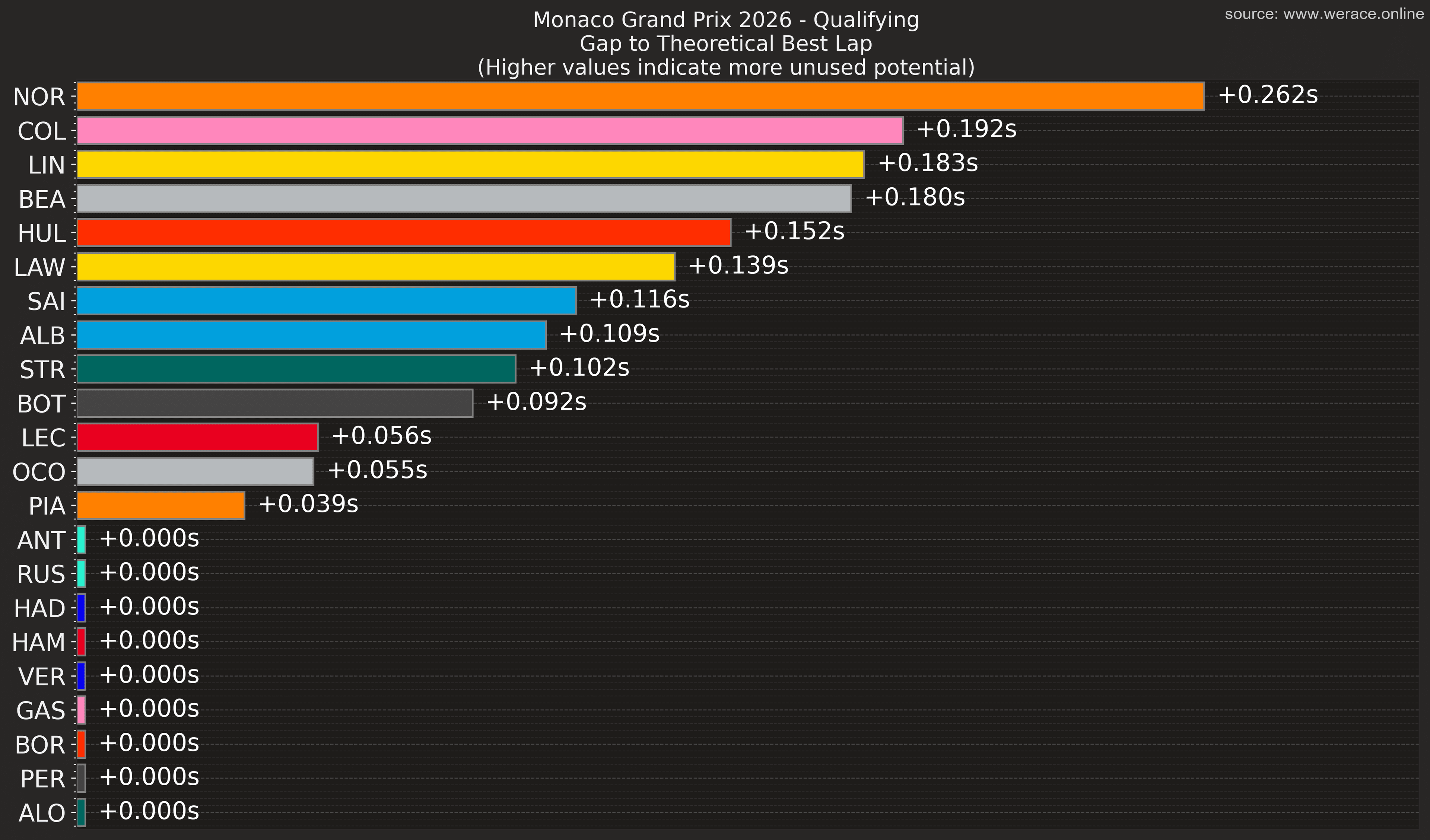
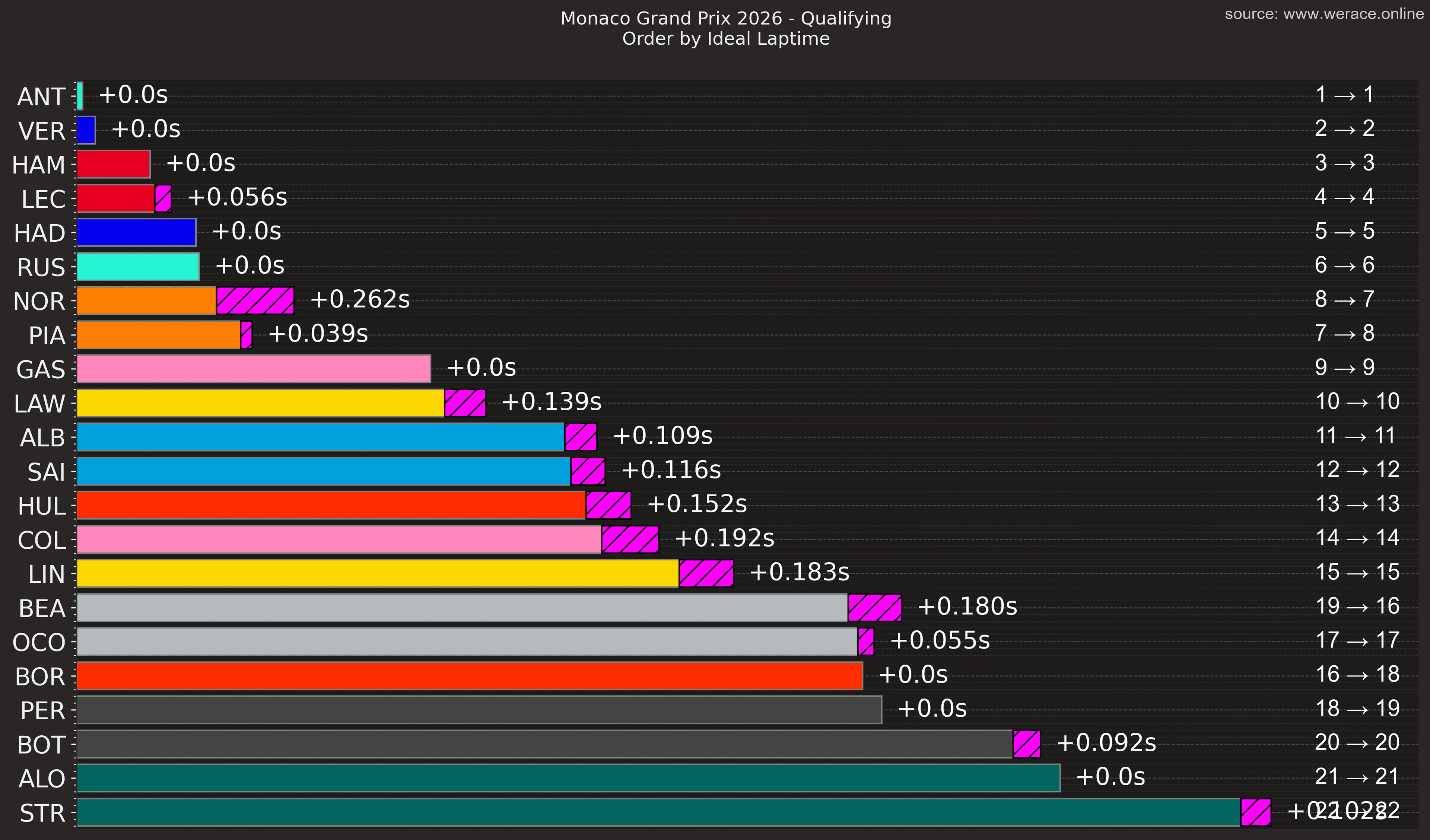
The analysis shows a remarkable trend: Antonelli, Verstappen, and Hamilton all delivered a +0.000s gap to their theoretical potential. Under the highest pressure imaginable, the top three drivers hooked up their perfect sectors on the exact same lap.
Conversely, Charles Leclerc left +0.056s of un-extracted potential on the table. Had he stitched together his best mini-sectors, he would have clocked a 1:12.295 - putting him closer to Hamilton but still matching the 4th spot on the grid. The biggest loser of un-extracted potential was Lando Norris, leaving a massive +0.262s on the table.
3. The Thermal Trap: Track Temperature vs. SF-26 Dynamics
Why did Ferrari's dominant Friday form completely evaporate when it mattered most? The answer lies hidden within the environmental asphalt dynamics. Lewis Hamilton’s radio channels told the early story: his mood was calm, but he was visibly less galvanised compared to his blistering Friday form.
The micro-climate of Monte Carlo played the ultimate trick here. Because the circuit hugs the Mediterranean coastline while the city is built vertically up the mountain, the setting sun drops behind the ridges rapidly. This sudden topography shadows the track, triggering an aggressive thermal plunge.
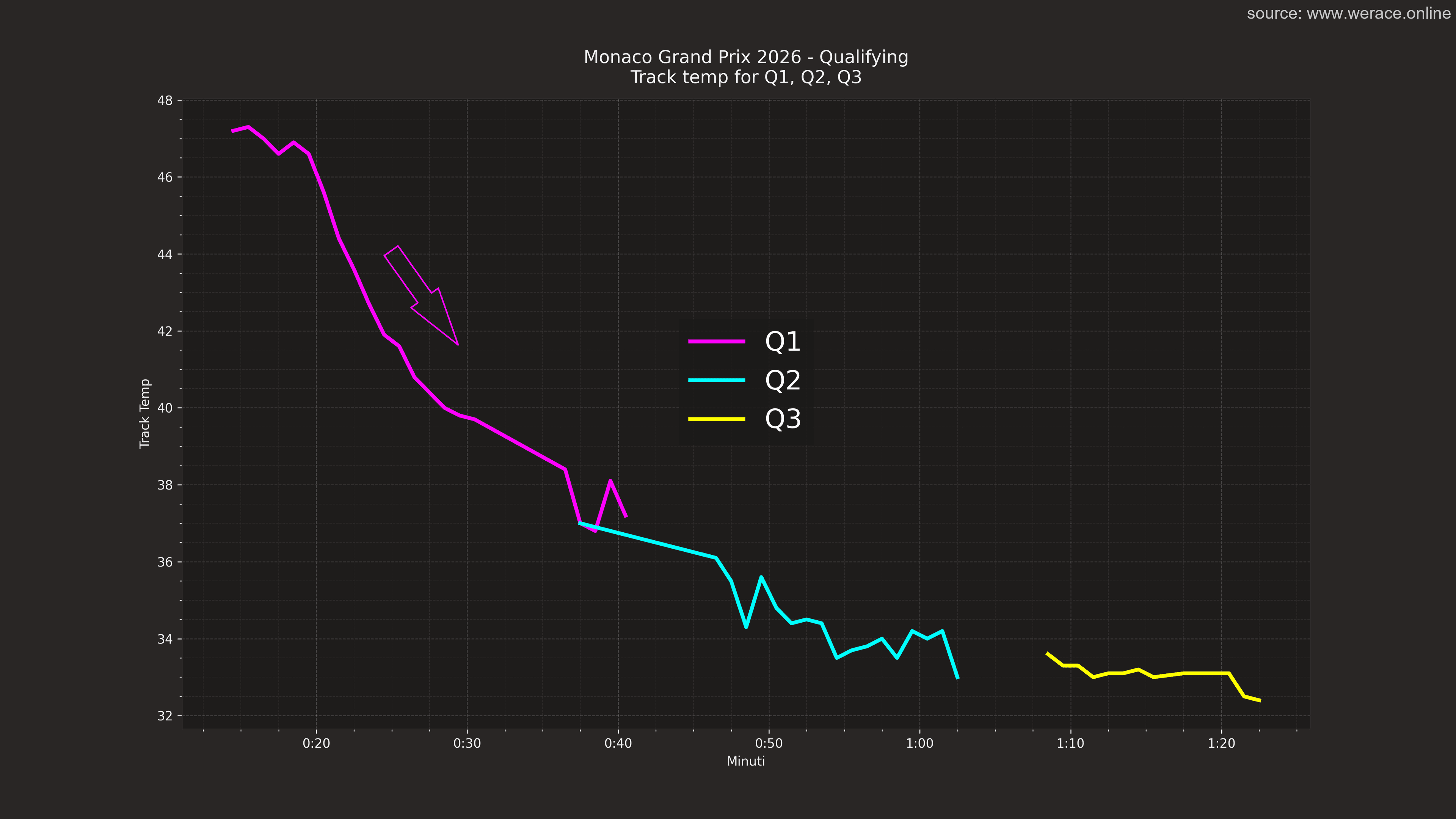
As plotted in the graph, track temperatures started at a warm 47.5°C at the beginning of Q1. Within just 18 minutes, the track temperature dropped by a massive 10°C. As we transitioned through Q2 and into Q3, the asphalt temperature lost another 6.5°C, bottoming out at a chilly 32.5°C.
This macro-thermal cliff completely destroyed the tyre operating window of the Ferrari SF-26:
- The Hot Window: when Ferrari was comfortably leading the pack early on, the track was hovering close to 50°C.
- The Chilled Window: as the track temperature fell, Ferrari's performance advantage didn't just stall - it was aggressively eroded by their rivals, who found better mechanical tyre compliance as the track cooled down, until Ferrari's advantage was reduced to zero.
This structural trap is brilliantly captured across the following charts.
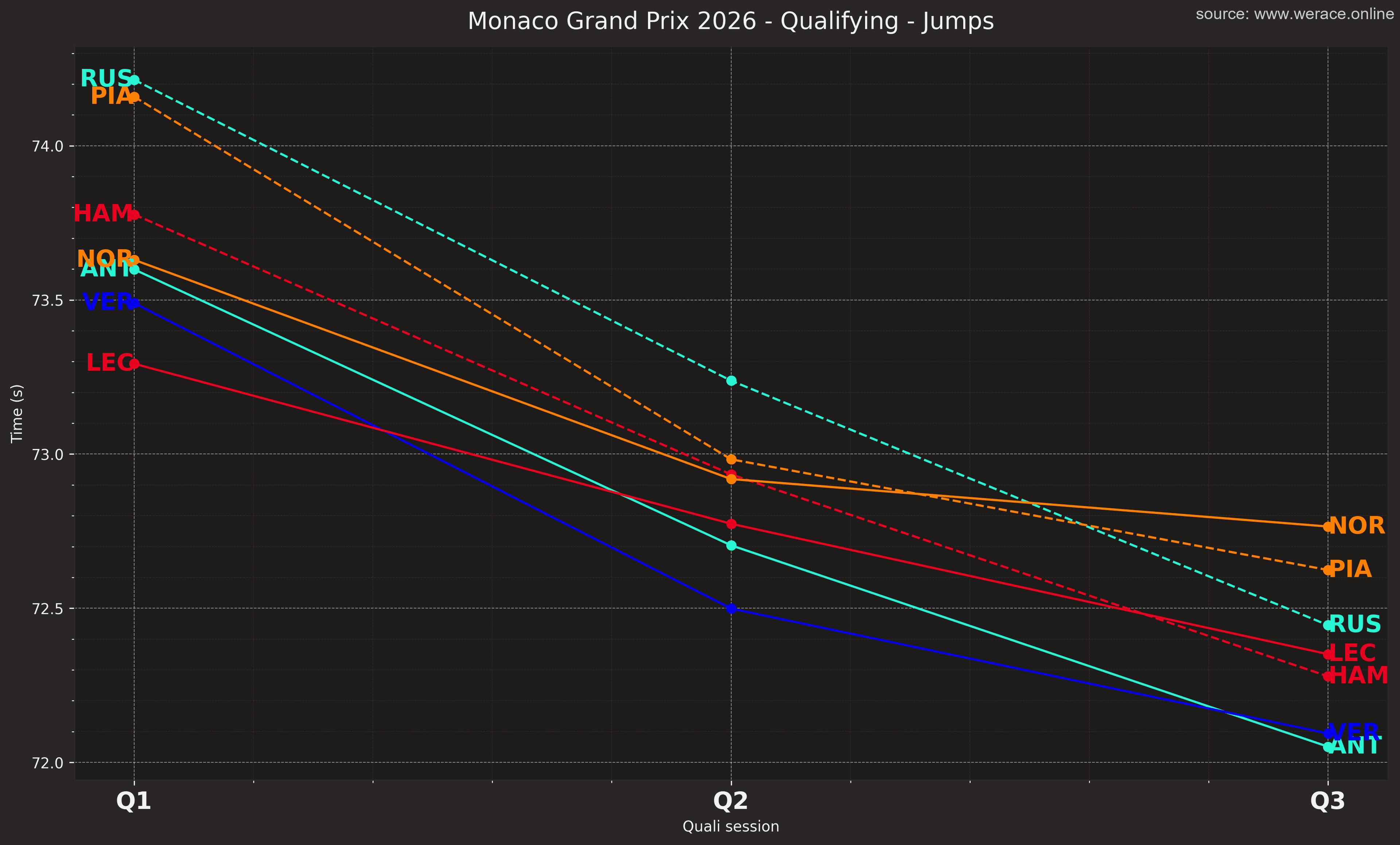
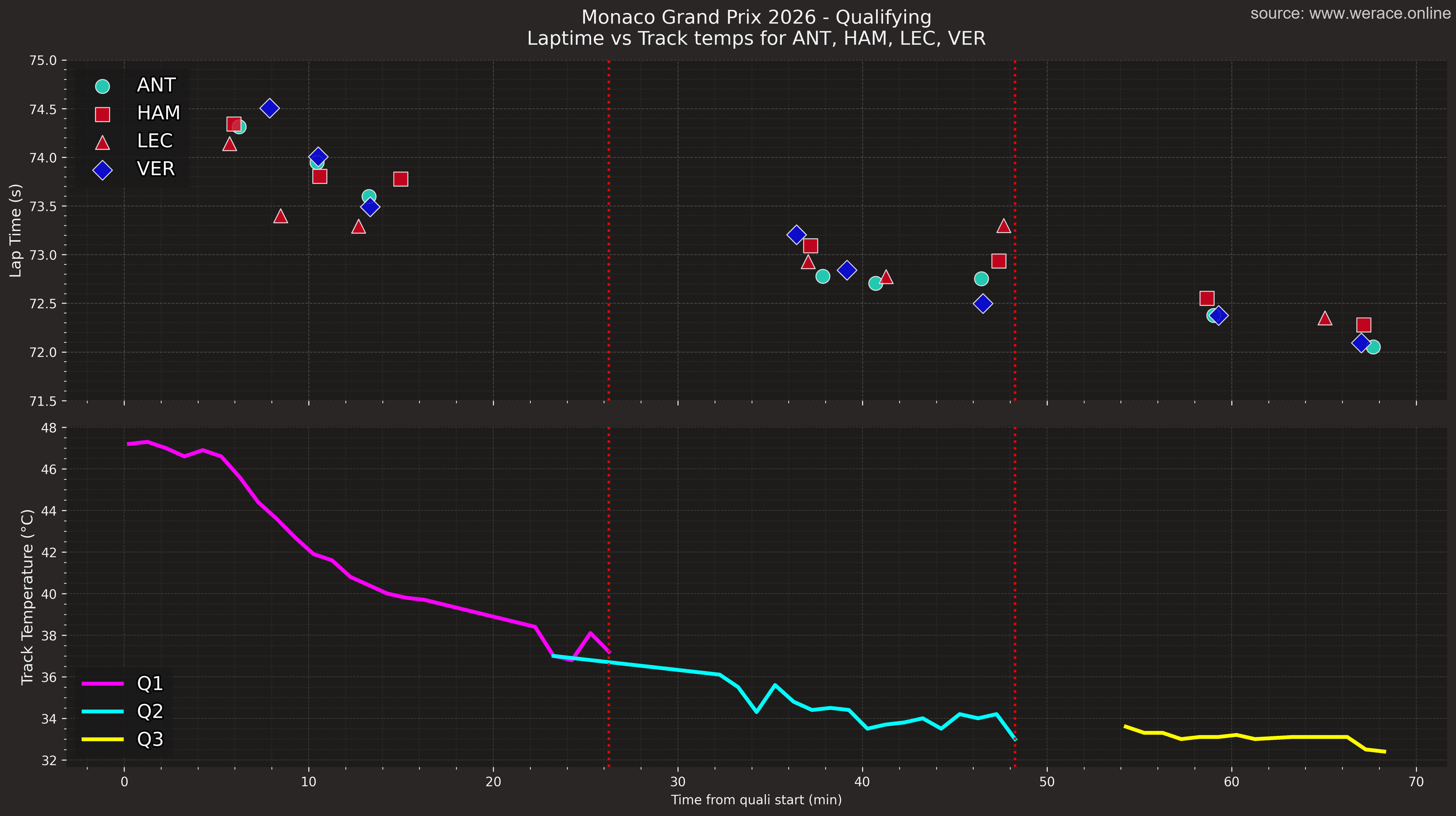
In Q1, Leclerc was undisputed king, sitting lowest on the time axis. But as we move to Q2 and Q3, Leclerc's performance improvement curve completely flattens out. In stark contrast, Antonelli and Verstappen continuously drop their lap times exponentially as the track conditions become fresher.
The onboard audio streams confirm this balance migration. In Q1, the Ferrari cockpit was quiet. From Q2 onwards, Hamilton started reporting that the car was suddenly too heavily pinned on the front nose, requiring constant front-wing flap regulations during pit stops to try and restore rear-end stability.
On the Leclerc side, the emotional state of the session mattered just as much as the raw lap time. By the end of Q2 he was visibly irritated on the radio, complaining that he had no feeling with the brakes, that he did not feel safe, and that he was being released into traffic at exactly the wrong moment. In Monaco, that kind of mental state is not a small detail. You need complete serenity, a stable rhythm, and real trust in the car if you want to assemble a pole lap around the walls. Leclerc simply did not look in that place anymore.
4. A Crisis of Confidence: Leclerc's Braking and MGU-K Dilemma
While the tyre window fell away from the car, handling errors further compounded Leclerc's deficit. From the middle of Q2, it was textbook clear that he would not secure pole position.
The technical root cause lies in how the drivers exploit braking:
While Hamilton exploits pure friction braking heavily, telemetry from previous seasons shows Leclerc utilizes an exceptionally high level of off-throttle engine braking compared to his teammates - historically more than Vettel, Sainz, and now Hamilton. Under the current regulations, engine braking is managed entirely differently, with a massive increase in electrical energy harvesting via a much more powerful MGU-K unit. On a tight street circuit with irregular kinetic absorption rates, Leclerc's mechanical engine braking preference may be clashing directly with the battery's state-of-charge recovery software.
That is the important caveat: this is not a definitive one-variable explanation, but it is a very credible technical hypothesis for why the problem appears to follow Leclerc rather than Hamilton. If Ferrari can refine the software and brake interaction further, the issue may soften. For now, though, it is a live limitation and it helps explain why Charles looked progressively less comfortable as the session evolved.
5. Where the Pole Was Won: Nouvelle Chicane Micro-Analysis
Let’s pivot to the pole lap of Kimi Antonelli. Fascinatingly, if we analyze sector performance, the young Italian did not actually secure a single absolute purple sector across the lap.
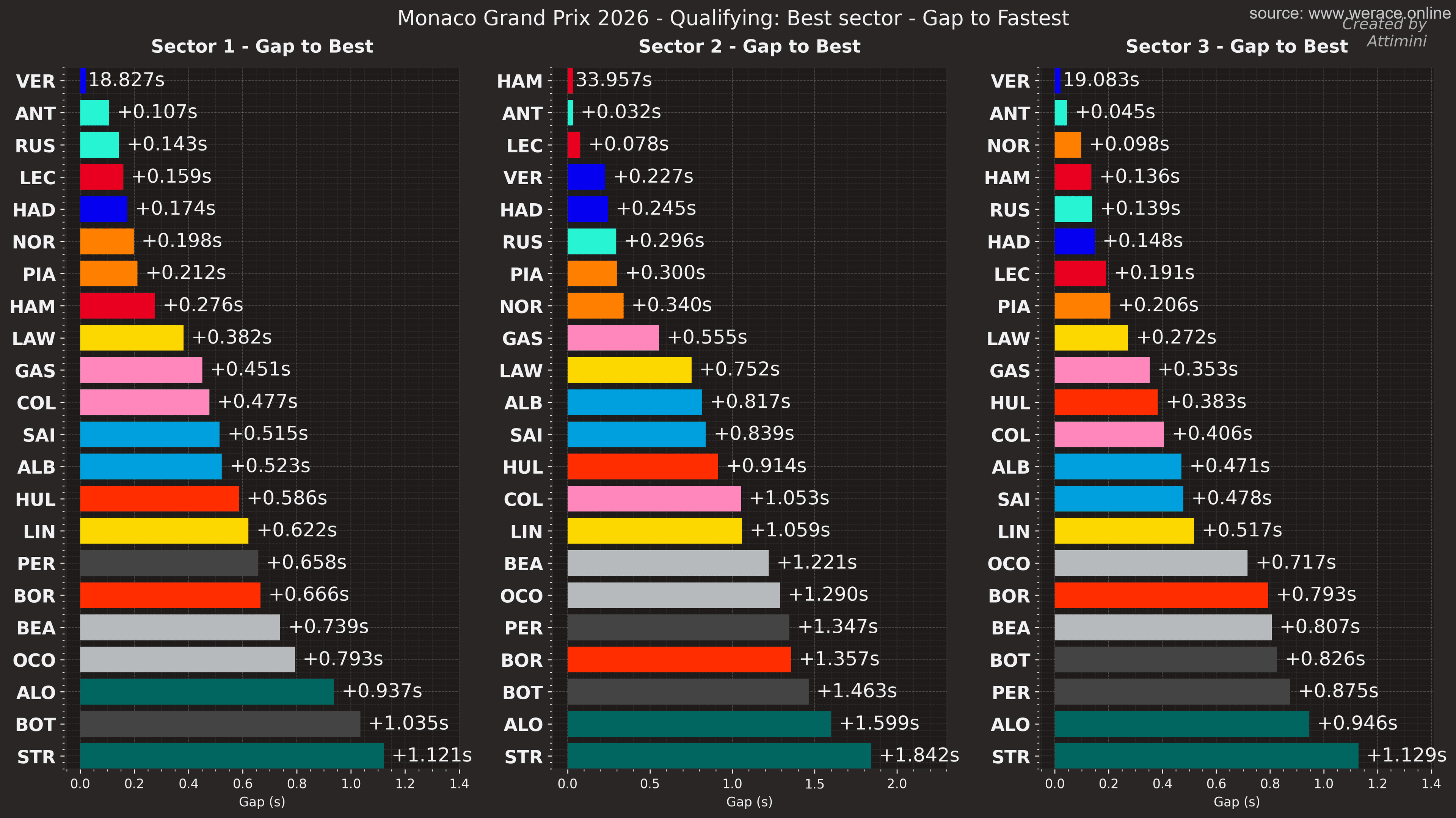
- Sector 1: Verstappen was the absolute benchmark (18.827s). Antonelli lost +0.107s, and Leclerc was +0.159s down.
- Sector 2: Hamilton set the absolute fastest time (33.957s), with Antonelli a mere +0.032s behind. Verstappen suffered massively here, leaking a painful +0.227s to Hamilton.
- Sector 3: Verstappen claimed the benchmark again (19.083s), with Antonelli right there at +0.045s.
Antonelli secured the front row via ultimate micro-sector optimization, completely fracturing Verstappen in Sector 2. To see exactly how he did it, we look at the high-frequency telemetry channels.
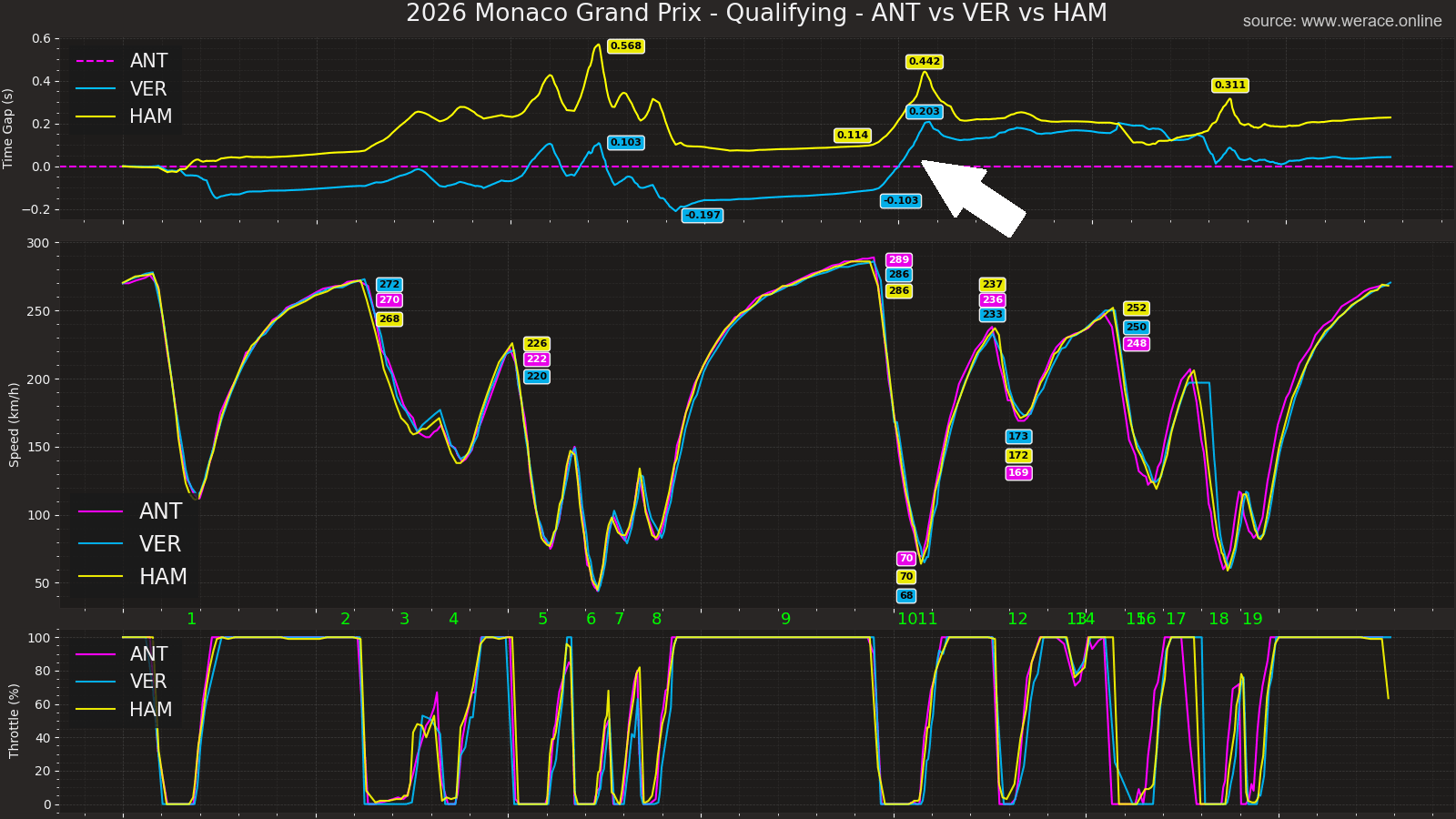
Look at the top time gap trace right at the exit of the Nouvelle Chicane after the tunnel. Entering the braking zone, Verstappen held a solid -0.197s advantage over the Mercedes. In the span of a single chicane, that delta completely flipped, leaving Verstappen trailing by +0.203s, while Hamilton's deficit spiked to a maximum of +0.568s. Antonelli carried an incredibly tidy minimum speed through Turn 10, got the car rotated effortlessly, and blasted out of Turn 11. That single corner earned him 3 tenths of a second against his primary rivals - a buffer he defended all the way to the line.
6. The Throttle Maps: High-Frequency Footwork Analysis
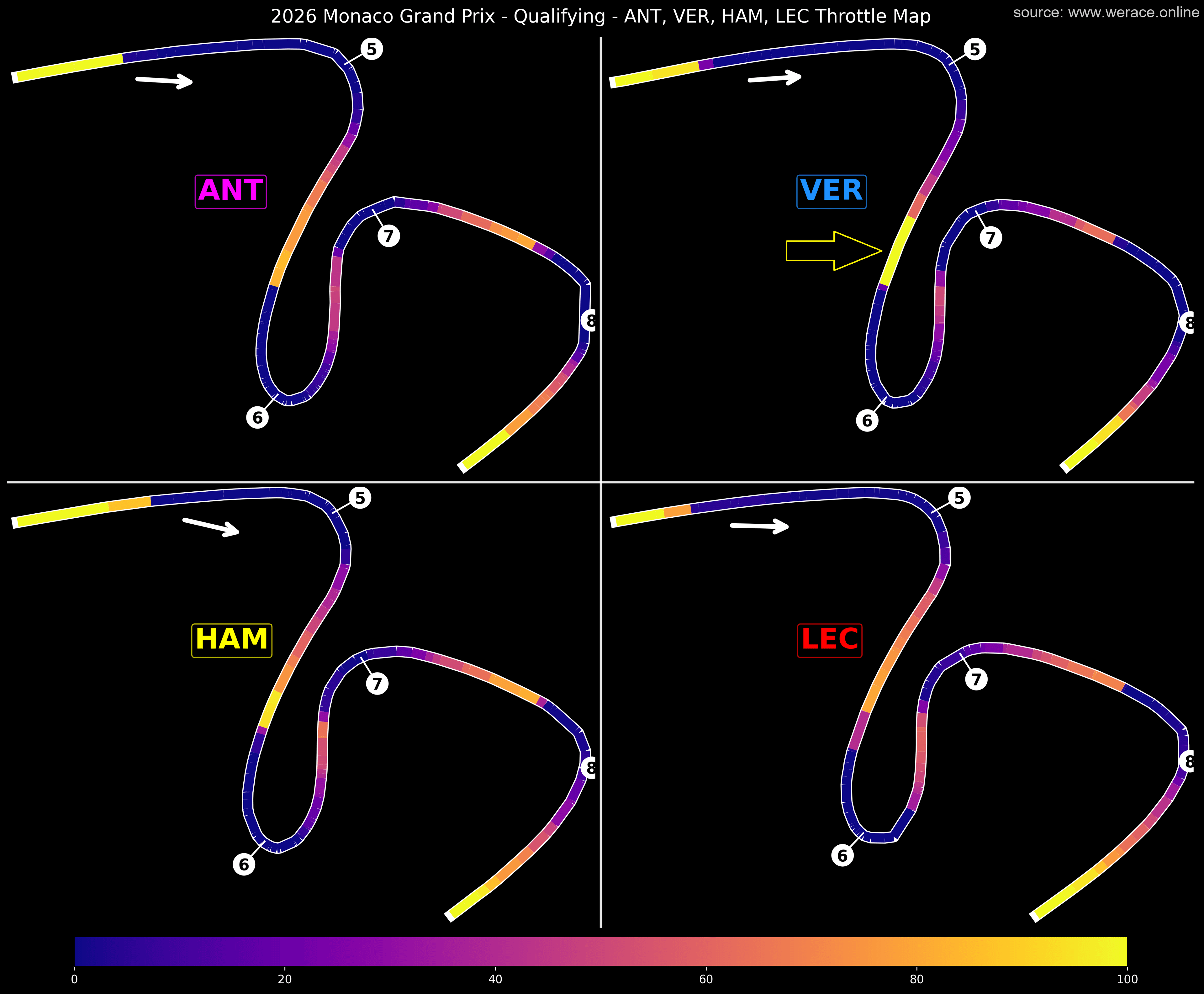
To see how the top cars handled the trickiest patches of tarmac, we look at the spatial throttle application maps.
Turns 5 to 8 (Mirabeau Haute to Grand Hotel Hairpin)
Max Verstappen is an absolute virtuoso through the slow speed sections. His trace features a denser, brighter yellow band through the corner transitions, proving he gets the RB back to full power quicker than anyone. Hamilton matches him closely, but look at Leclerc: his trace is saturated in dark purple and orange hues, highlighting a hesitant foot on the pedal and an unstable rear axle compared to his teammate.
Turns 10 to 11 (Nouvelle Chicane Exit)
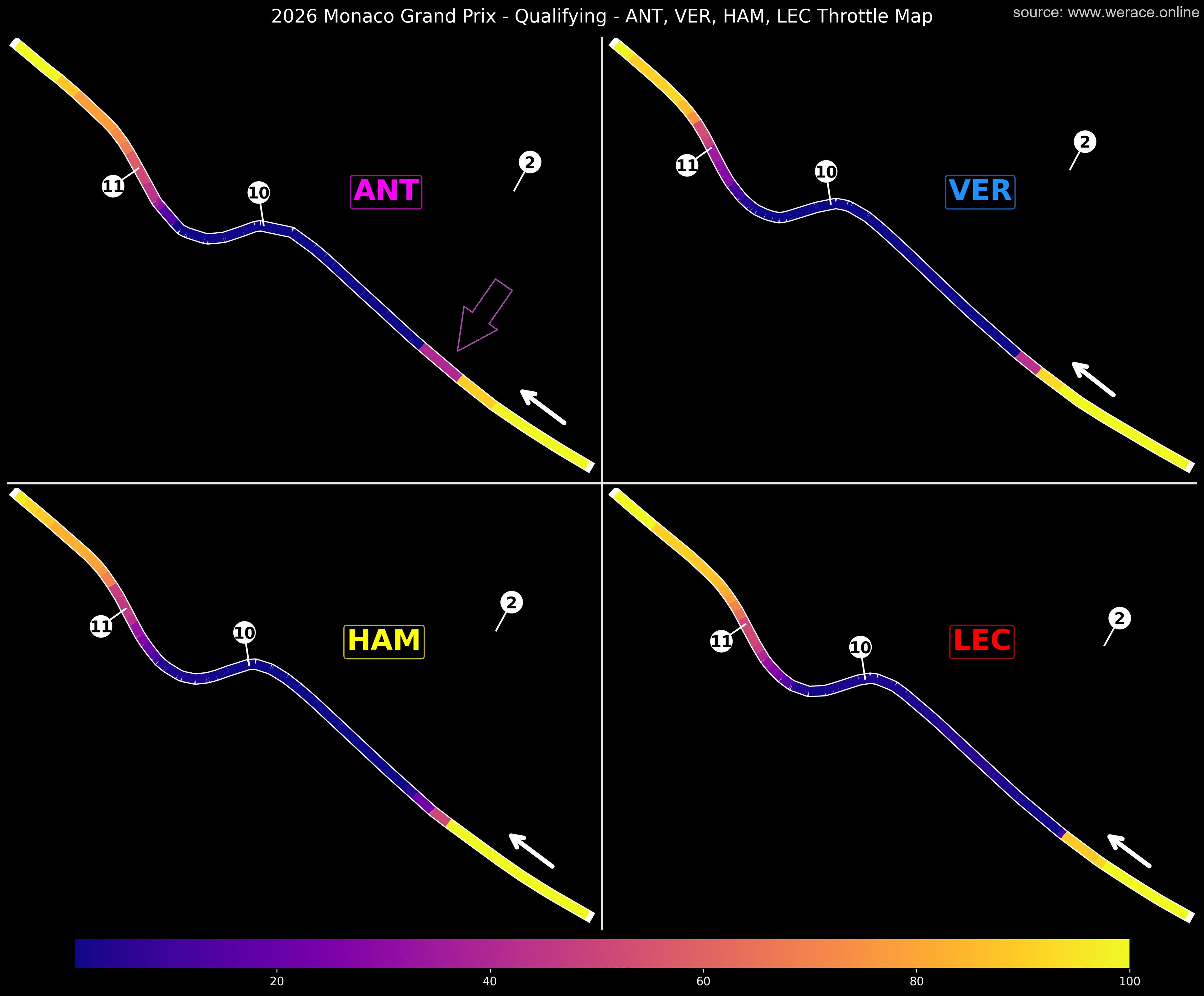
We see the exact anatomy of Antonelli's pole. Kimi enters the apex with a perfectly stable, controlled 40% throttle application, keeping the platform balanced before being the first to smash the pedal back to full yellow on exit. Fascinatingly, Leclerc matches Kimi’s smooth geometric profile through the middle of the chicane perfectly. This confirms that without his frantic nervous tension, Leclerc was the only driver with the raw car placement to deeply threaten the Italian.
Turns 13 to 16 (The Swimming Pool Complex)
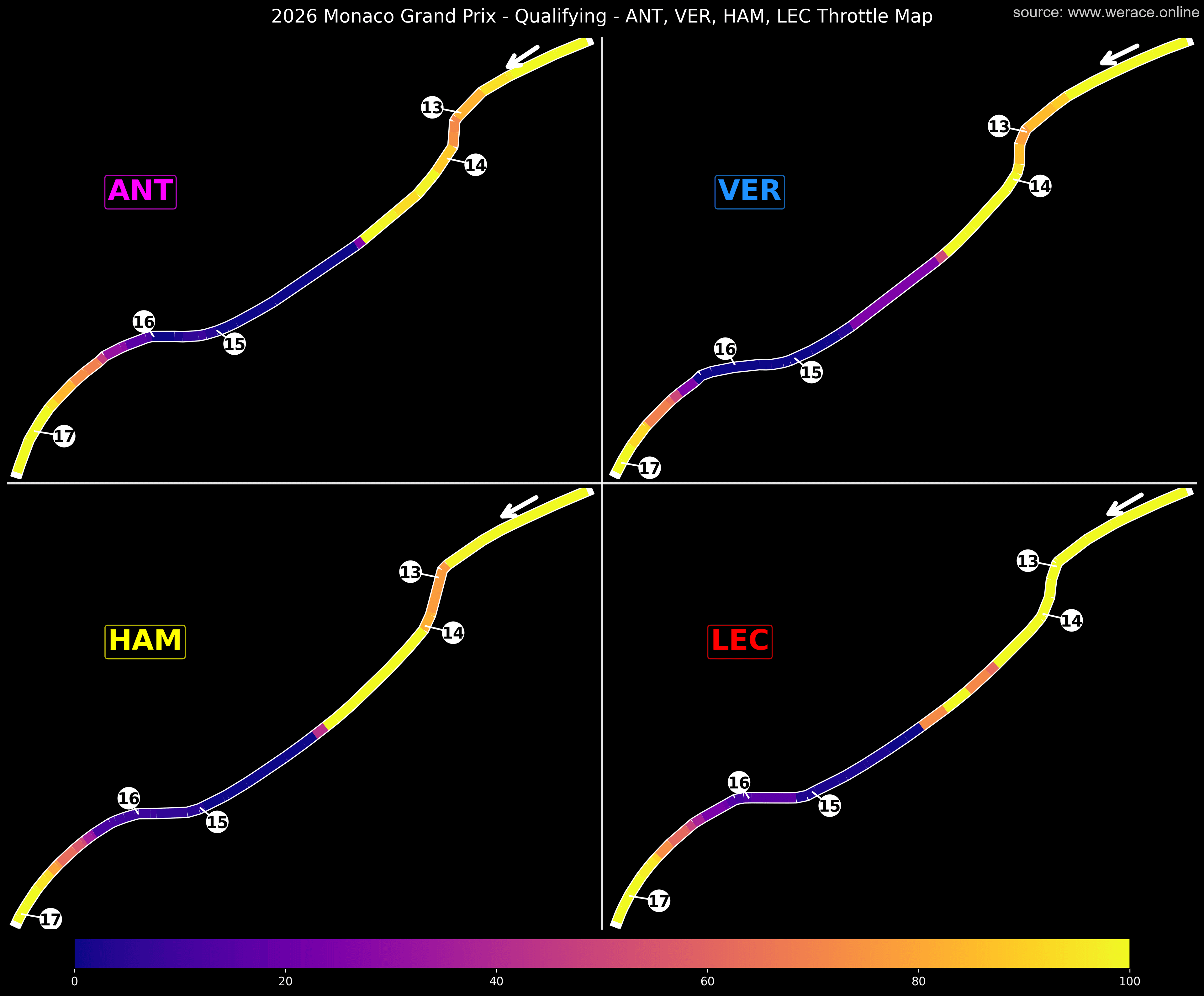
Telemetry indicates this was Antonelli's weakest link. His map is noticeably darker, losing ground to Verstappen's lighter violet signature. Crucially, look at Hamilton and Leclerc: both Ferrari chassis absolutely light up this sector in brilliant yellow. They attacked the curbs with stunning, fearless confidence on the gas. It's a painful reminder of the SF-26's inherent mechanical grip when the drivers felt safe.
Turns 18 to 19 (Anthony Noghes to Start-Finish)
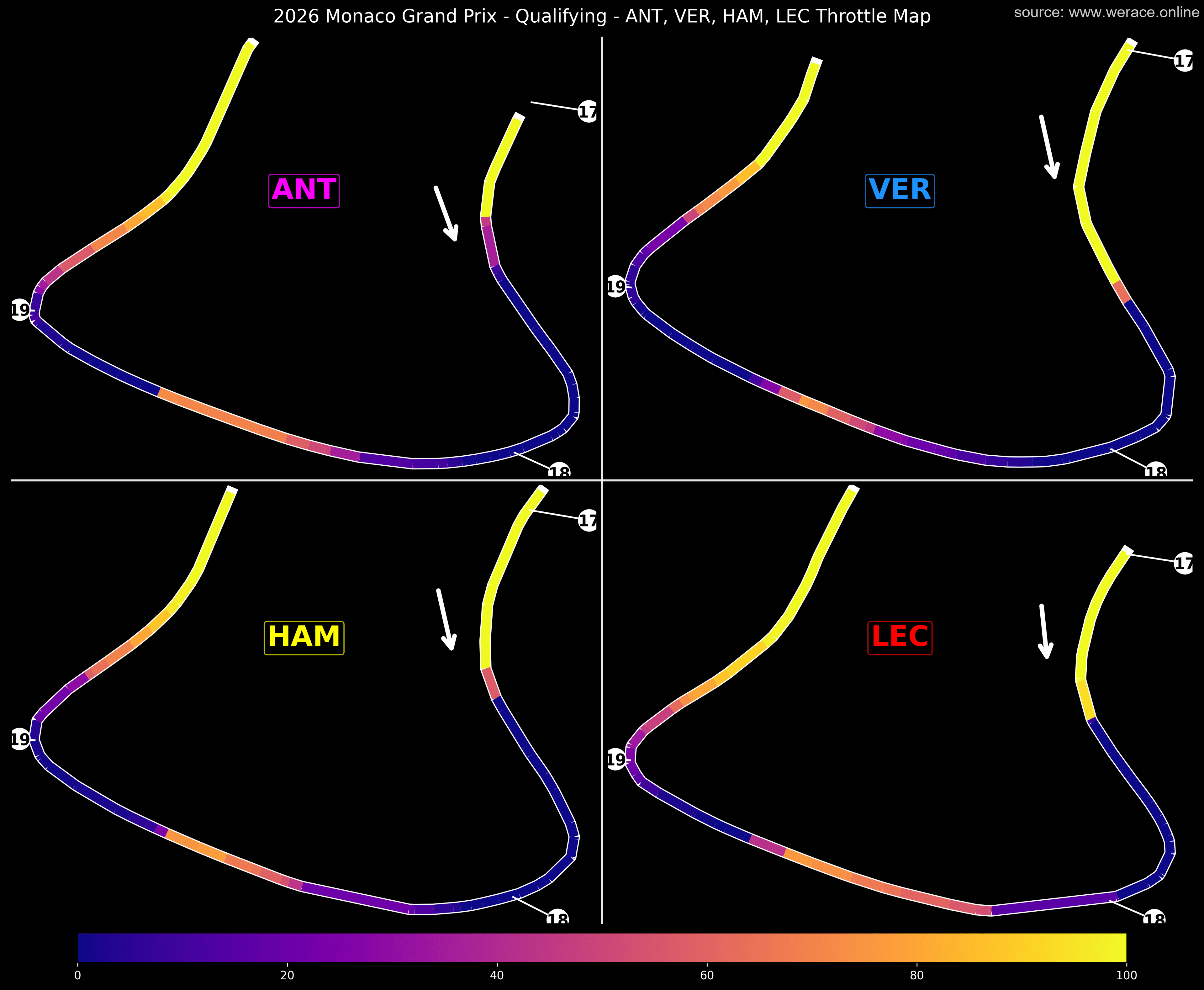
Leclerc was an absolute rocket ship through the final corner, maintaining a demonstrably higher throttle percentage out of Turn 19 to maximize his straight-line velocity.
7. Structural Progress: Mercedes' Setup Fix vs. The Development Gaps
The macro progress made by Mercedes from Friday to Saturday is an engineering masterclass. By softening the setup, they unlocked a beautifully compliant, reactive suspension platform that allowed Antonelli to confidently lean on the tyres and find ultimate traction.
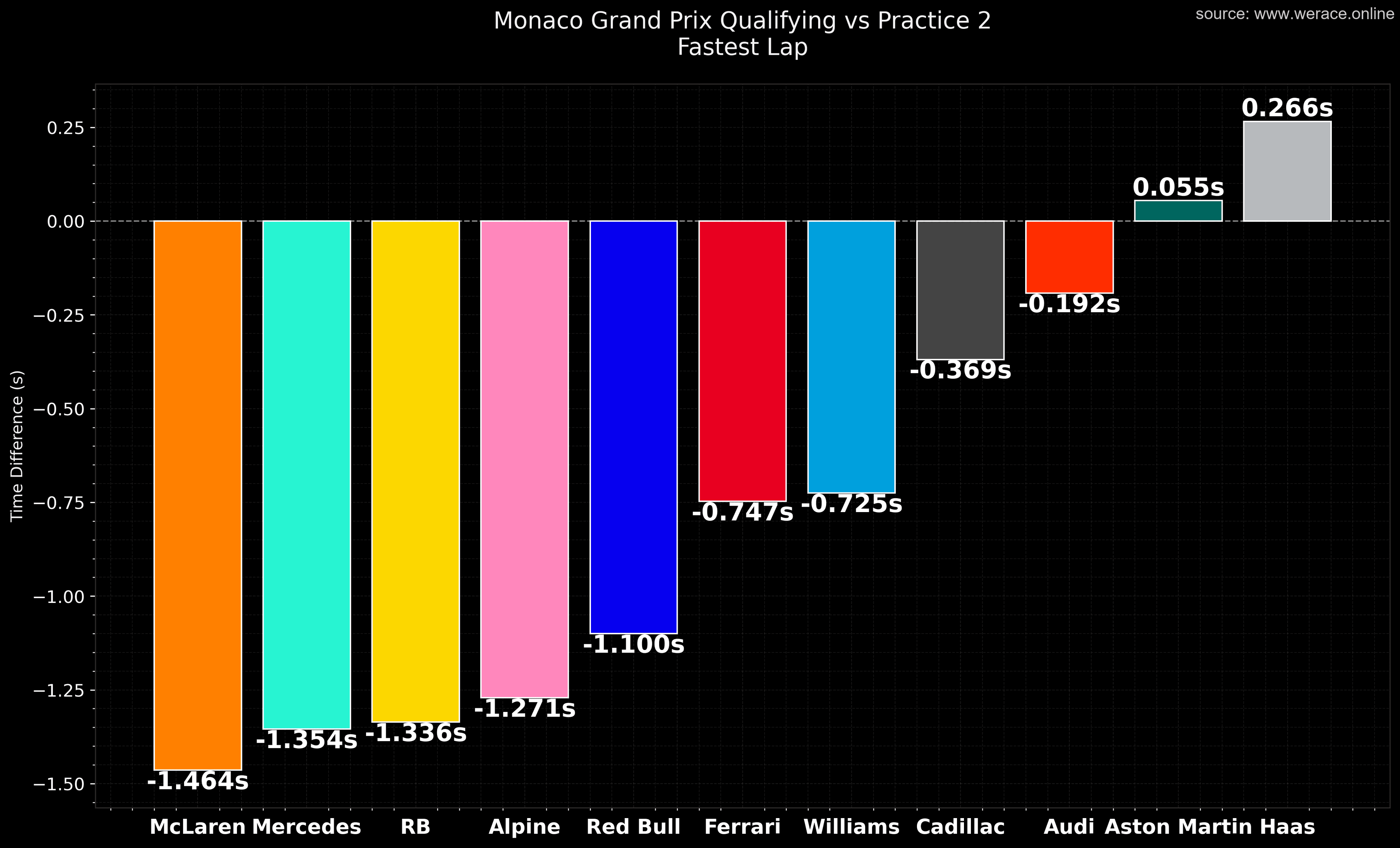
Mercedes unlocked a massive jump from their FP2 baseline, trailing only McLaren. However, when we view the macro development cycle against last year's regulations, the real architectural truth emerges:
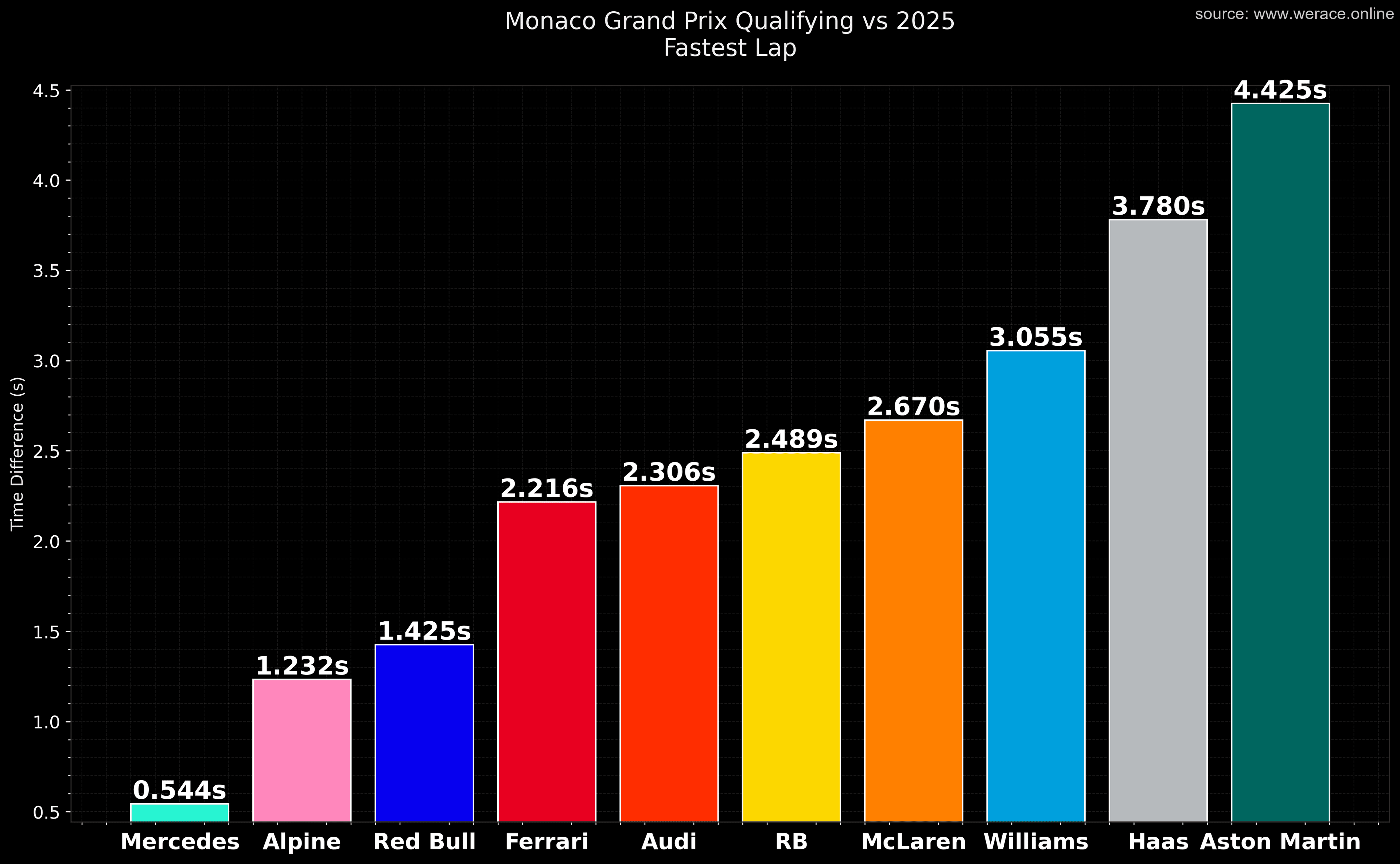
- Mercedes: the undisputed winter development winners.
- Ferrari: hemorrhaged a painful delta compared to last year.
- Aston Martin: collapsed into a developmental abyss.
For a team shouting about extreme, radical suspension concepts, Aston Martin's chassis compliance looked completely broken around the Principality, representing the gravest disappointment of the weekend.
8. The Ultimate 'What If': Leclerc's Fatal Touch
To close out this analysis, let’s address the agonizing climax of Q3. Charles Leclerc did not complete his final flyer due to a terminal brush with the barriers at the entry of the high-speed Tabac corner.
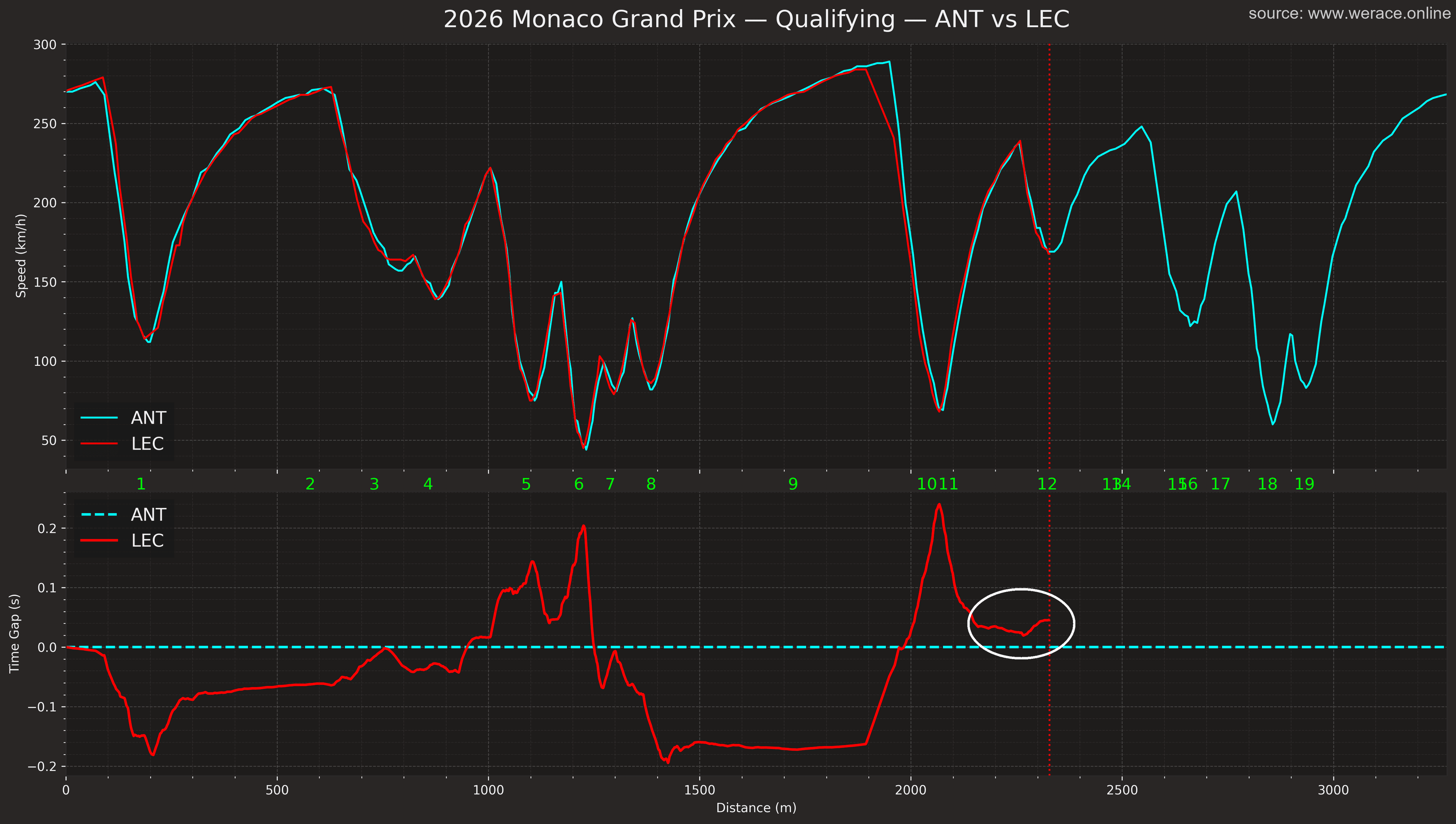
By reconstructing his high-frequency telemetry channels up to that exact apex impact, the data reveals a heartbreaking truth for Scuderia Ferrari. Entering Sector 2, Leclerc was under by nearly two tenths. He lost ground through the hairpin, but right as he exited the tunnel, he made a frantic push.
At the exact moment Leclerc clipped the inside wall at Turn 12, he was tracking a microscopic +0.048s behind Kimi Antonelli’s pole time. He was fully in the fight for the front row. But because the braking feel wasn't coming naturally to him, he was overdriving, forcing the car past its structural limit, which ultimately led to the terminal mistake.
Looking ahead to Sunday, a classic, high-tension Monaco chess match awaits. While a clean launch off the line usually guarantees victory around these walls, the immense championship pressure is mounting. Antonelli faces 78 grueling laps with a relentless Max Verstappen glued to his gearbox, waiting to pounce on the slightest rookie slip-up. Behind them, the Ferraris will need a strategy miracle to get back into victory contention.
Let me know your predictions in the comments below, enjoy the Grand Prix, and I will see you right here for the full race debrief.