
Mercedes Strike Early in Montreal: Has the W17 Found Its Perfect Track?
The first day in Canada delivered exactly what Formula 1 fans hoped for: a fast, technical circuit, changing conditions, and already a fascinating technical storyline developing around Mercedes.
And honestly, after Friday, it feels like the Silver Arrows may have arrived with something much bigger than a normal update package.
The W17 looked transformed.
Mercedes brought its first major upgrade package of the season and visually alone, the new floor immediately caught attention throughout the paddock. The area in front of the rear tyres is incredibly aggressive in how it manipulates airflow - twisting, curling, and redirecting vortices in ways we really haven't seen from them before this season. Even from static images, the amount of aerodynamic work involved looks substantial.
Alongside that came a revised front wing featuring flatter main elements and completely redesigned endplates, while changes were also made around the side profiles beneath the inlet areas.
The result? A car that suddenly looks much more complete.
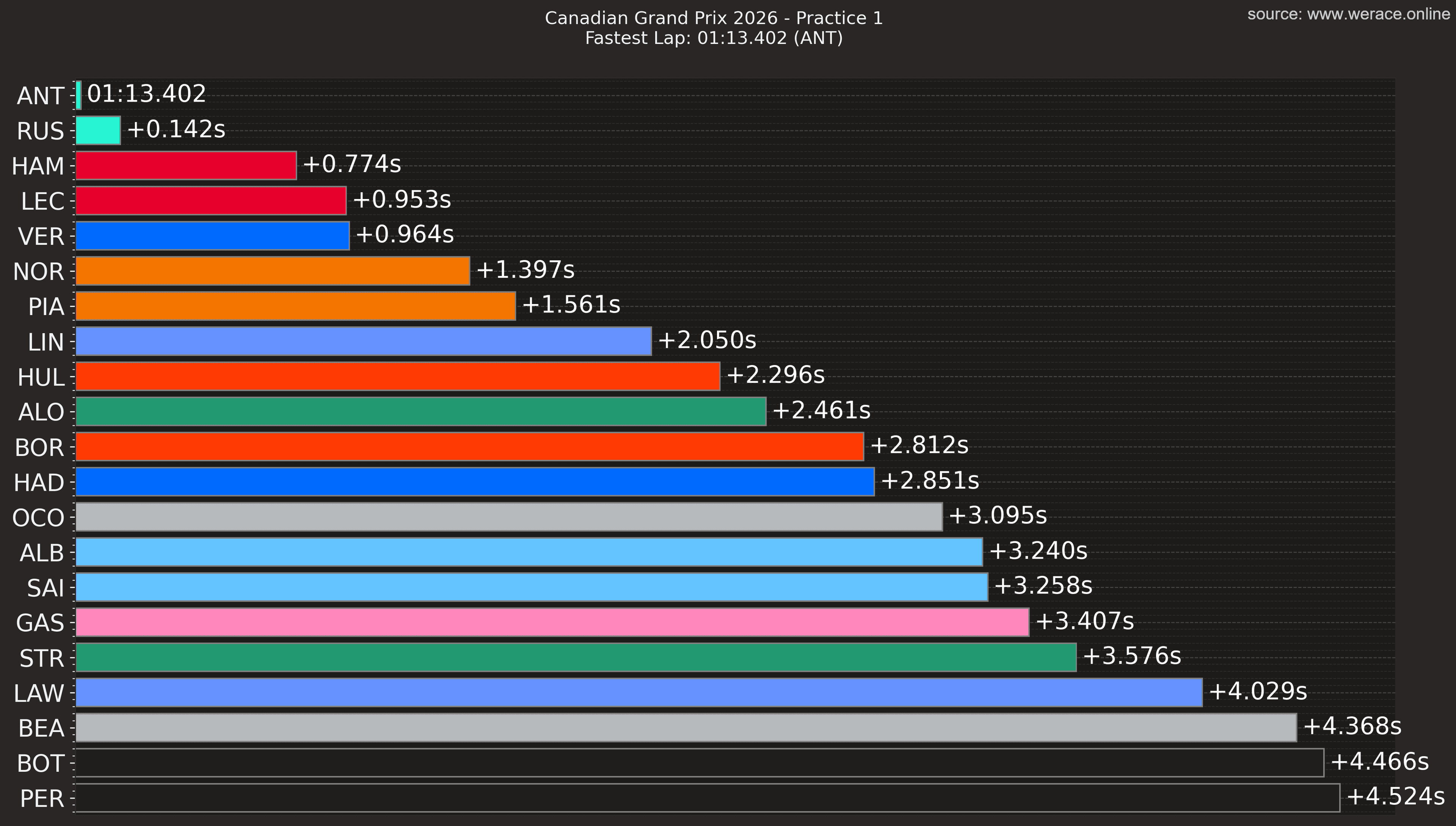
And in FP1, the numbers were honestly alarming for everyone else.
Mercedes Immediately Opened a Huge Gap
During the opening session, Mercedes appeared comfortably ahead of the field. The margin over Ferrari - their closest challenger at that stage - was reported at over half a second.
That is massive around a circuit like Montreal.
But the worrying part for rivals was not just the raw lap time. It was how the W17 was producing it.
Usually, teams trade something away:
high downforce but lower straight-line speed, or strong top speed with weaker grip in slow corners.
Mercedes somehow looked strong everywhere.
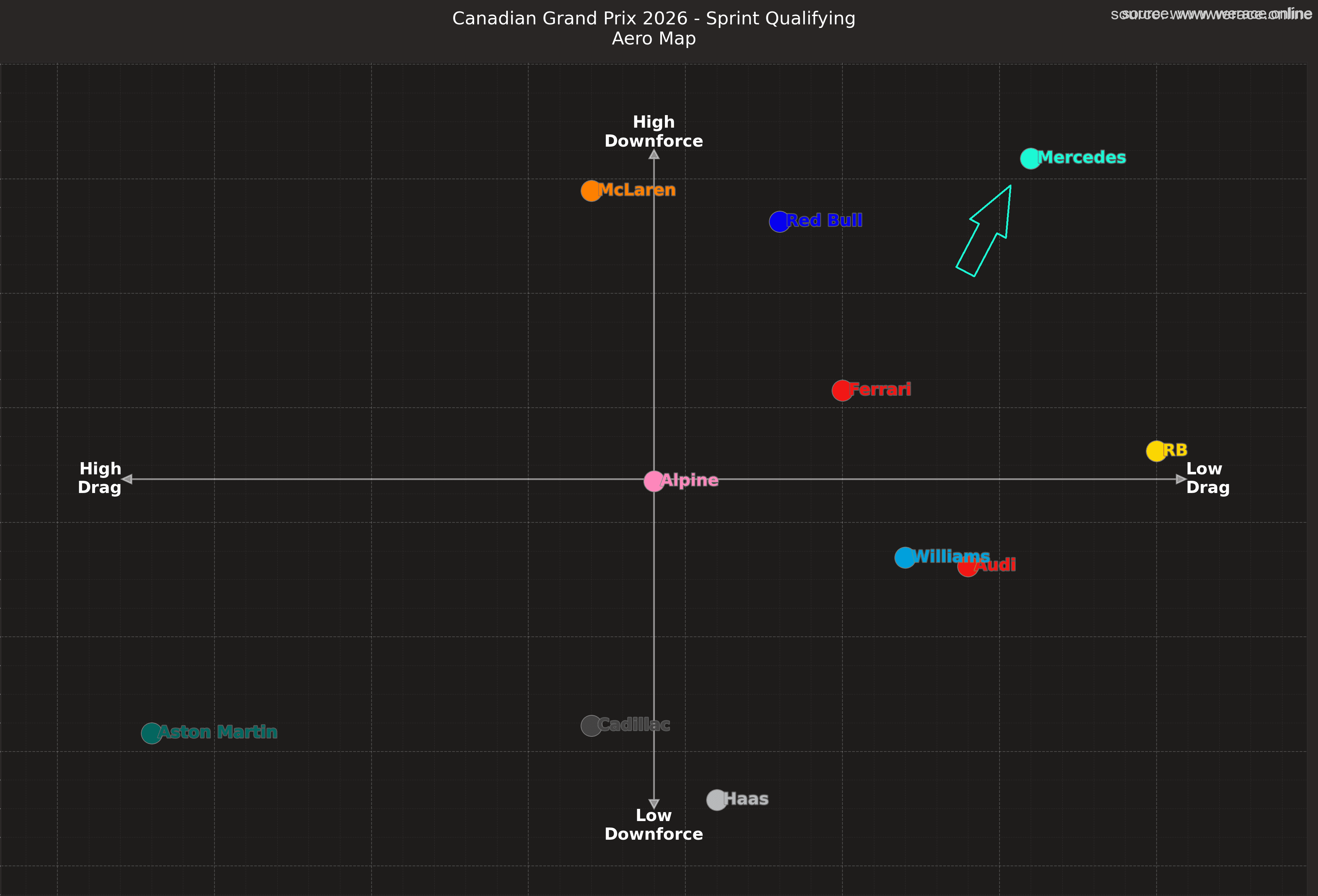
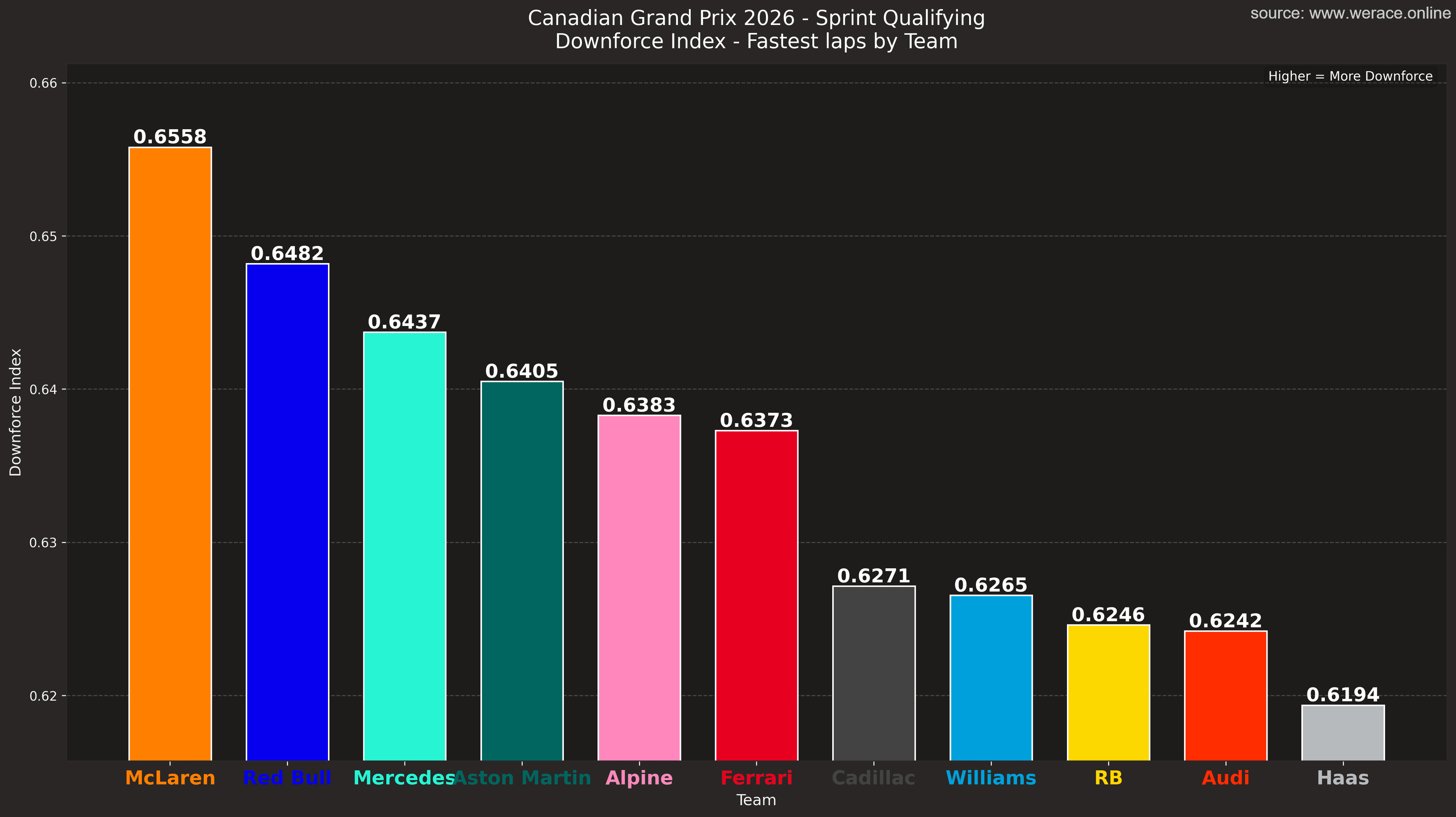
They already had excellent straight-line performance earlier this season, but now the car also appears to generate significantly more grip. Aerodynamically, the W17 currently sits almost perfectly inside the ideal performance window.
When looking at the downforce efficiency data, Mercedes are not just inside the good quadrant - they are sitting right in the sweet spot.
That is what makes this potentially dangerous for the rest of the field.
Russell vs Antonelli: The Internal Battle Is Already Fascinating
One of the most interesting stories of Friday was the contrast between the two Mercedes drivers.
In FP1, Kimi Antonelli genuinely looked sensational.
Mercedes were actually the only top team not properly focusing on race pace simulations during the session, but even within that context, Antonelli was comfortably outperforming George Russell over a single lap.
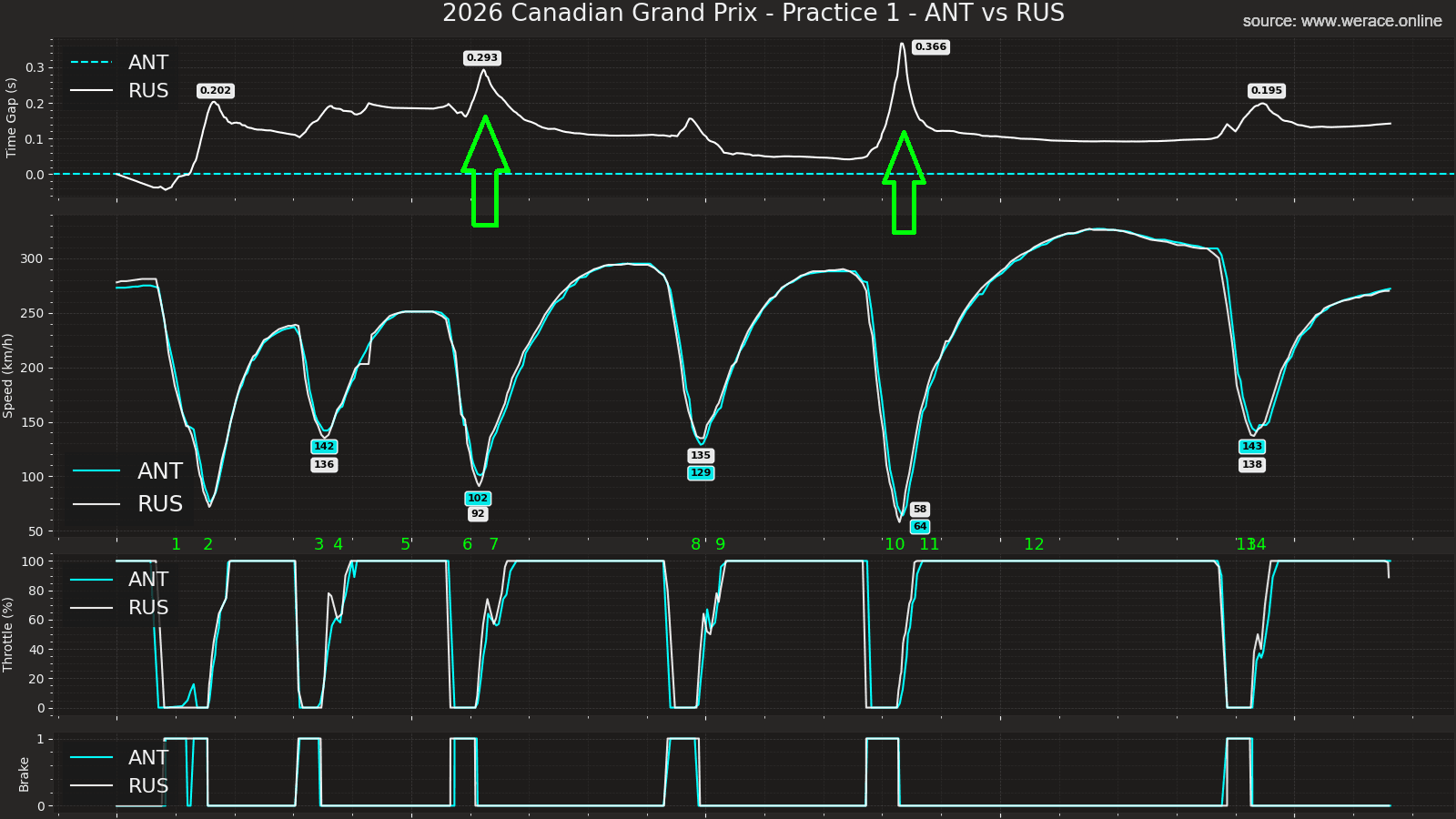
Looking at the telemetry:
Antonelli (green trace) was consistently stronger under braking, especially into slower corners, and Russell was losing significant entry speed almost everywhere.
At Turn 6 alone, Russell was down by nearly 10 km/h at apex speed. More importantly, he could not recover the loss on corner exit either.
At that point, it genuinely looked like Antonelli had the upper hand heading into Sprint Qualifying.
Then everything flipped.
In SQ, Russell suddenly reversed the situation completely.
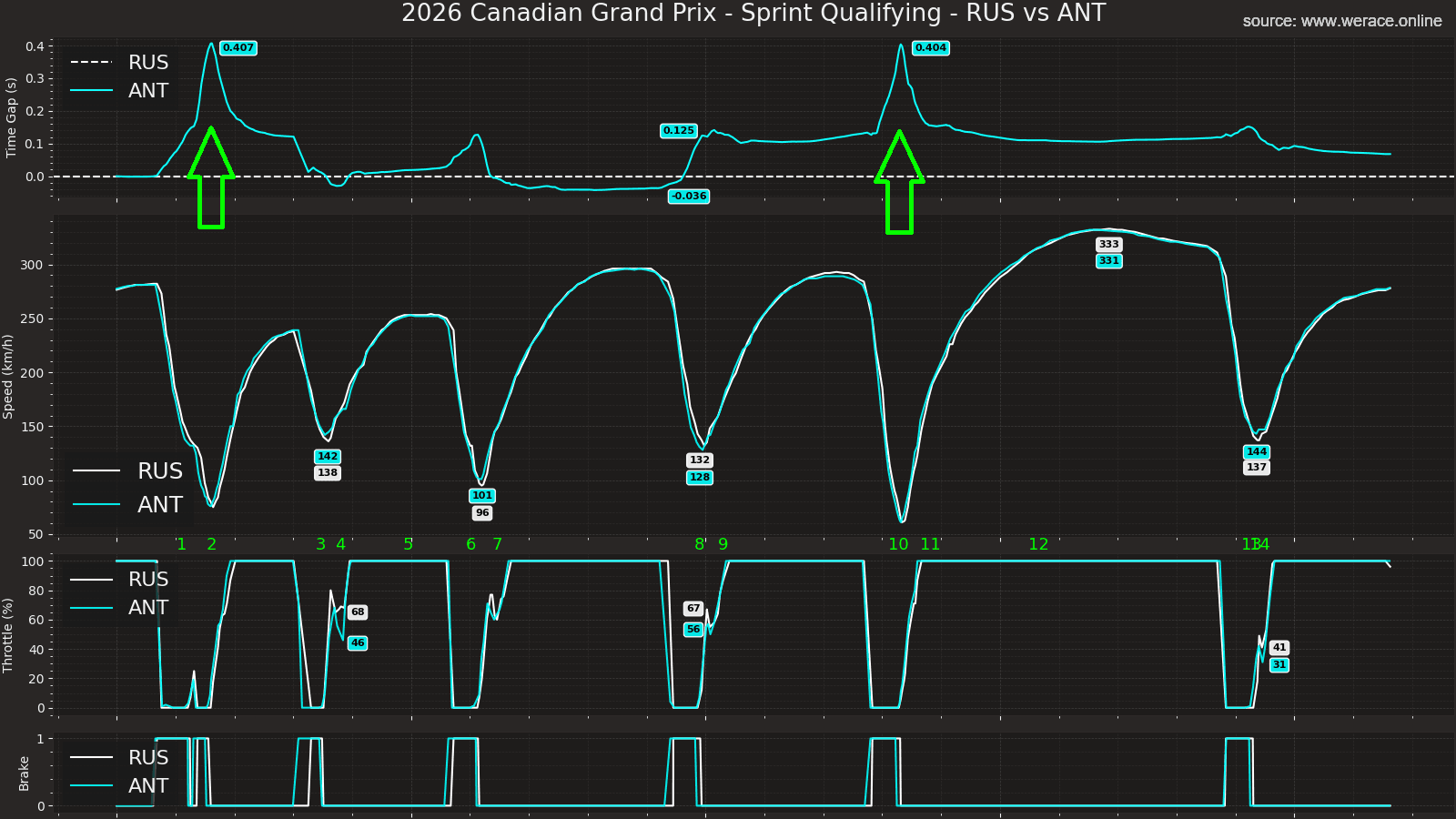
This time it was Antonelli losing massive chunks of time in the slowest corners on the circuit - particularly Turn 1 and the Turn 10 hairpin.
The losses do not look dramatic visually on the telemetry traces, but they add up to over four tenths combined through just those two corners.
That alone likely cost him a realistic shot at Sprint Pole.
So now the real question becomes:
was FP1 the true picture, or did Russell simply unlock the car better once conditions evolved?
Saturday qualifying should answer that.
Sprint Qualifying: The Field Compressed... But Mercedes Stayed Ahead
Compared to FP1, the gaps in Sprint Qualifying came down significantly.
Mercedes no longer had over half a second in hand - the advantage was roughly cut in half - but three tenths around Montreal is still a serious margin.
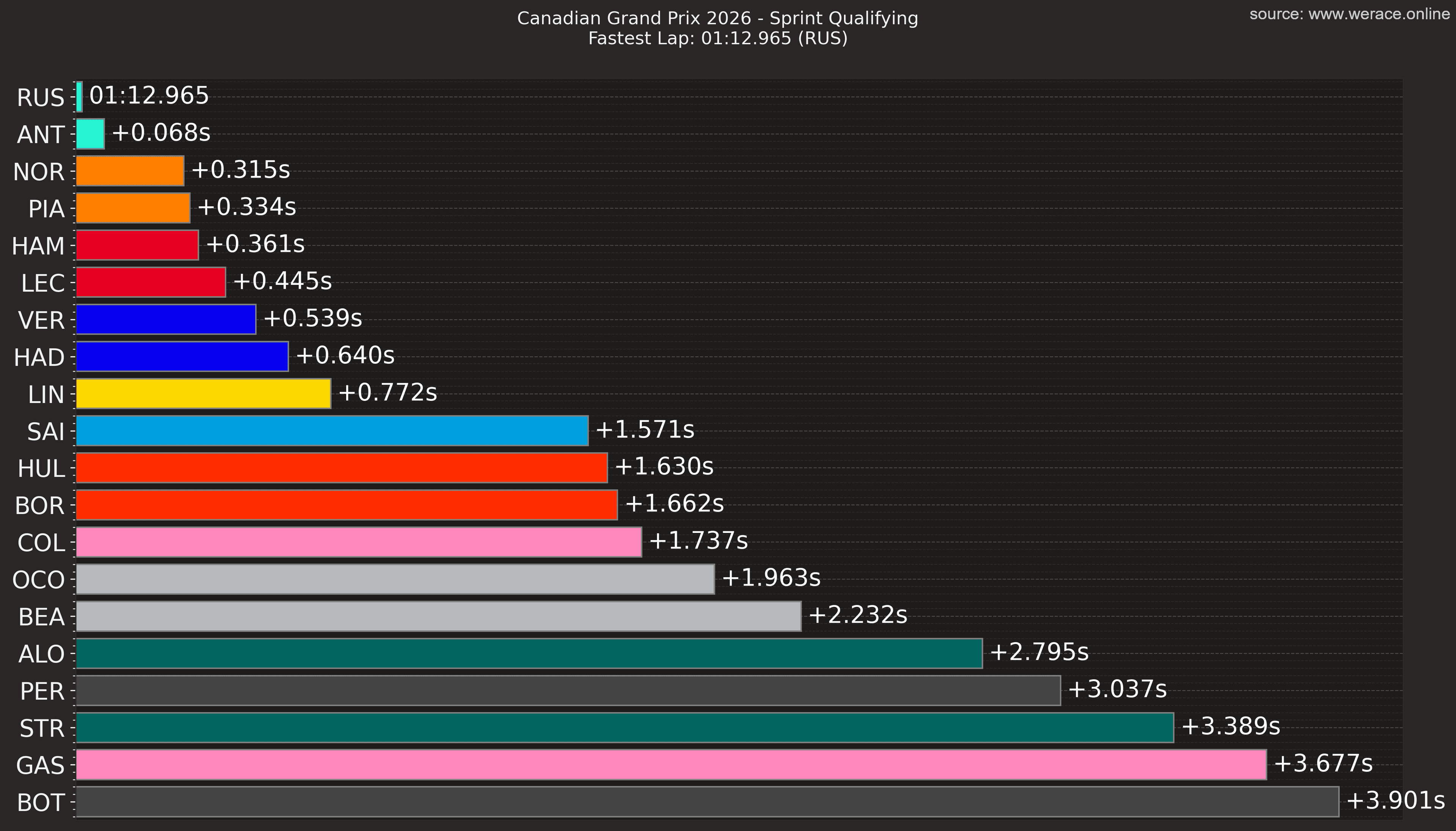
And what is particularly interesting is how the field grouped itself almost perfectly into pairs:
Mercedes McLaren Ferrari Red Bull
The order itself was not shocking.
The gaps, however, were.
Ferrari's Strange Double Personality Returns Again
Ferrari once again showed the same trend we have seen repeatedly in Sprint Qualifying formats.
As long as the sessions are run on medium tyres - particularly Q1 and Q2 - the SF-26 looks genuinely competitive.
Lewis Hamilton especially looked extremely comfortable.
But the moment the switch to soft tyres happens in Q3, Ferrari seem unable to unlock the same step in performance as their rivals.
And at this point, it is becoming a pattern rather than an isolated issue.
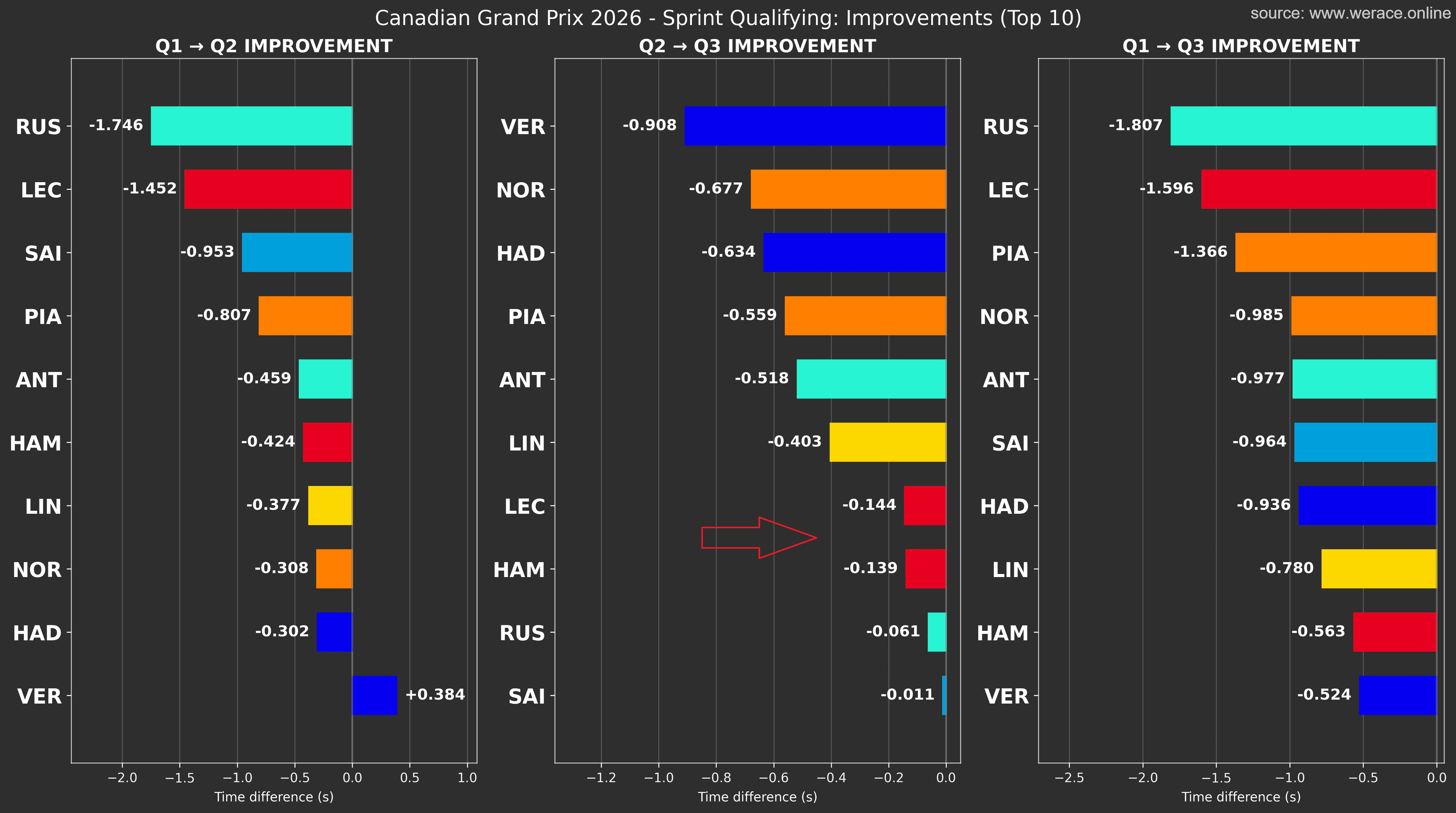
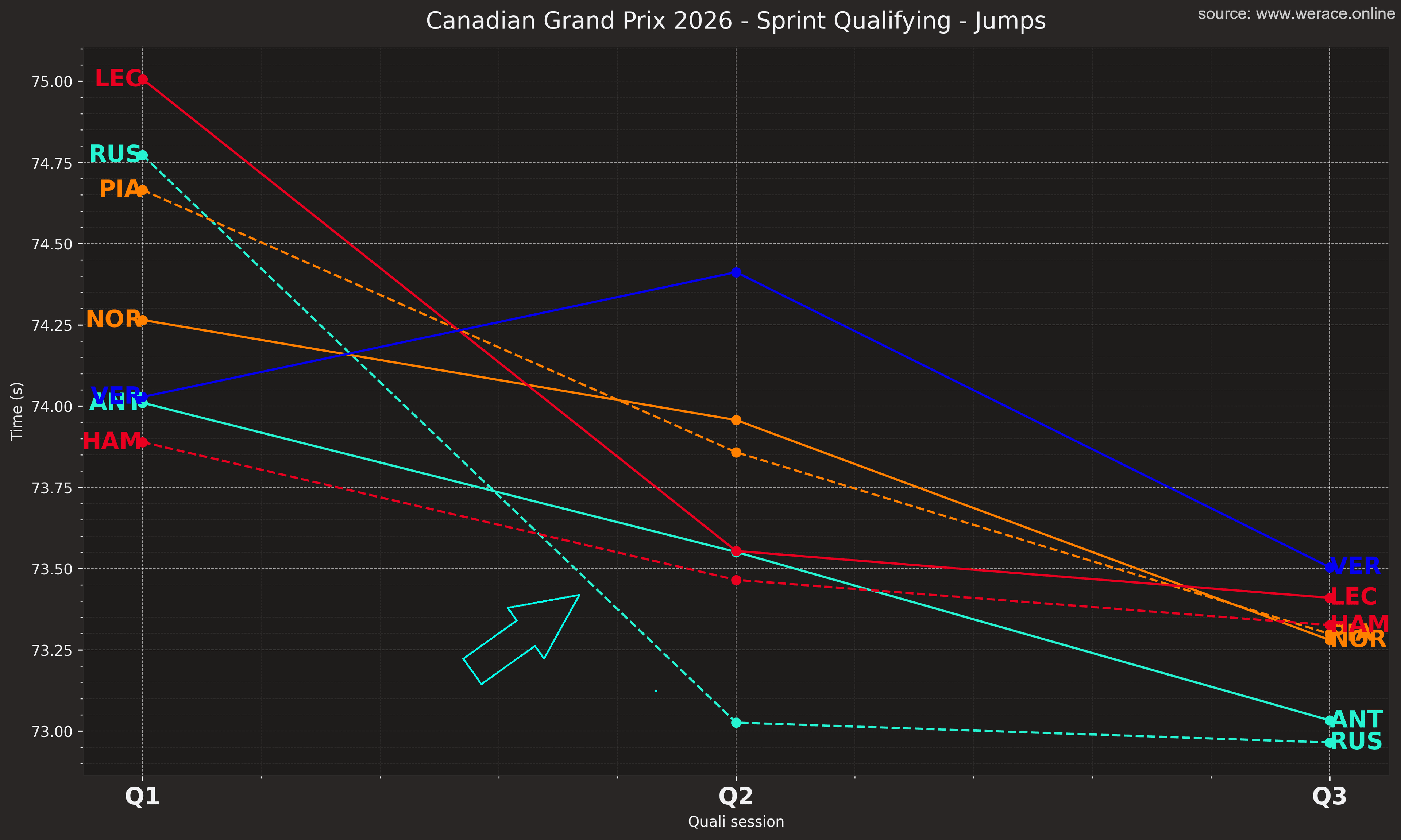
When comparing improvement rates between Q2 and Q3:
both Ferraris were among the drivers improving the least, only Russell improved less - but that is largely because he already found enormous time between Q1 and Q2.
That graph is honestly fascinating because it highlights how Ferrari repeatedly fail to maximize the tyre transition when grip peaks.
Still, there are positives.
Ferrari May Be Closer Than The Headlines Suggest
One of the most encouraging signs for Ferrari is actually the year-on-year comparison.
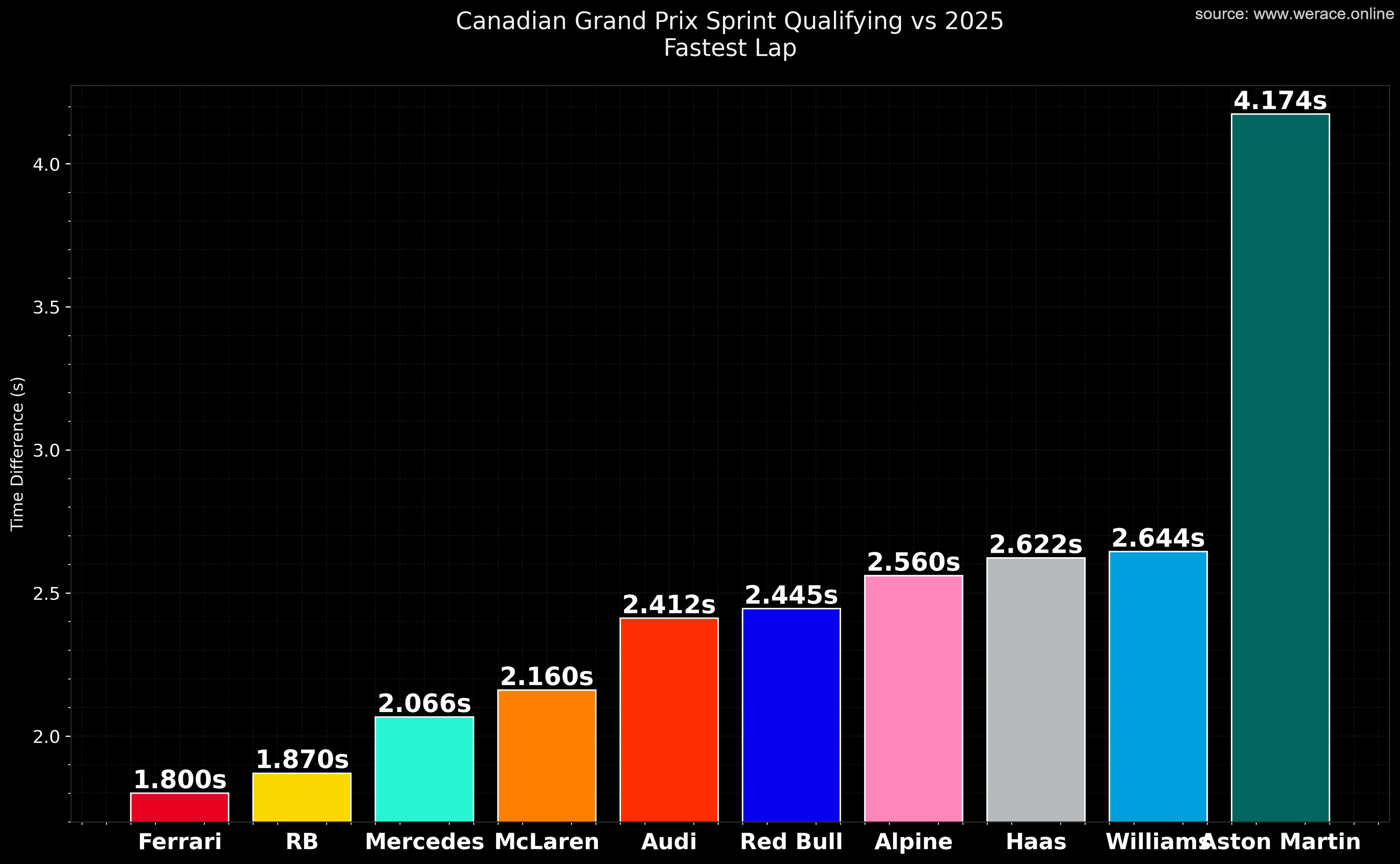
Compared to last year’s qualifying pace:
Ferrari lost significantly less time than both Mercedes and McLaren, while those two teams improved by over two seconds.
So although Ferrari do not currently have the outright pace to challenge Mercedes, the relative trajectory of the car at Montreal is actually more encouraging than the raw classification suggests.
And then there is Hamilton.
Hamilton and Montreal Still Feel Like a Natural Combination
Lewis openly admitted during media duties that he intentionally avoided using the simulator before arriving in Canada.
And somehow... it almost looked beneficial.
His confidence through Sector 1 was incredible all day.
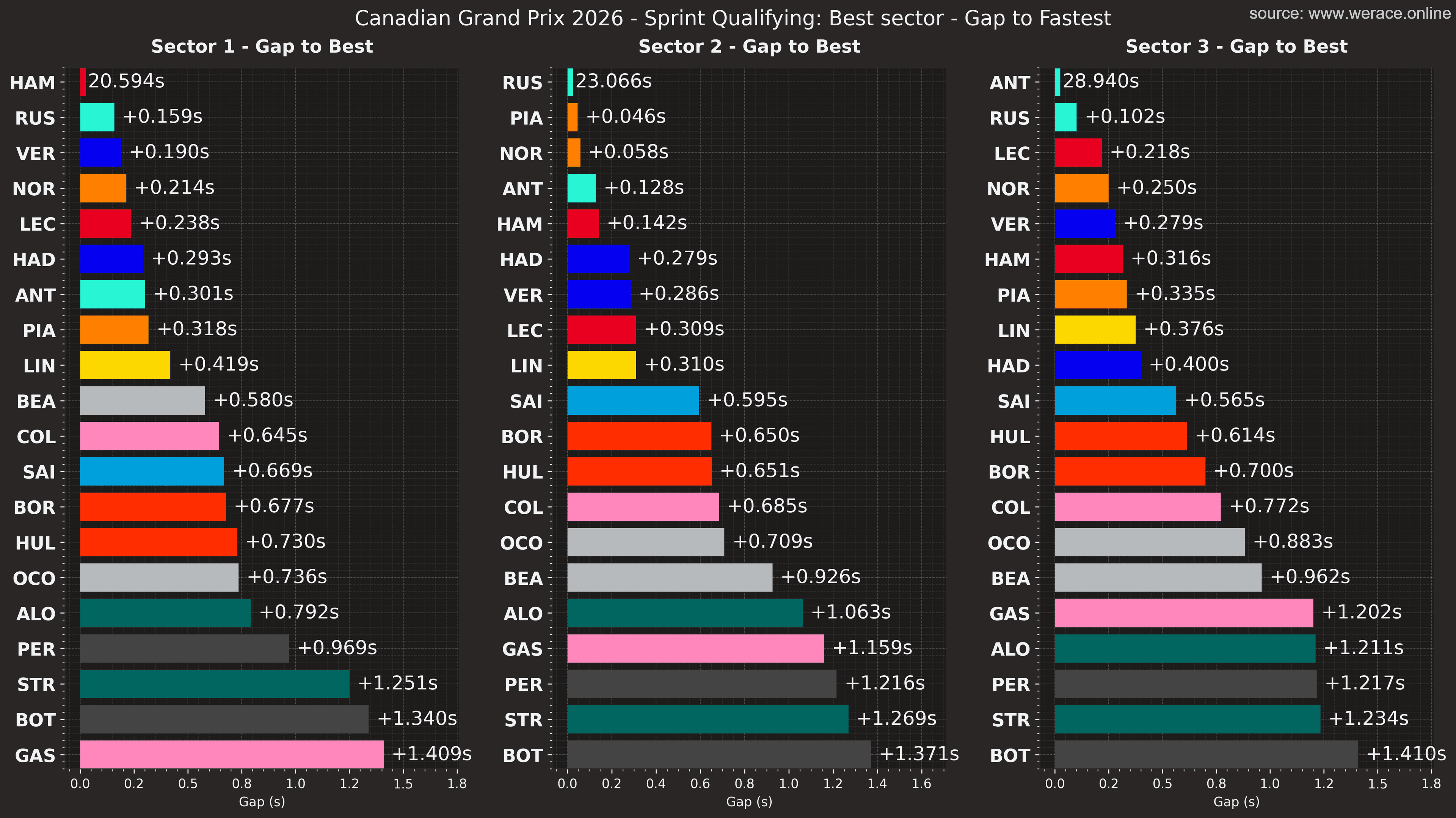
In several corners, Hamilton was gaining at least one and a half tenths over almost everybody else through the opening sector alone.
That first sector commitment - especially over the kerbs and through the quick direction changes - looked vintage Hamilton.
He also was not far away from Antonelli in Sector 2 either.
The frustrating part for Ferrari is that the final result massively underrepresents the lap potential.
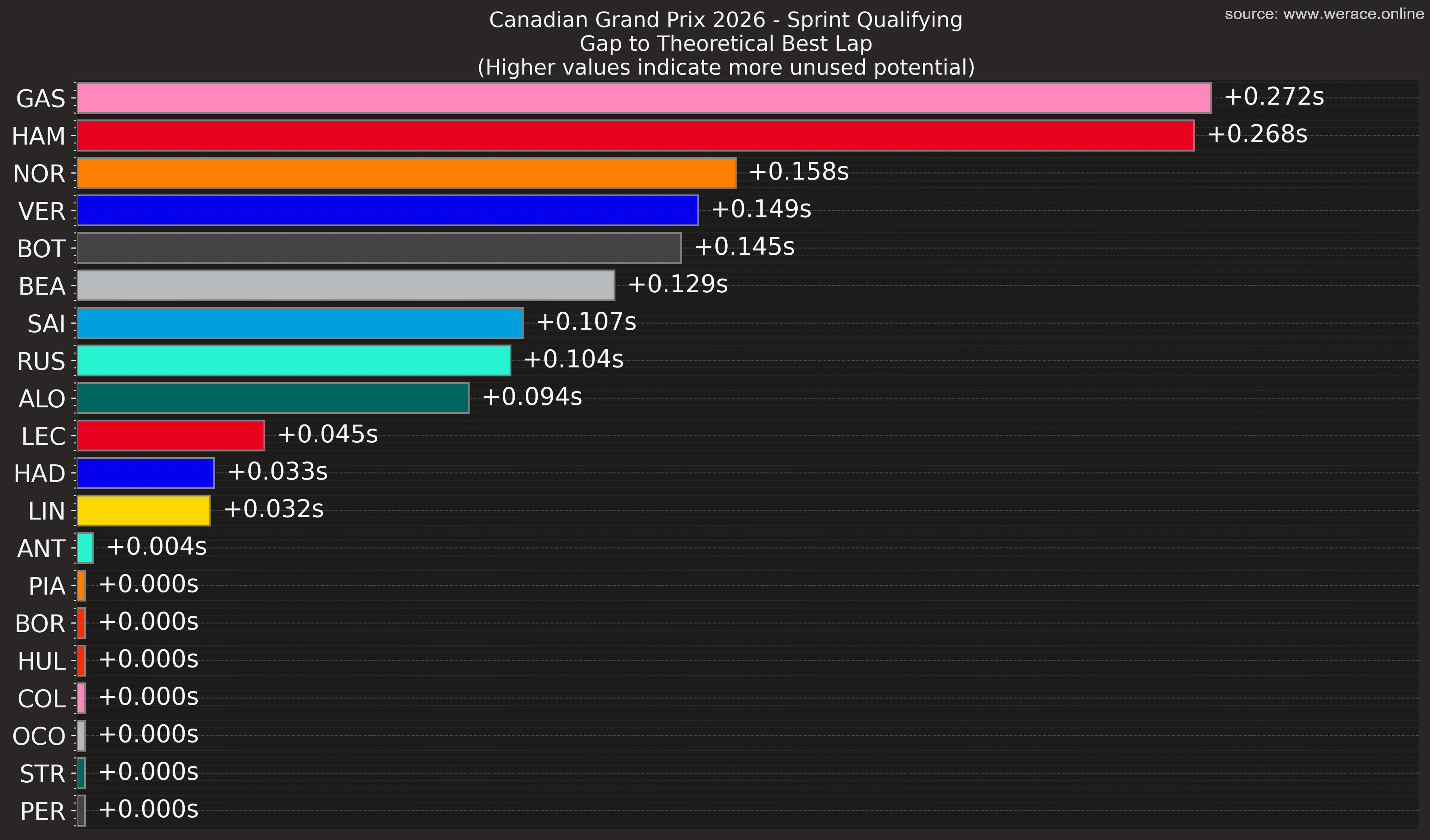
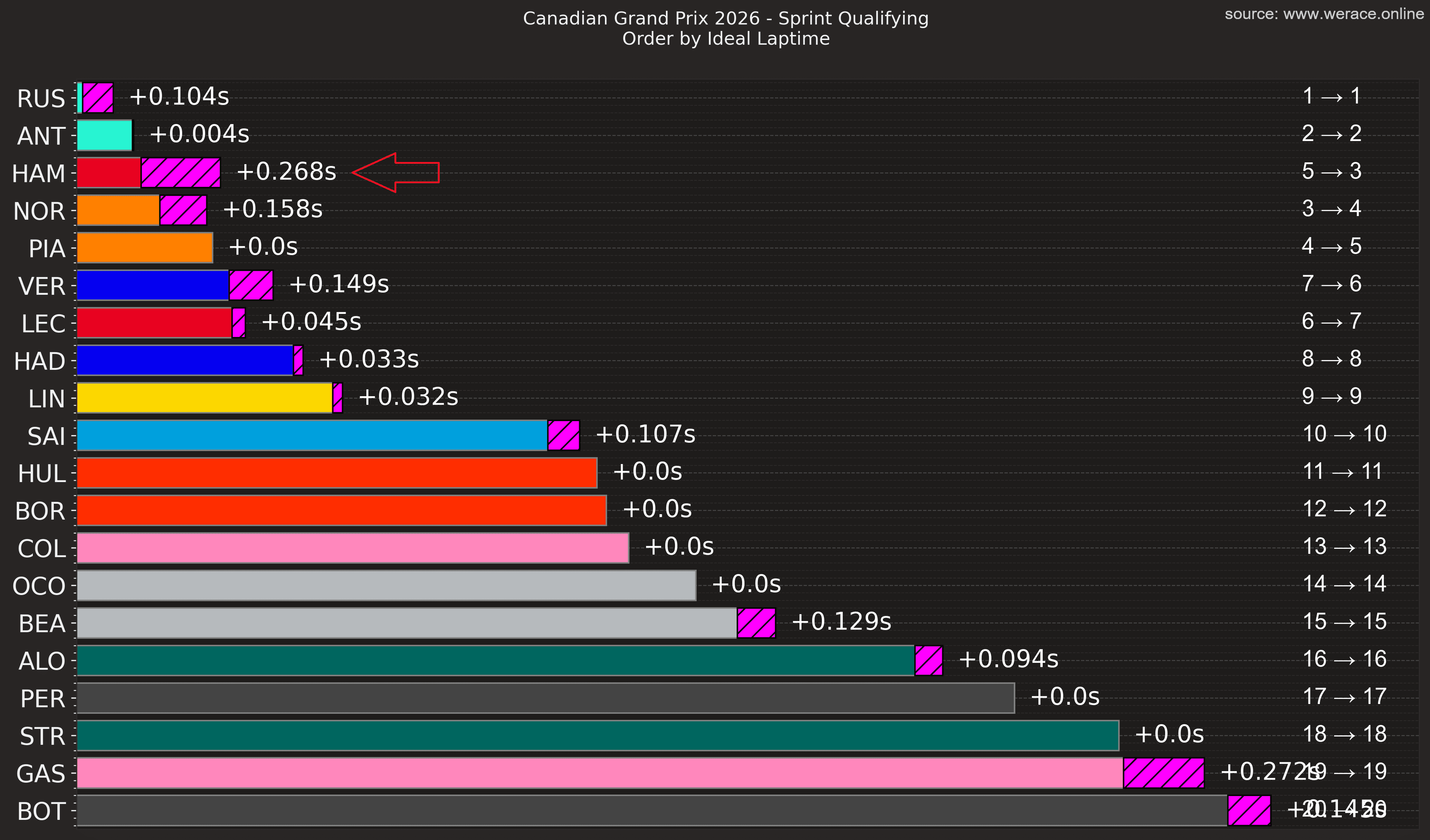
Hamilton left over two tenths on the table compared to his theoretical best lap.
And when the ideal laps are reordered, he potentially jumps into P3 - right behind the Mercedes pair.
So the speed is there.
Ferrari simply are not extracting it consistently when the soft tyre arrives.
Norris and Verstappen Also Left Something Behind
Both Norris and Verstappen looked capable of more than the final result suggested.
For Verstappen, the issue appears familiar: the rear instability is still there.
Montreal’s layout - dominated by slow corners and traction zones - does not naturally suit the current Red Bull package, and Max spent much of the session complaining over team radio about a nervous rear end.
McLaren also looked slightly further back than expected.
Considering the circuit characteristics, though, maybe that is not surprising.
Montreal minimizes:
tyre degradation, overheating, long loaded corners.
And those are exactly the areas where McLaren’s strengths usually shine.
Interestingly, McLaren also tested a new front wing in FP1 before quickly abandoning it later in the day after it failed to produce the expected gains.
That is definitely not the ideal start to the weekend.
The Clipping Story Is Extremely Interesting This Weekend
One of the more technical but important trends from Friday was the reduced clipping effect.
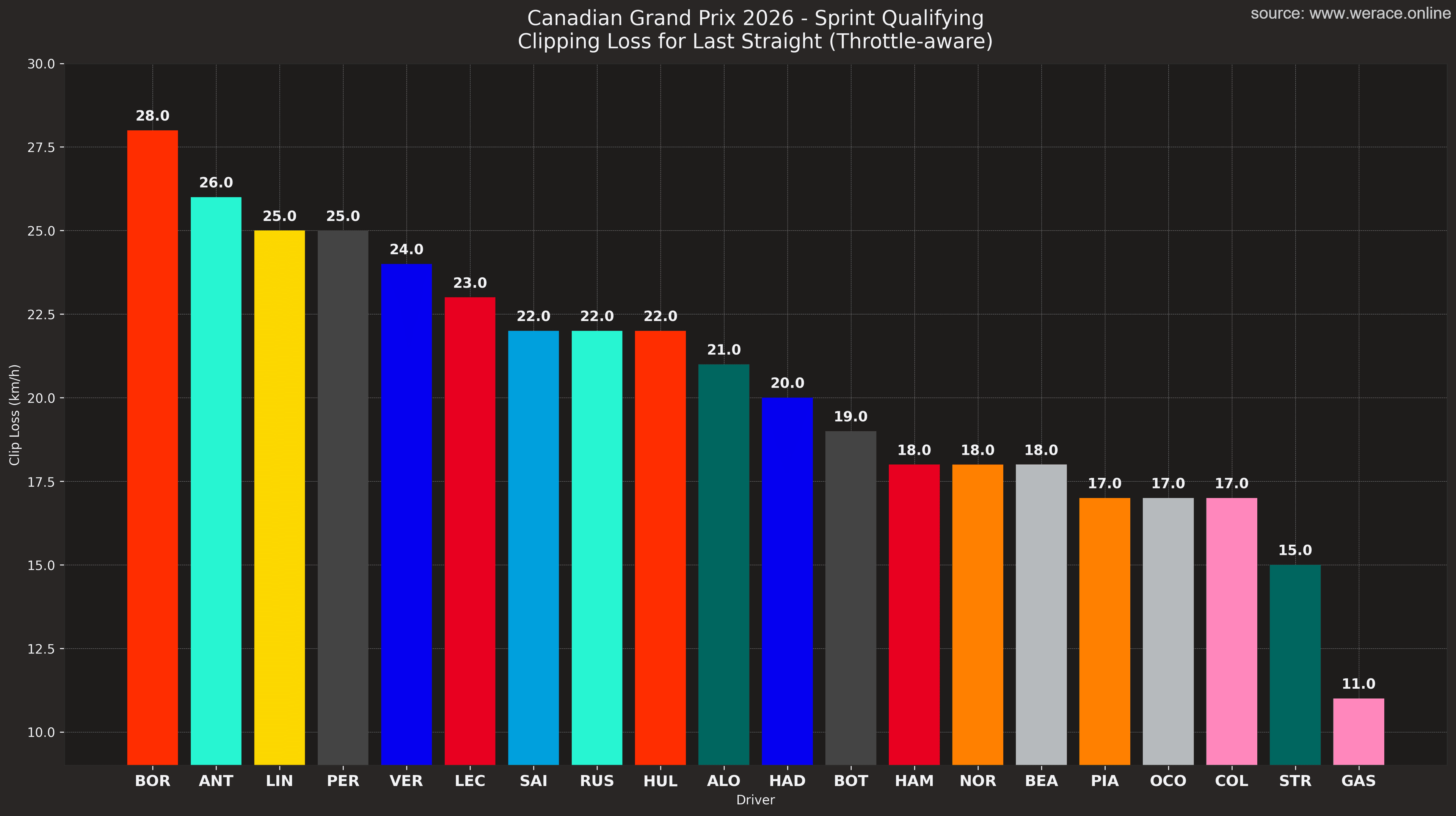
Because of the lower energy deployment demands around Montreal, the speed losses from harvesting are much smaller than in previous weekends.
From the calculations:
maximum clipping losses were around 27-28 km/h, compared to 40-60 km/h at other circuits this season.
Mercedes once again led the field here, with Antonelli showing the strongest recovery profile at roughly 26 km/h.
What is particularly interesting is how similar all four top teams look through the early acceleration zones.
But after Turn 7, the profiles start separating clearly.
Hamilton’s Ferrari, for example:
progressively loses more top speed mid-straight, with the gap increasing over distance.
Red Bull behaves differently:
it struggles to sustain velocity in the final metres before braking, effectively cutting the straight early, but then regains stronger deployment toward the end of the lap.
Mercedes, meanwhile, consistently maintains the highest and most stable top speed profile of the group.
And honestly, that is probably the biggest warning sign for everybody else.
Mercedes May Have Found Their Perfect Scenario
Montreal was already expected to suit Mercedes reasonably well:
heavy braking, aggressive traction zones, lower tyre overheating, repeated stop-and-go sections.
Those characteristics naturally fit the W17.
Now add a major aerodynamic upgrade package that appears to work immediately, and suddenly Mercedes look capable of recreating the dominance they briefly showed at the beginning of the season.
But there are still two huge unknowns heading into the rest of the weekend:
the internal Russell vs Antonelli fight, and the weather.
Because if conditions keep changing, the margins we saw on Friday could shift very quickly.
Still, after day one in Canada, one thing is clear:
Mercedes are not just fast.
Right now, they look comfortable.