
Singapore Sprint: Verstappen Controls, Hamilton Shines from the Start, Leclerc Cooks His Tyres and McLaren Spin Twice
The sprint is over. Rain falling about five minutes before the start made things a little livelier than expected, but it was a light shower: only two laps were lost, and the race got under way shortly afterwards. It was a short race with a lot to unpack, starting with the first few hundred metres.
1. Hamilton's Launch
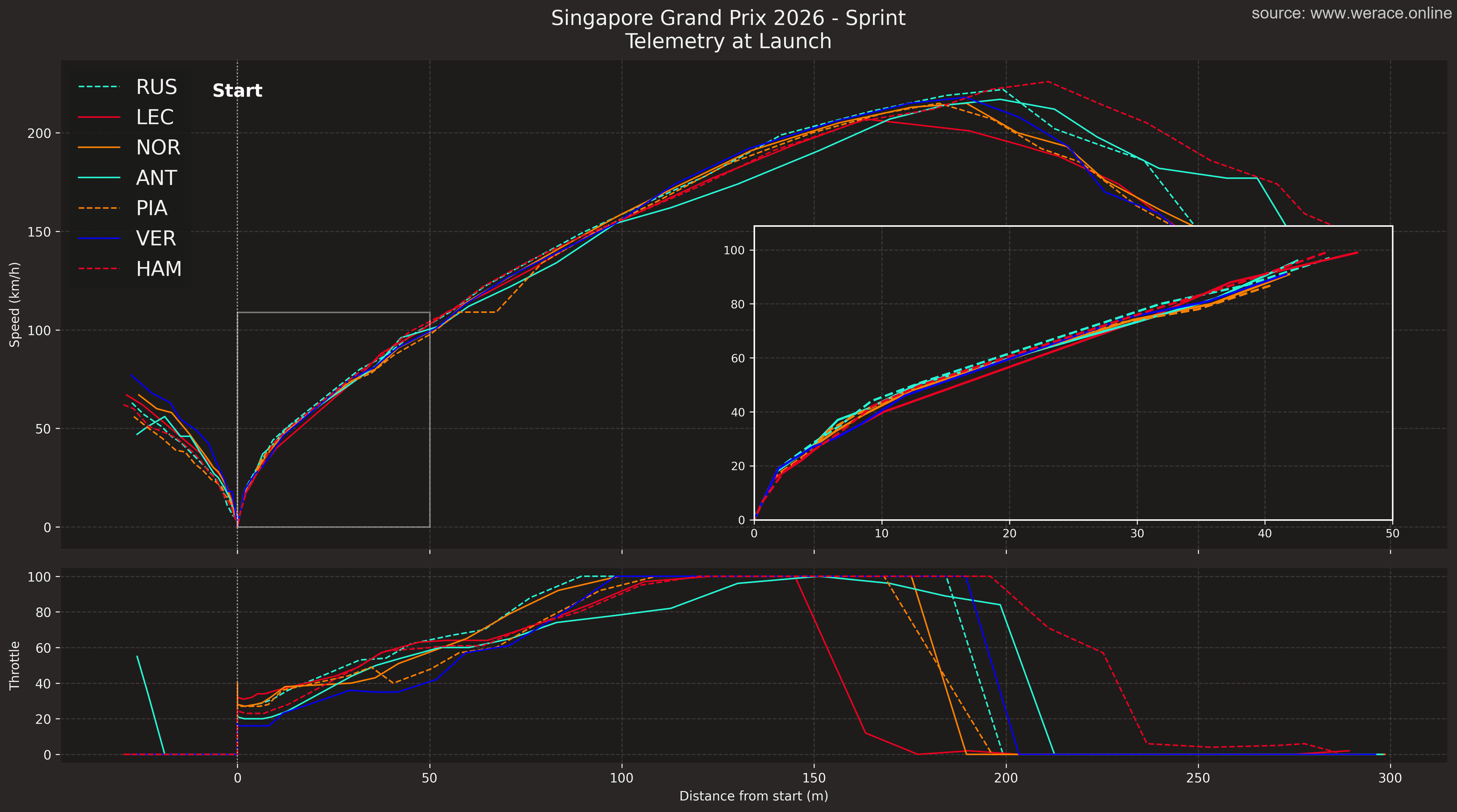
Hamilton's start was excellent, and the telemetry shows why. The dashed red trace is not the quickest in the opening metres, where the inset shows it slightly behind the Mercedes of Russell, but it keeps accelerating for longer: it reaches around 226 km/h, the highest of anyone, and brakes for Turn 1 clearly later than the rest of the field, with the throttle released at roughly 230 m from the start against 150-200 m for the others. The result is that Hamilton arrives at the first corner with more speed than any of his rivals, which is how he made up the places.
The same chart shows a few other things. Antonelli's launch was noticeably weaker, with the throttle held at around 75-80% between 80 and 130 m and speed below everyone else's over that stretch, which fits a driver managing traction on a damp track. Leclerc, meanwhile, gets off the line slightly slower than the others and is the first to lift for the braking zone, at around 150 m.
2. Russell's Mistake
Russell's race ended at the final corner: at over 200 km/h he lost the rear and went into the barrier. He was fortunate in one respect, as the impact was towards the inside of the start grid and not particularly violent. It is a rather serious mistake for a driver of his experience, although the lack of experience of these cars in the wet softens the judgement somewhat. We also suspect the electrical deployment may have been a little too aggressive for the moment, delivering more torque than the grip allowed. That said, he was the only driver to make a mistake in those circumstances, so it is difficult to conclude that there is a systemic problem.
3. Verstappen in Control, Hamilton the Only Threat
With Russell out, the door to victory opened for Verstappen, and he went through it.
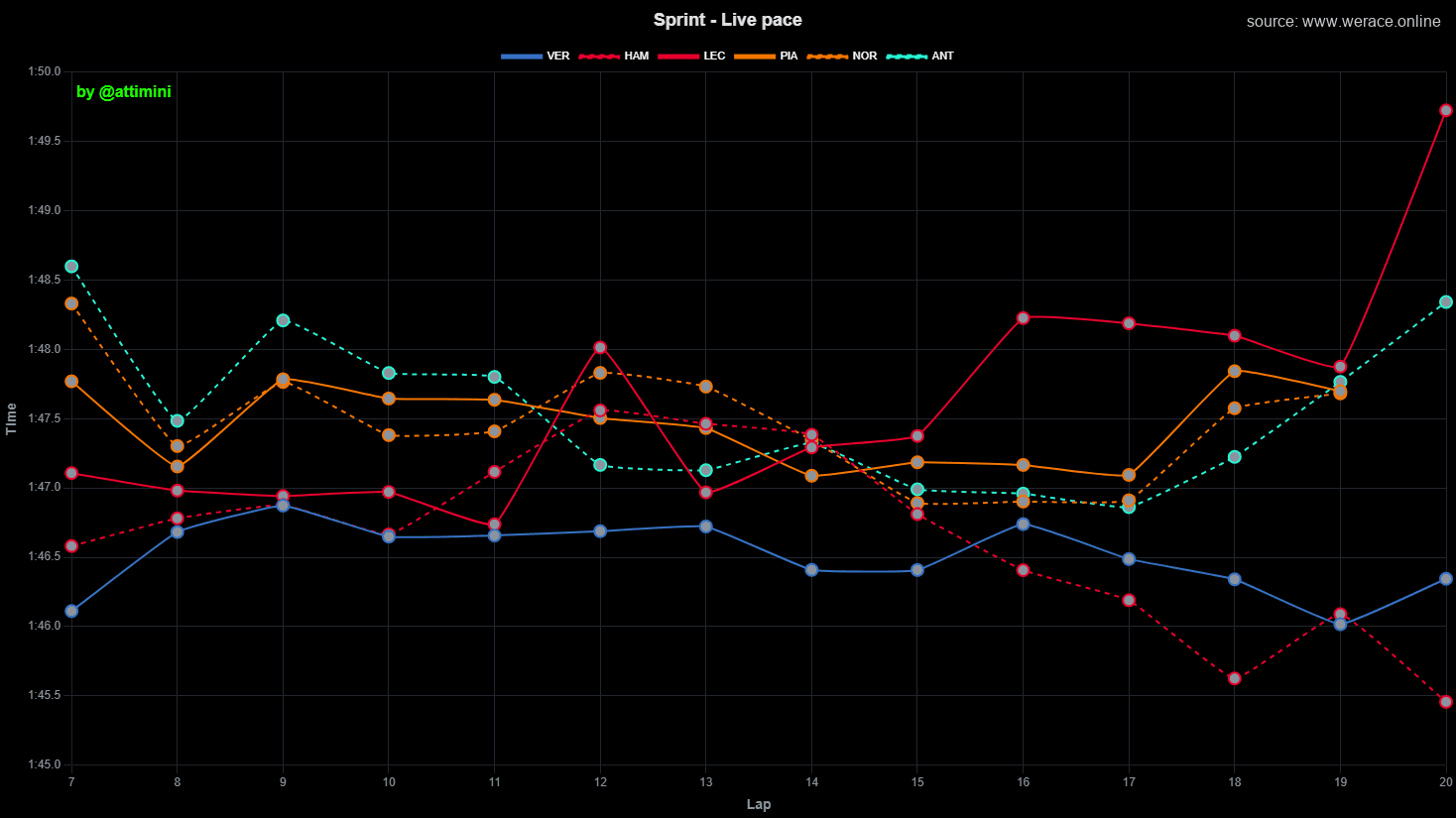
The pace chart shows Verstappen as the quickest or very close to it across almost the whole race, with lap times between 1:46.0 and 1:46.9 and remarkably little variation. The only driver who could challenge him was Hamilton, who ran a very well-judged race: a strong start, as discussed above, and then excellent tyre management, keeping the rubber in its window without overheating or overusing it. In the final laps his pace is clearly better than Verstappen's, with 1:45.626 on lap 18 and 1:45.452 on the last lap, against 1:46.3 for the Red Bull.
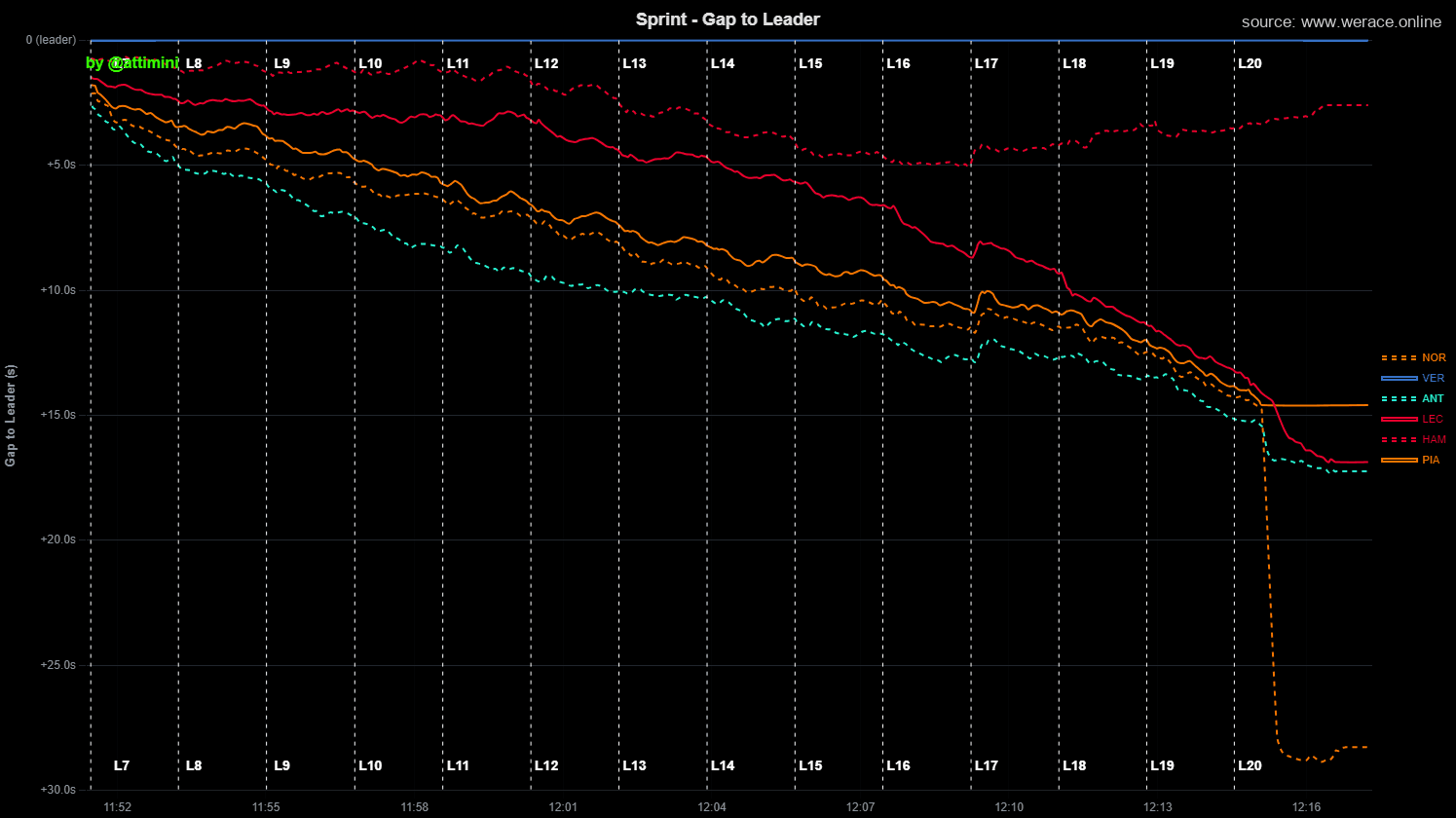
That recovery came too late, however. Hamilton's gap to Verstappen grew to roughly 5s by lap 16 and, although it shrank to under 3s by the flag, Verstappen was never in real danger and was able to manage the finish comfortably.
4. Leclerc: Good Pace, Bad Tyre Management
Leclerc's race went the opposite way. The first laps looked promising, with a pace of around 1:46.7-1:47.1 that was close to Verstappen's, and a single slow lap on lap 12 was quickly recovered. But from lap 16 onwards his times drop to around 1:48.1-1:48.2, roughly 1.2s per lap slower than a few laps earlier.
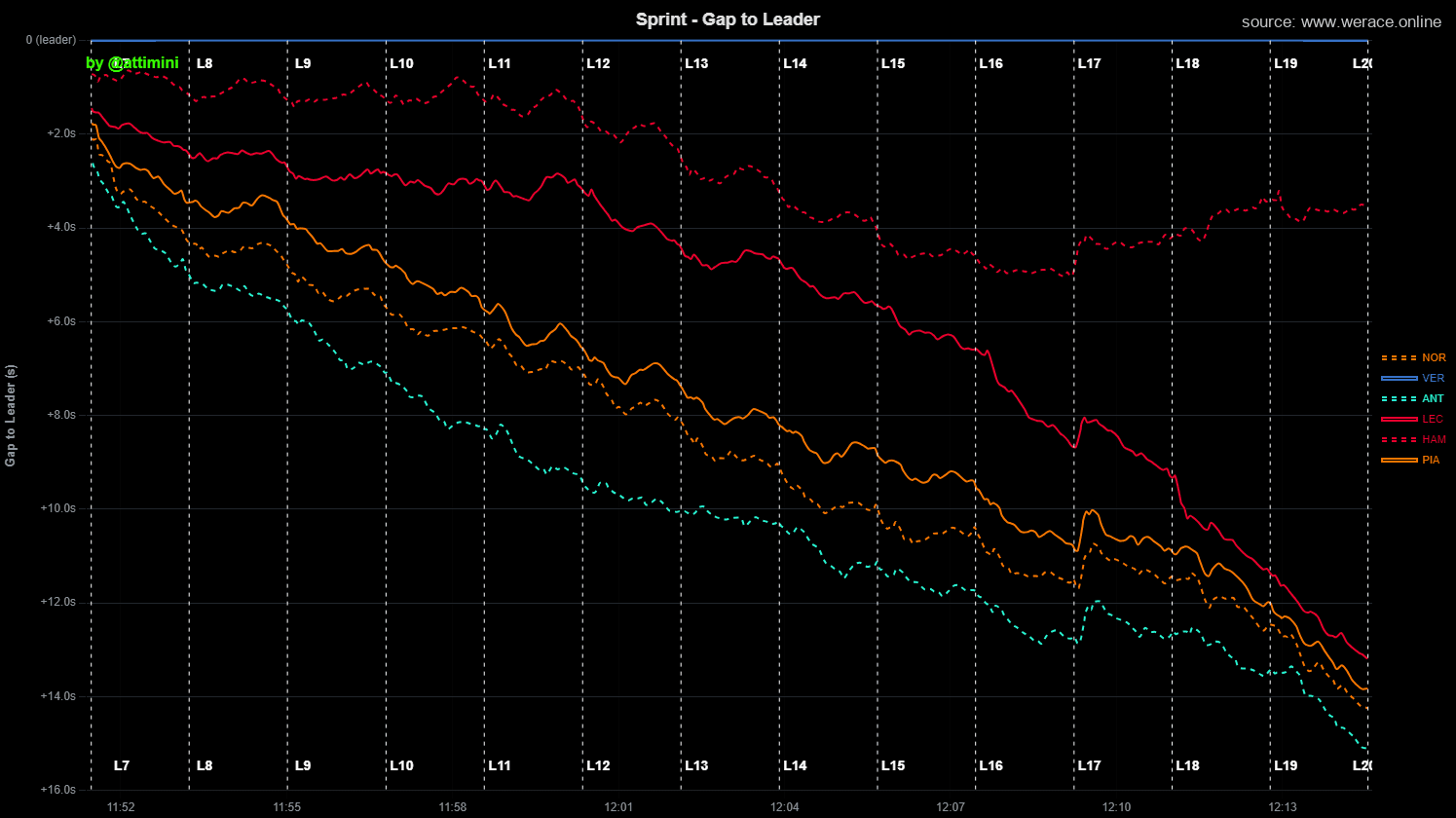
The gap-to-leader zoom shows it clearly: Leclerc's red line, which had held a steady gap of about 3s over the opening stint, begins to fall away from lap 12 and then drops sharply in the closing laps. In our view, he overdid it with the tyres. His engineer reportedly asked him over the radio to cool them on the straights and to take care, and the requests were not followed, leaving him with ruined tyres three or four laps from the end.
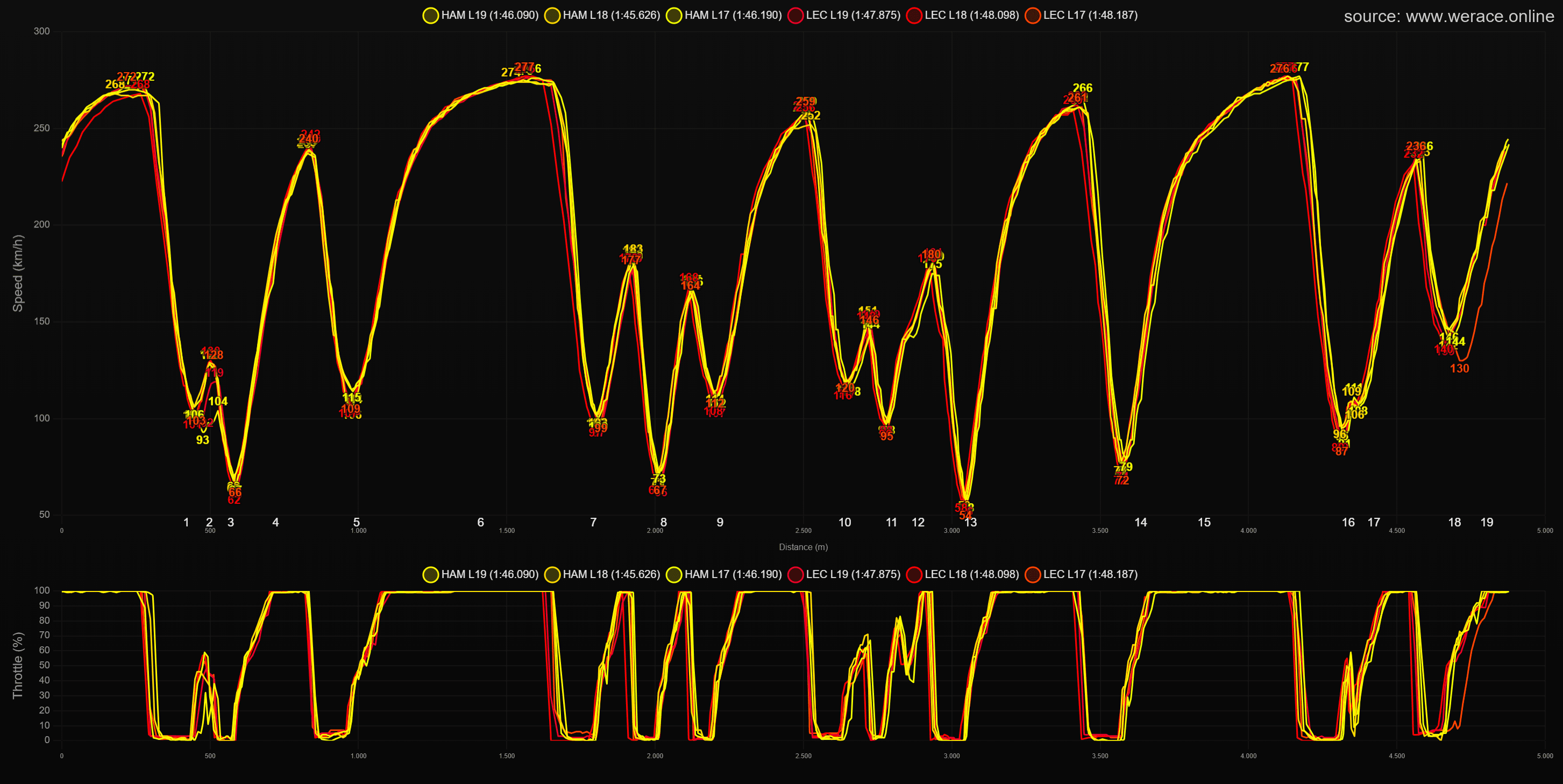
The comparison of laps 17-19 against Hamilton makes the difference concrete: Hamilton is between 1.8s and 2.5s per lap quicker. Top speeds on the straights are almost identical (around 277 km/h), so the time is lost in the corners and the braking zones: Leclerc lifts earlier before the major braking points and has minimum speeds some 3-9 km/h lower at slow corners such as Turns 8, 14 and 16.
The post-race interviews explained the cause. Leclerc said the balance of the car was too extreme, set too far towards the rear, which is reasonable on a track like this. The problem is that the more you push the balance in that direction, the more you put the front axle in difficulty, and this is what happened.
5. McLaren's Double Spin
McLaren had looked competitive until the end, with Norris perhaps slightly quicker than Piastri, but the pit wall could not keep the situation under control. On the final lap, with qualifying only a few hours away, both drivers decided to treat us to a double spin. Norris' gap to the leader jumps from about 14s to about 28s on that lap. It was a significant risk to take so close to a session that matters far more than the sprint.
Away from the track, the mood in the McLaren camp was worth noting. In the interviews Norris looked very annoyed, and it seemed that the answers had not been agreed with the communications team beforehand, as is normally done in these situations. Whether he did not speak to them or did it on purpose to avoid giving the standard answers is unclear. Piastri was far more relaxed and replied with exactly the kind of neutral, press-office responses that say nothing. It was a rather hot day for the team.
6. What We Learned
Red Bull appear well balanced, with a good rear end, and clearly better than what we saw in the recent past. They seem to have managed their developments properly and improved the car. Verstappen's constant pace was the cherry on top.
For Ferrari the sign is encouraging. We remember how the car was unable to stay on the road in the wet, with any driver; this time it looks, and we stress looks, much better in these conditions.
McLaren will need to work out how the set-up changes and whether they can get closer to the pole that really matters.
7. Looking Ahead to Qualifying
Now it is time for the real qualifying. With the parc fermé open, we will see what changes, and it should be remembered that on this track grid position is everything, so the session will be crucial.
Good luck to everyone, and see you after qualifying!