

Ferrari Leads Monaco Friday as Hamilton Challenges Leclerc While Verstappen Lurks
Monaco has always been one of Ferrari’s strongest tracks and Friday’s running confirmed exactly that. The Scuderia finished at the top in both practice sessions, first with Charles Leclerc in FP1 and then with Lewis Hamilton leading FP2, immediately establishing Ferrari as one of the clear references for the weekend.
But while the timing sheets suggest Ferrari control, the overall picture is far more complex. Max Verstappen remains extremely close, Red Bull continues to improve session after session, and the battle inside Ferrari itself may become one of the main stories of the Monaco Grand Prix weekend.
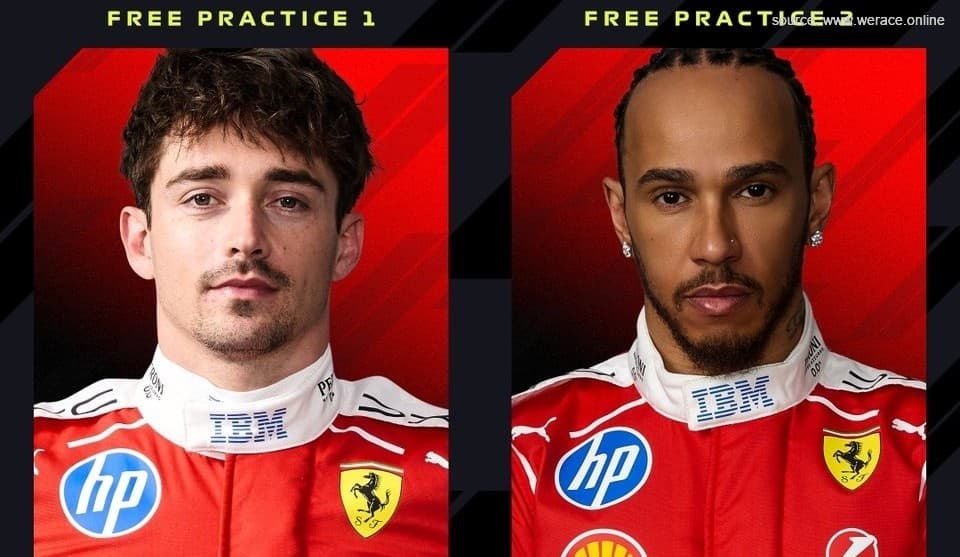
The Most Interesting Aspect Of Friday
The most interesting aspect of Friday was not simply Ferrari’s pace, but how the two drivers extracted performance in very different ways. Hamilton looked increasingly confident throughout FP2, especially in the final sector where commitment between the barriers becomes critical. Leclerc remained extremely fast as always around Monaco, but the telemetry revealed slight differences in driving approach and balance preference.
Ferrari’s SF26 appears particularly suited to Monaco’s characteristics. Stability under braking, strong traction at low speed and compliant suspension behaviour over kerbs are all essential around the Principality, and those are precisely some of the strongest qualities of this year’s Ferrari package.
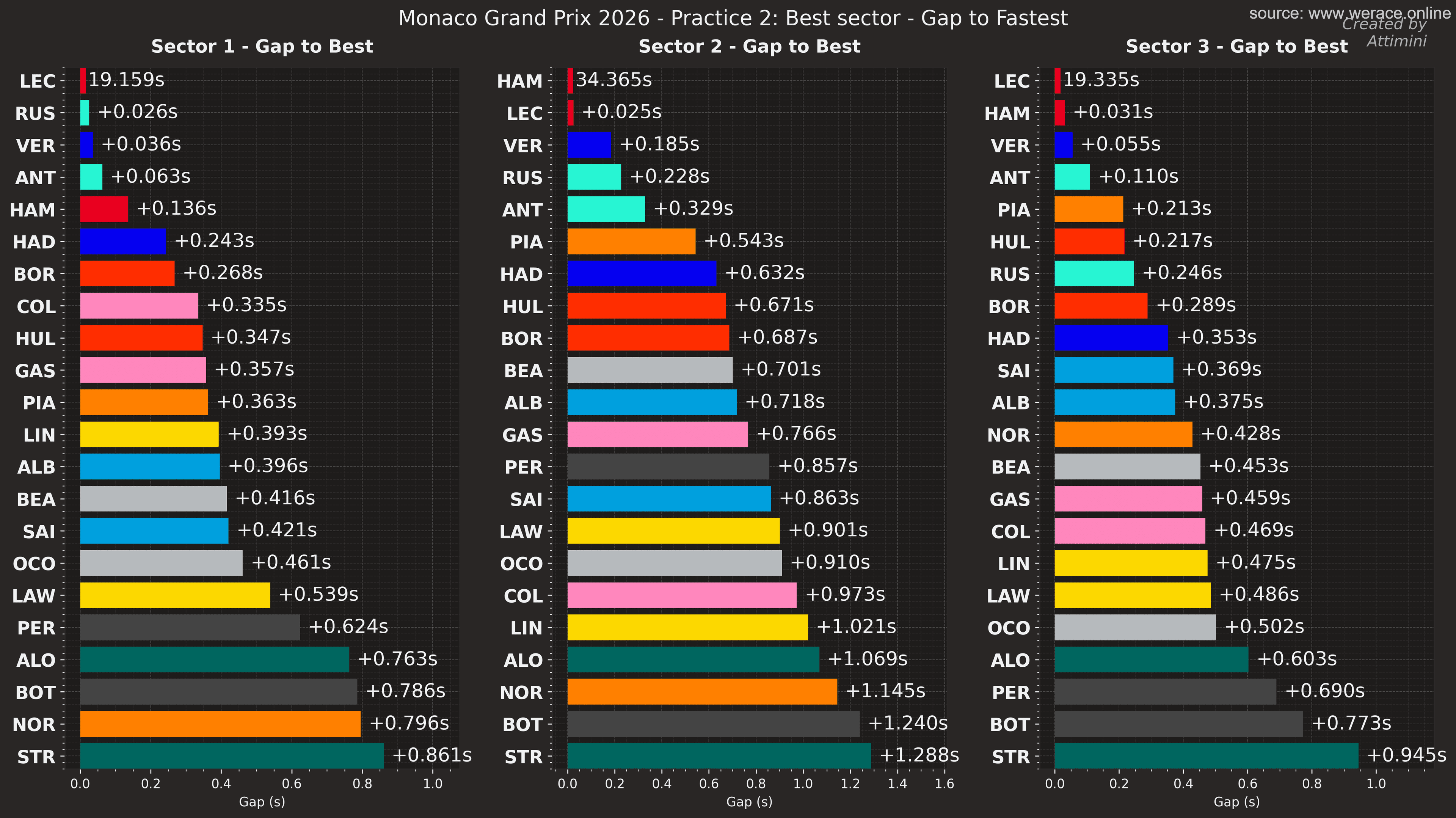
Sector analysis highlights how close the fight really is at the front. Ferrari controlled most of the competitive sectors, but Verstappen remained consistently within striking distance and looked especially strong before the final corner sequence.
The Dutchman may not have started the season with the strongest car in slow-speed conditions, but Red Bull’s development direction is clearly beginning to work. From Bahrain testing to Monaco, the RB machine has evolved significantly in mechanical balance and drivability, especially over a single lap.
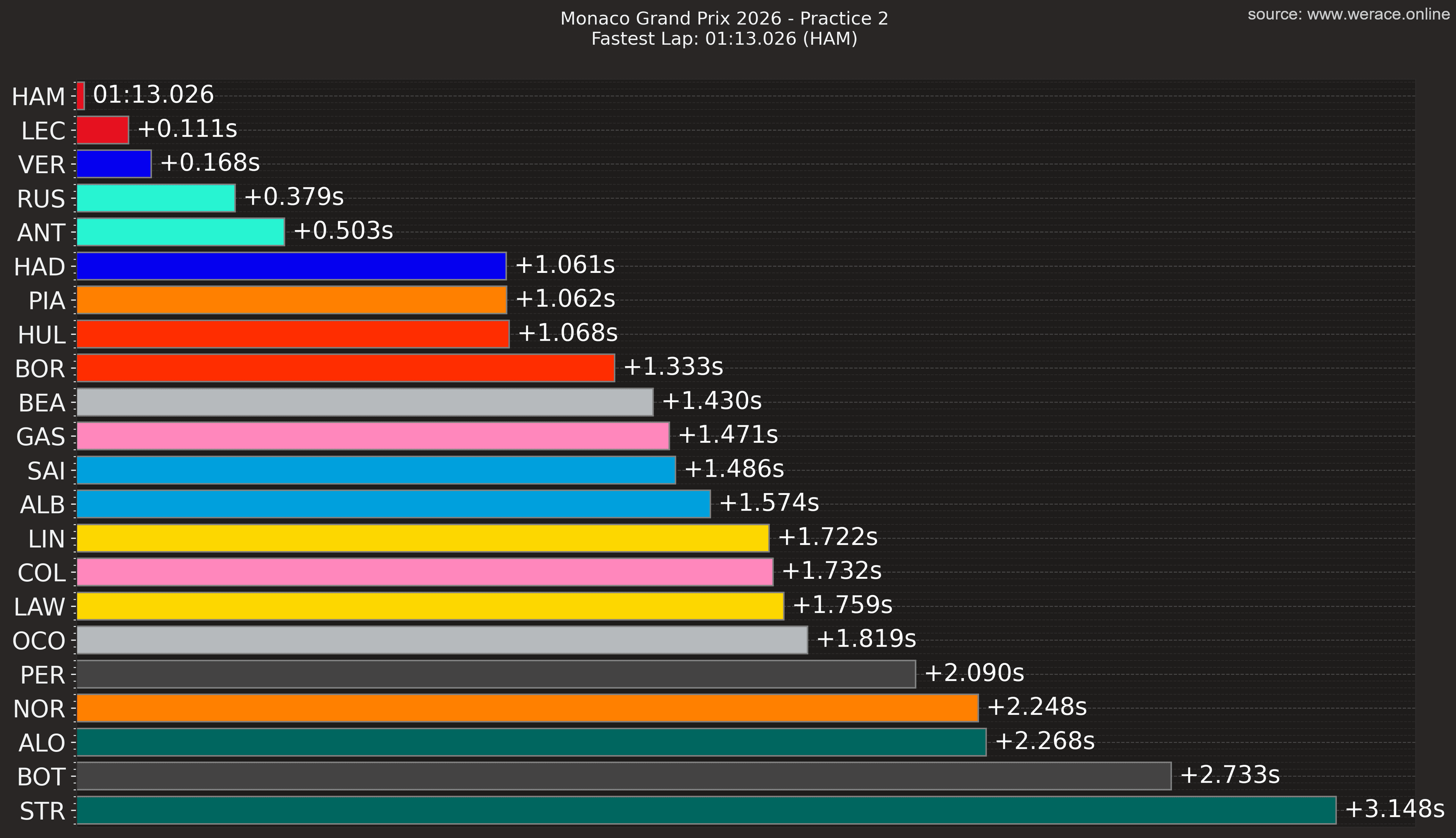
The overall gap chart from FP2 shows just how compressed the top positions are. Ferrari leads the field, but Verstappen remains dangerously close while Mercedes and McLaren currently sit slightly behind the leading trio.
One particularly interesting detail from FP2 was Verstappen’s confidence during long runs. While several drivers completed only short qualifying simulations, Verstappen stayed on track longer and managed to complete an extended sequence of laps, combining qualifying preparation with early race pace work.
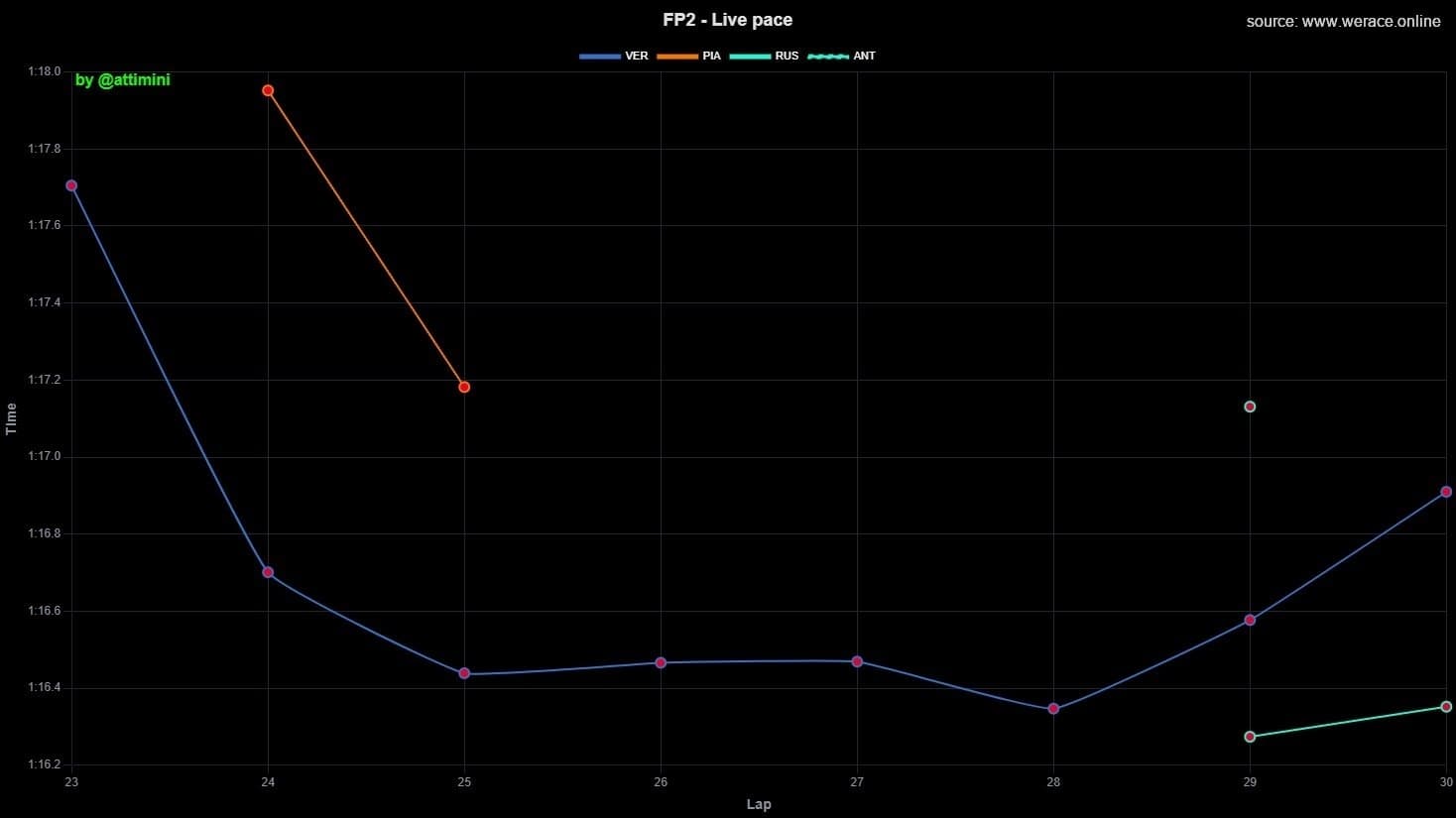
That level of confidence is usually a strong indicator at Monaco. Red Bull may not yet have the outright edge, but Verstappen already looks comfortable enough to attack the circuit limits aggressively.
Telemetry Tells A More Fascinating Story
The telemetry comparison between Hamilton, Leclerc and Verstappen tells an even more fascinating story.
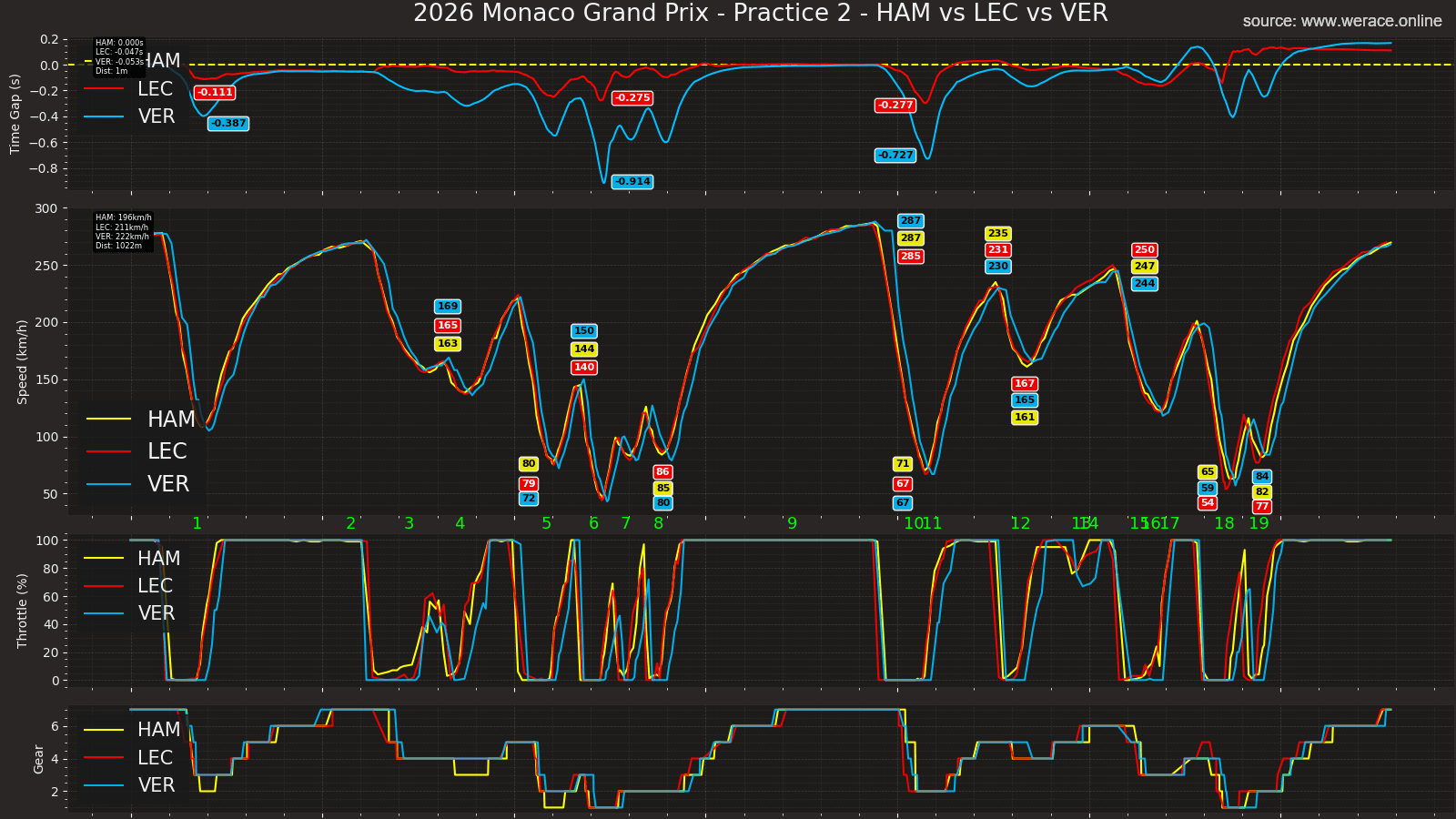
Until the final corner, Verstappen was arguably carrying the strongest overall lap. Hamilton ultimately gained crucial time thanks to superior traction and exit performance onto the main straight, but the Red Bull remained highly competitive throughout the lap.
Hamilton’s biggest strength appears to be rear-end confidence. Through Portier, under the tunnel and especially in the acceleration phases after slow corners, the Ferrari allows him to commit to throttle application extremely early.
That characteristic becomes even more visible when comparing Hamilton directly with George Russell.
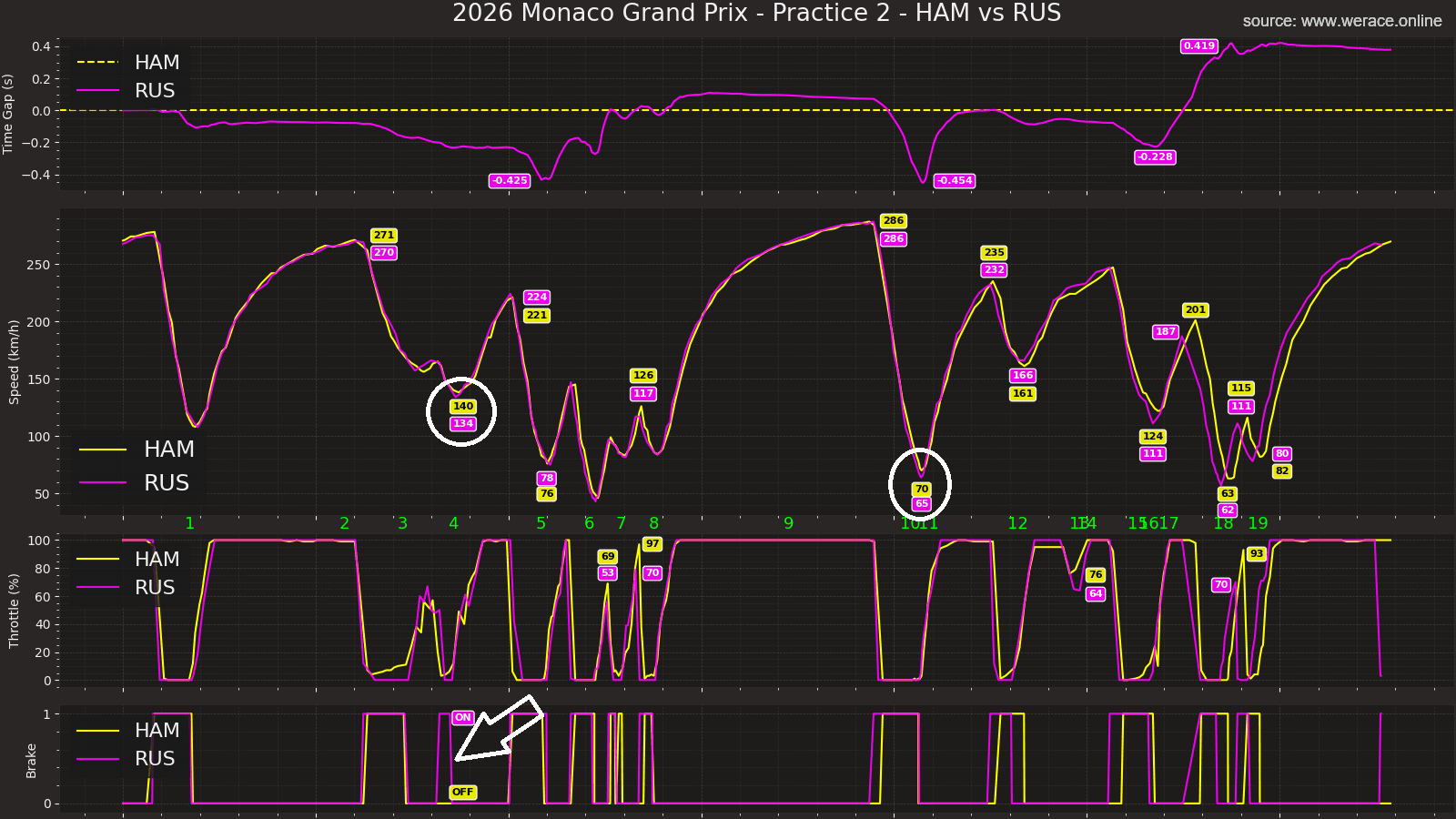
Mercedes currently appears to struggle with front-end stability around Monaco’s slow and medium-speed corners. Russell can often carry competitive entry speed, but loses significant time during corner rotation and exit stability.
At Casino Square, Hamilton barely lifts while Russell is forced into a more cautious approach. Similar patterns repeat through Mirabeau, the Hairpin and the final sector.
The throttle traces make the difference even clearer.
Hamilton consistently reaches full throttle earlier between Turns 5 and 8, exploiting Ferrari’s superior rear stability. The Mercedes drivers seem forced into a more progressive throttle application due to instability on entry and mid-corner balance limitations.
Even Verstappen, despite looking stronger overall than Russell, cannot always match Hamilton’s throttle confidence in those sections.

This ability to commit earlier on throttle is one of the reasons Hamilton looked so convincing throughout Friday, particularly in the low-speed traction zones that define Monaco lap time.
Leclerc Still Has More In Reserve
However, Leclerc remains extremely dangerous.
Despite finishing marginally behind Hamilton in FP2, the Monegasque still showed enormous untapped potential. His ideal lap analysis reveals that he left significant time on the table.
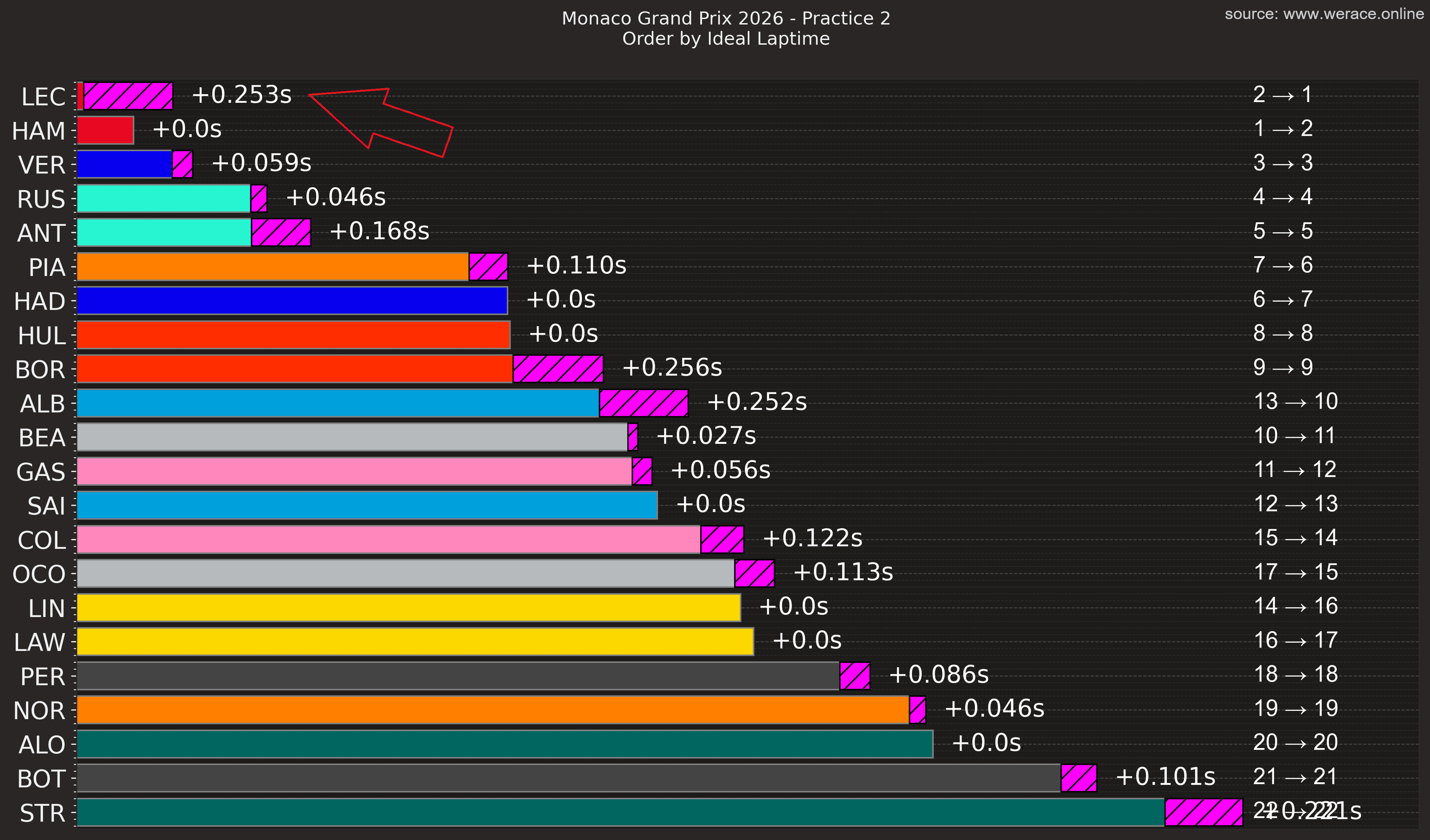
Had Leclerc combined all of his best microsectors into a single lap, he likely would have moved into P1 ahead of Hamilton. His theoretical improvement was among the highest of all front-running drivers.
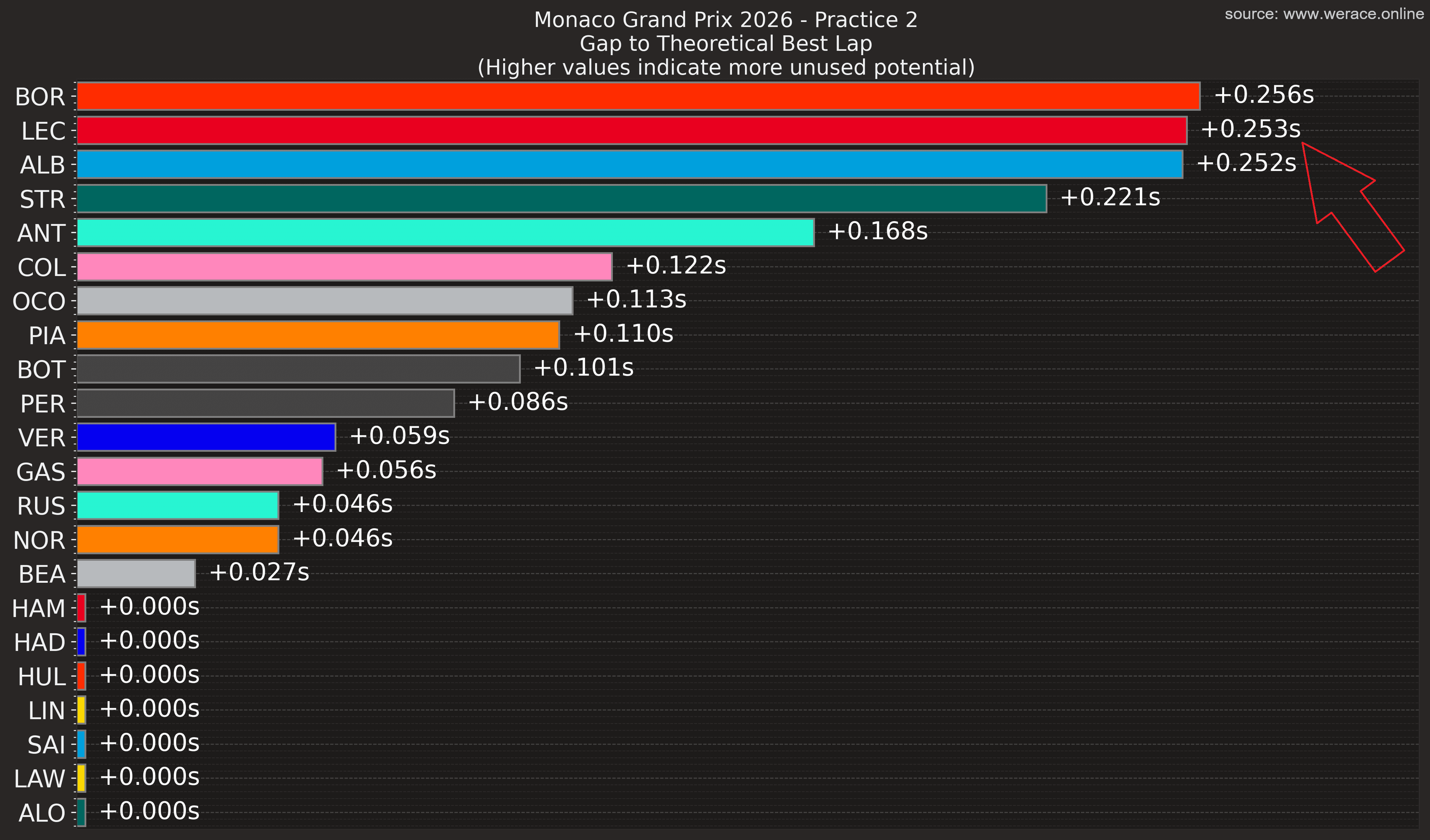
That suggests Leclerc may still have additional pace available once the pressure of qualifying arrives, especially considering how naturally comfortable he usually feels around Monaco.
Another extremely interesting comparison comes from analysing Leclerc’s 2026 FP2 lap against his FP2 lap from 2025.
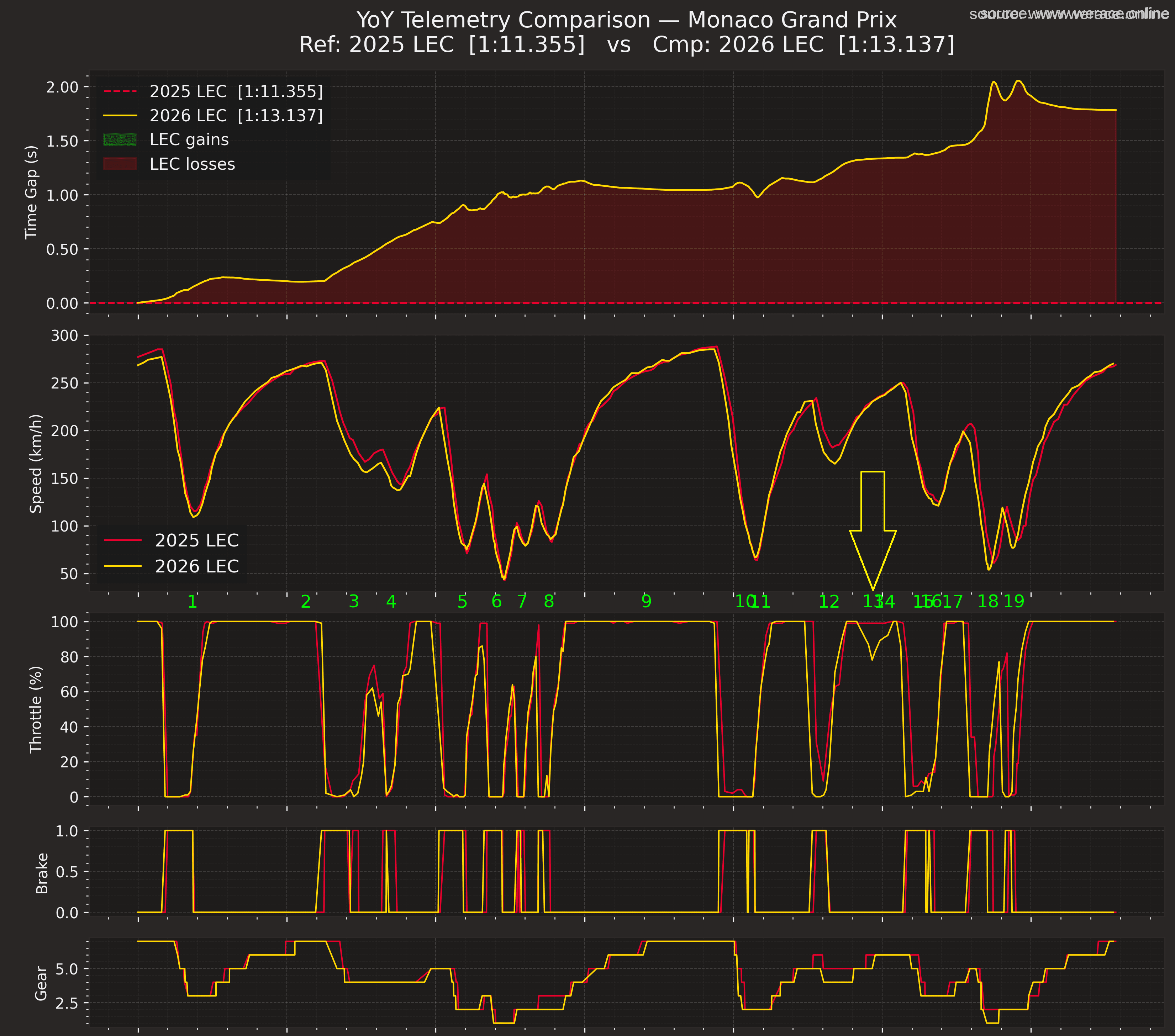
The differences are striking. Despite Monaco being one of the least power-sensitive tracks on the calendar, the 2026 Ferrari loses considerable performance compared to last year through the Casino section and especially around the fast swimming pool complex.
In several places where the 2025 car was comfortably flat-out, the 2026 Ferrari requires noticeable throttle modulation. Through the Swimming Pool chicane sequence alone, Leclerc is forced to lift significantly compared to last season.
That indicates how much overall aerodynamic and mechanical grip levels have changed compared to previous regulations, even at a circuit where engine power traditionally matters less.
Tyres And Strategy Could Still Matter
Tyre management may also become one of the hidden factors this weekend. The compounds are slightly harder this year, but teams are still pushing for repeated consecutive qualifying-style laps during practice.
Hamilton himself reported overheating tyres over team radio multiple times, occasionally aborting laps because the front tyres were already exceeding the ideal operating window by Turn 1.
This opens interesting strategic possibilities not only for qualifying preparation, but also for Sunday’s race where undercuts and tyre behaviour could become more important than usual for Monaco standards.
McLaren Looked Like The Big Disappointment
McLaren, meanwhile, appears to be one of the biggest disappointments so far.
Lando Norris suffered another electronic reliability issue while Oscar Piastri struggled to extract grip during tyre preparation phases. The MCL car currently looks weak in long low-speed corners and lacks immediate front-end confidence during the opening part of laps.
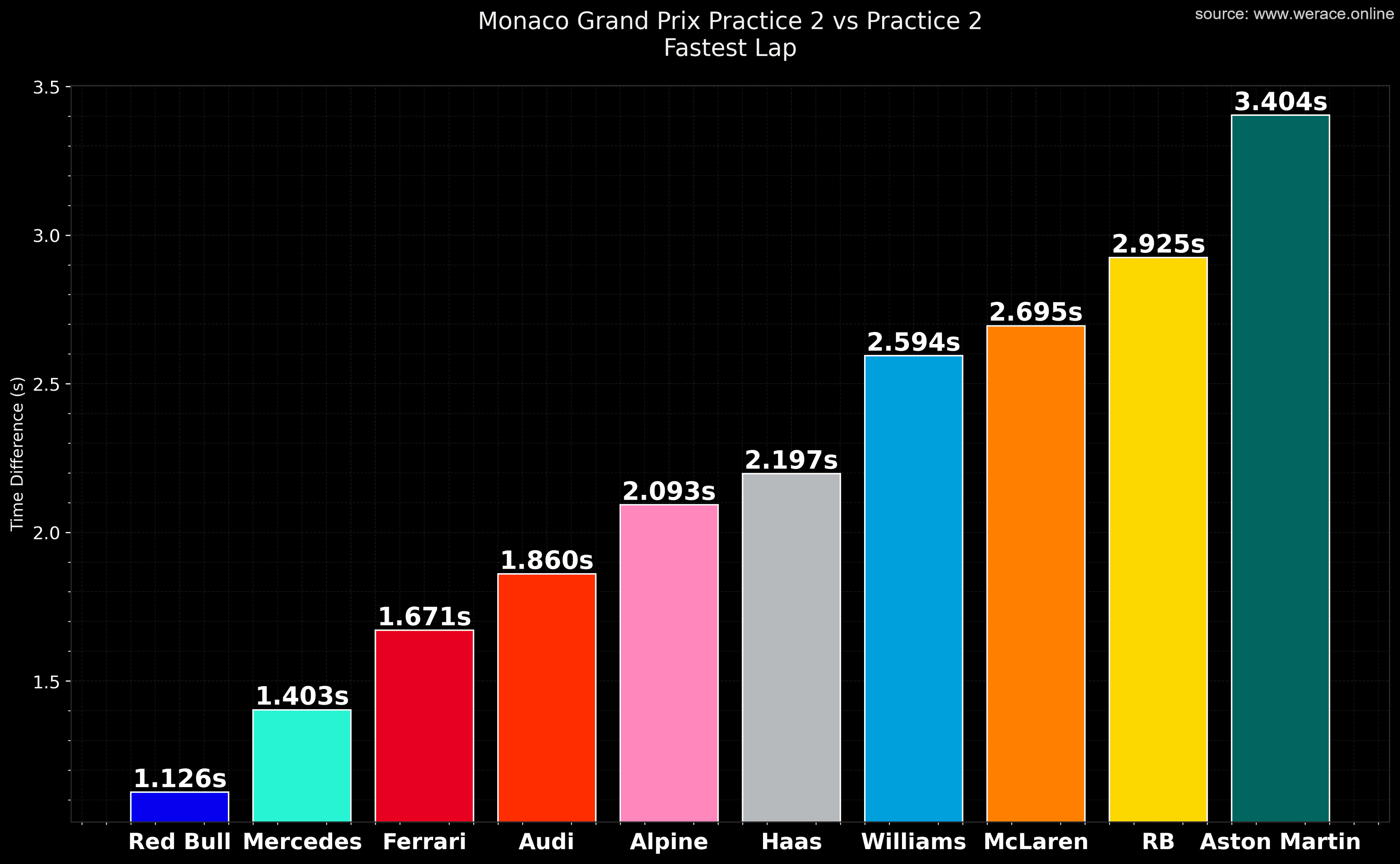
Compared to 2025, McLaren appears to have lost more performance than any other top team around Monaco. While Red Bull remains relatively close to last year’s benchmark, McLaren’s deficit has grown dramatically.
Final Thoughts
Finally, Aston Martin endured a deeply worrying Friday. Monaco should theoretically minimise engine disadvantages and reward chassis quality, yet the team remained uncompetitive even in these conditions. Meanwhile Audi managed to place itself near the top ten, which may represent one of the more encouraging signs of the weekend for the future manufacturer project.
Friday in Monaco rarely decides the final outcome, but the early signs are already fascinating: Ferrari looks genuinely strong, Hamilton appears increasingly comfortable inside the SF26, Leclerc still has pace in reserve, and Verstappen remains close enough to threaten everyone once qualifying begins.
And around Monaco, qualifying changes everything.