
F1 2026 Melbourne FP2: Remote-Controlled Drivers, Hybrid Tricks & The Lap Count Drama
I've just finished watching the first day of free practice here in Australia, and I find myself hovering somewhere between extreme sleep deprivation and absolute shock. Welcome to the new Formula 1. It's a completely different beast, requiring a driving style that is frankly unnatural and unlike anything these guys have done since their karting days.
Before we dive into the juicy telemetry data, I need to point out something that blew my mind: the drivers are entirely dependent on the pit wall now. Forget about banning team radio; right now, drivers are practically remote-controlled. They are constantly being told when to lift, where to coast, and exactly how many meters before a corner they need to brake just to manage the new hybrid parameters.
Watching Lewis Hamilton and his new race engineer, Santi, was fascinating. In the first half of FP1, their communication was chaotic—almost a worse version of his old dynamic with Adami. But by FP2, it improved massively. Santi seems very precise and quickly understands what Lewis needs, which is crucial because the 2026 cars require constant, microscopic assistance. This newfound harmony translated directly to the track, where Hamilton showed a level of confidence and brilliance we haven't seen from him in a while, proving the SF-26 has a very solid and stable rear end.
The Lap Count Drama: Reliability is the New Gold
Before we look at the telemetry, we have to talk about who actually managed to stay on track. In this new 2026 era, where drivers need constant practice to understand the most effective ways to manage hybrid energy, losing track time is an absolute disaster.
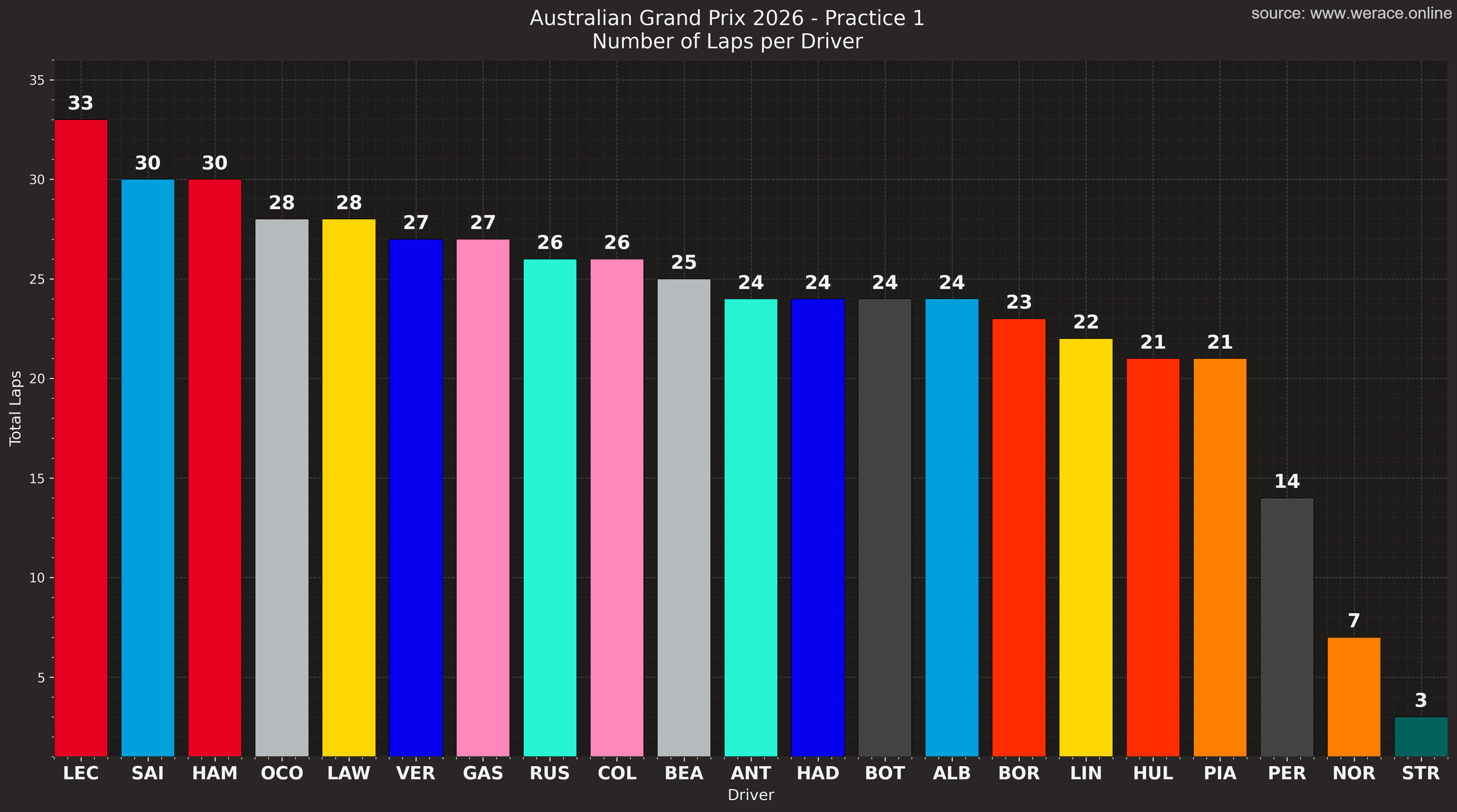
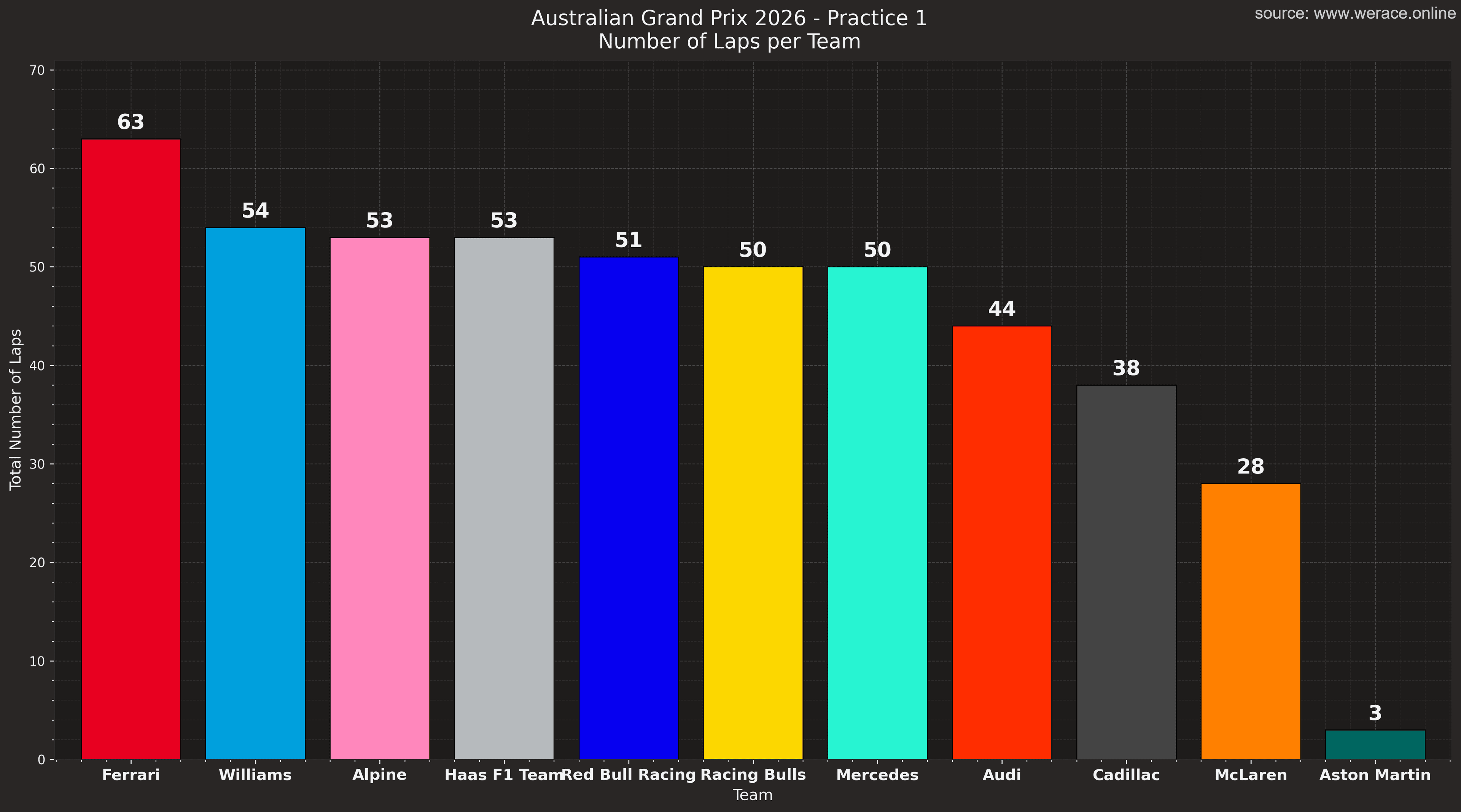
Looking at the FP1 charts, the standout nightmare is Aston Martin. They practically didn't run at all. Fernando Alonso didn't even turn on his car due to a Power Unit issue, and Lance Stroll managed a mere 3 laps. They are suffering from violent vibrations that make the AMR26 almost impossible to drive. Adrian Newey himself confirmed they only have two spare batteries left, which is a massive red flag for the budget cap, as fixing these issues will drain development resources fast.
But they weren't the only ones suffering in the morning. Lando Norris had a very compromised FP1, completing only 7 laps due to reliability issues on his McLaren.
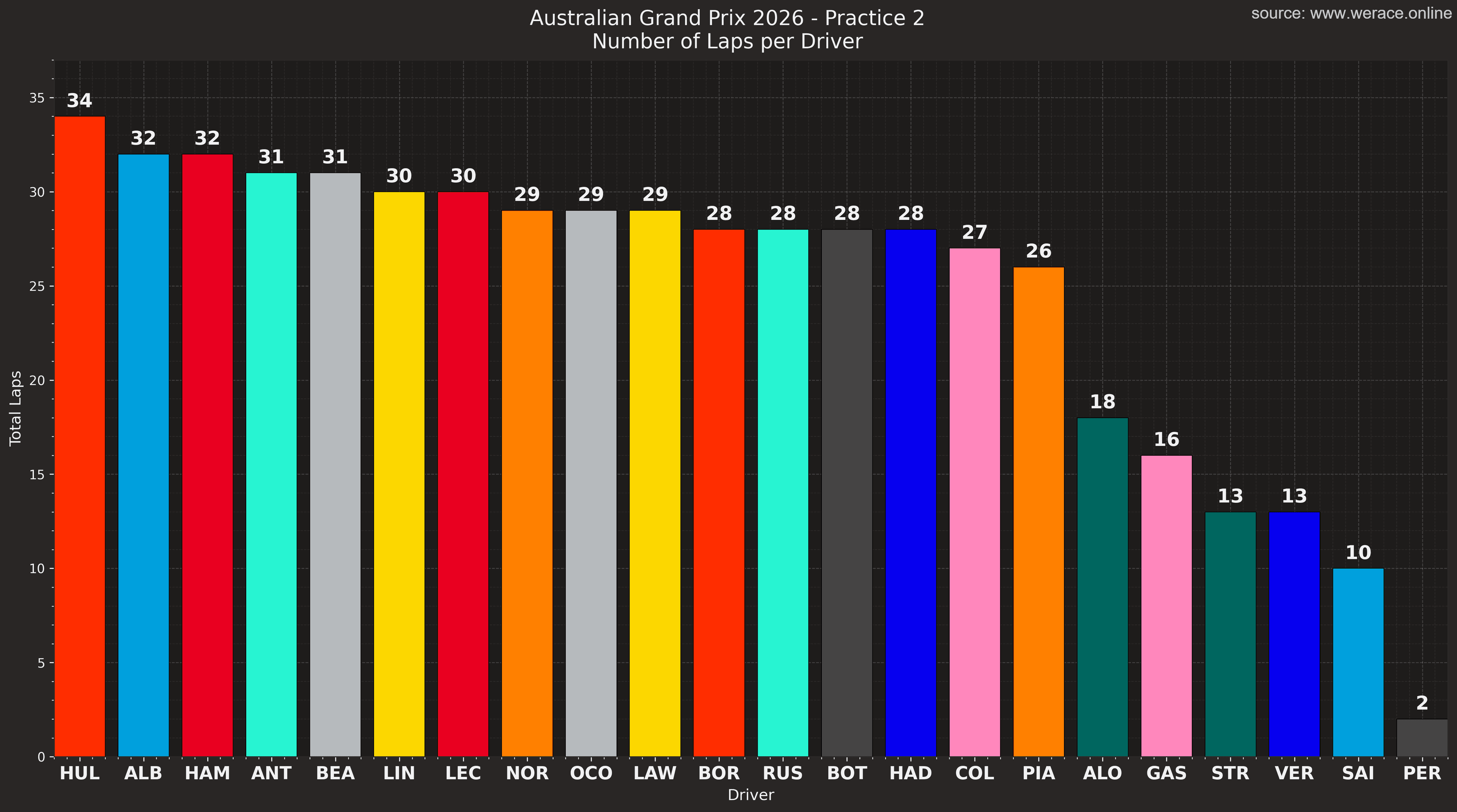
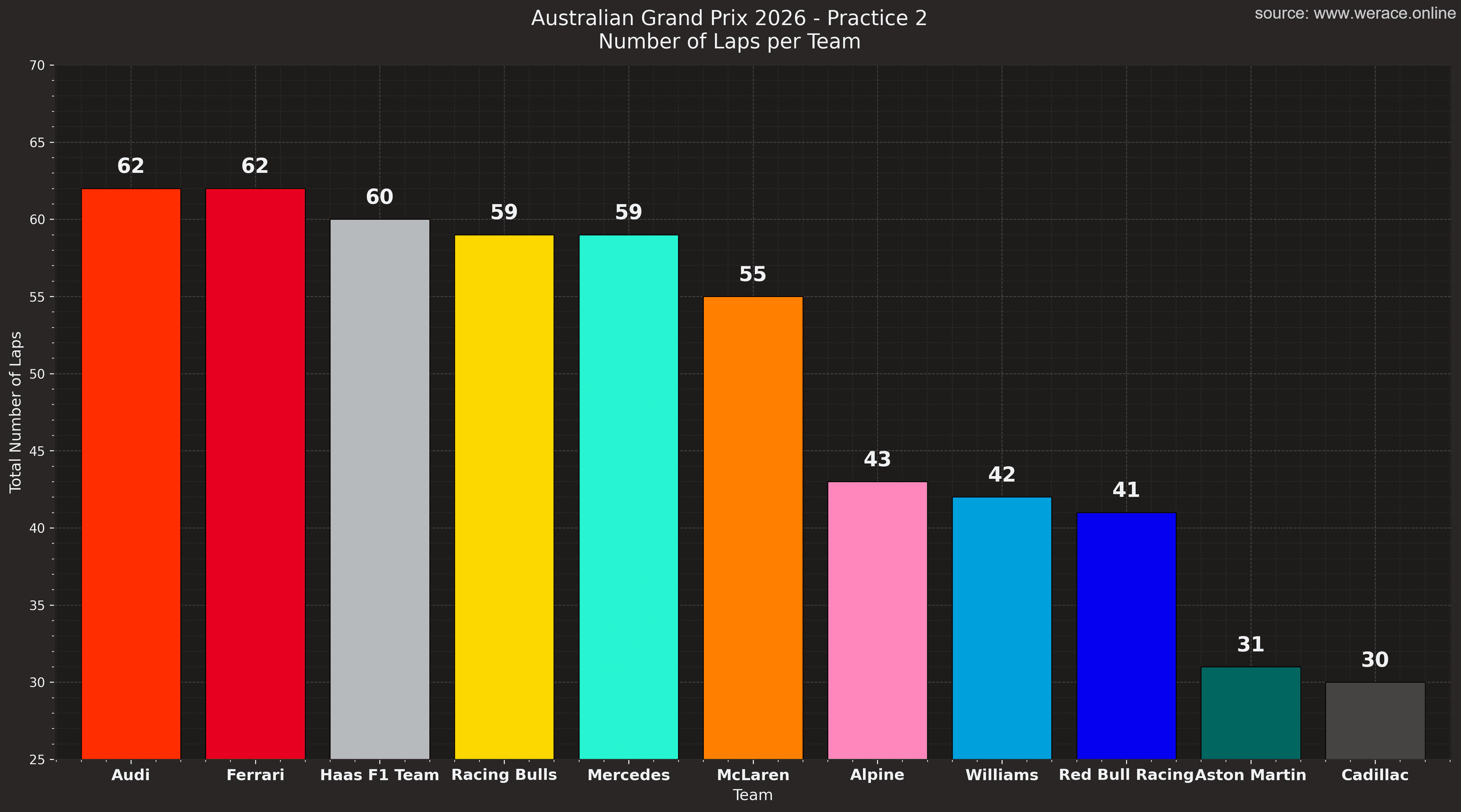
Moving to FP2, Aston Martin managed a slight recovery with 15 laps per driver, but their performance is still nowhere, losing a shocking 7 seconds compared to last year.
In the afternoon, the reliability curse shifted to Max Verstappen. The Red Bull driver was forced to pit after a violent excursion into the gravel and was restricted to just 13 laps overall in FP2.
If we look at the overall team mileage across the day, Ferrari is the absolute workhorse. The Scuderia completed 125 laps, confirming a very solid baseline reliability. They are followed by Mercedes (109 laps) and Red Bull (98 laps), while McLaren sits at the bottom of the top teams with only 83 laps overall.
The Sandbagging Game & Overall Pace
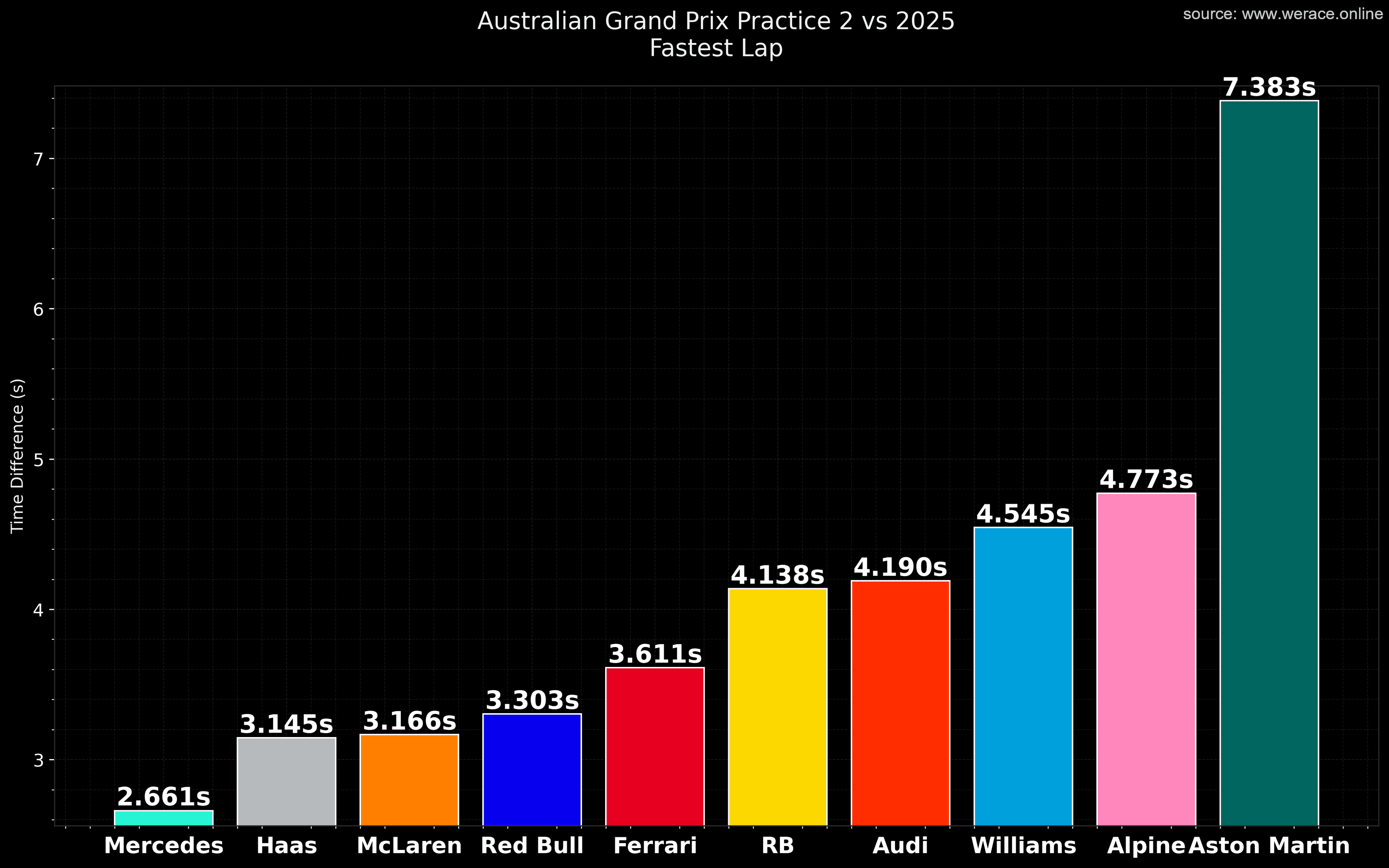
Looking at the overall times, FP1 was generally much slower than last year. Mercedes seemed to have lost the least, but the truth is they were heavily sandbagging in the morning. In FP1, George Russell and Kimi Antonelli were cruising down the straights with engine revs over 1000 RPM lower than the competition just to preserve the Power Units. But in FP2, they turned up the heat, and the change in pace was evident.
Telemetry Deep Dive: The McLaren "Super Traction" vs. Mercedes
This is where it gets incredibly technical. I've modified my telemetry charts for you to clearly see the differences. In the following graphs, Green is the throttle, Red is the brake, and the Black area in the middle represents the "Cornering" or "Lift and Coast" (LiCo) phase.
Let's compare Antonelli's Mercedes and Piastri's McLaren (both running the same Mercedes PU).
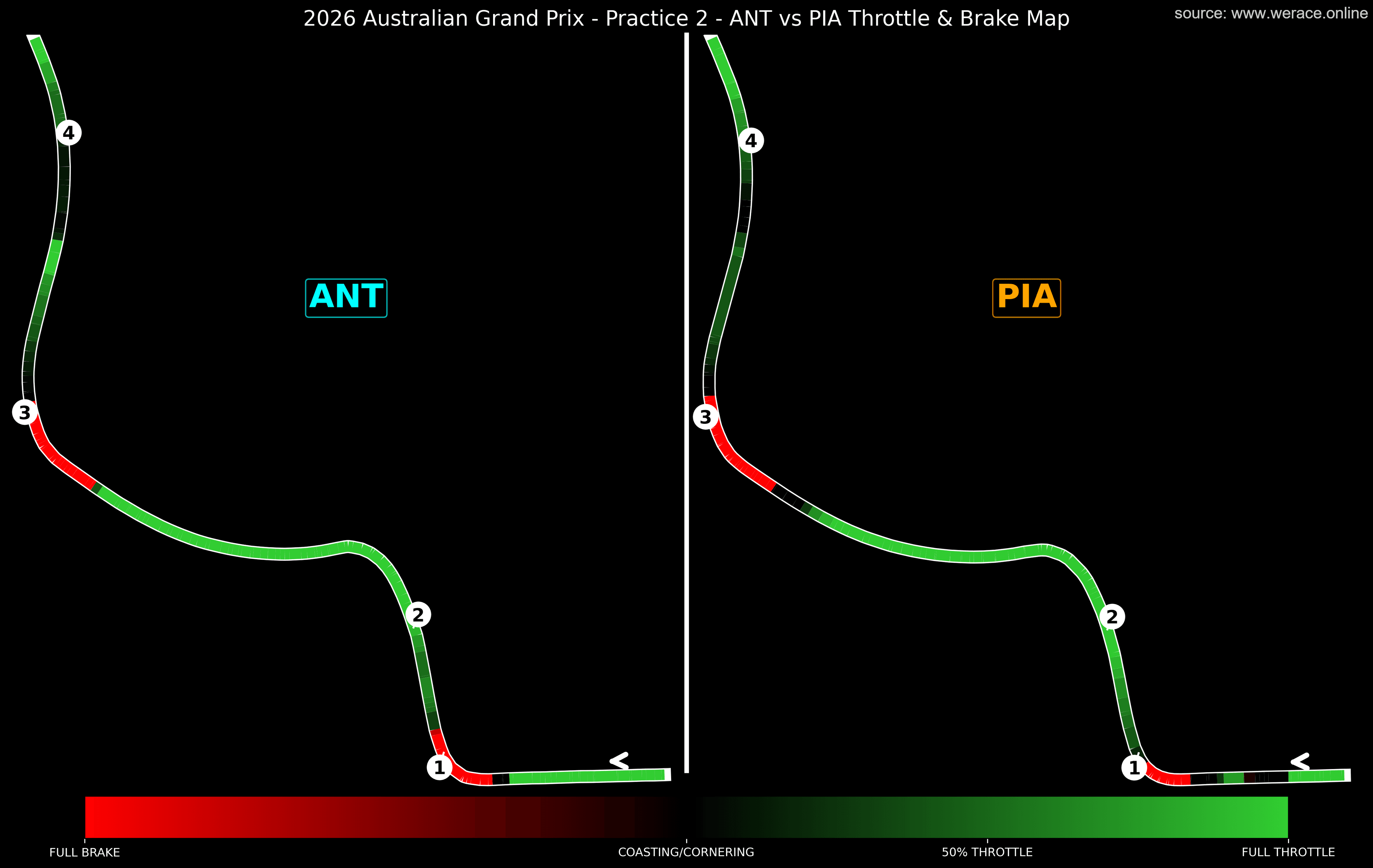
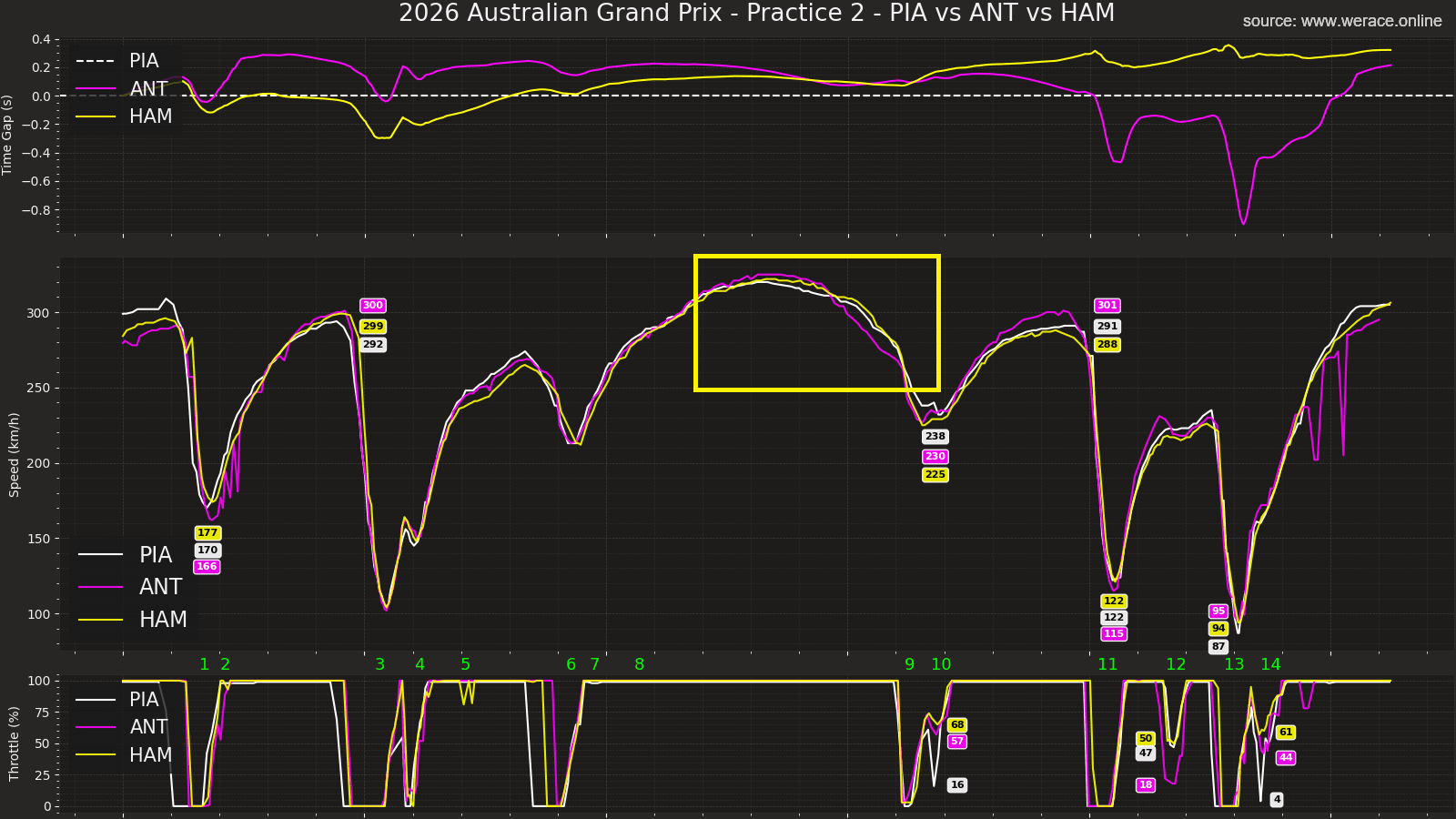
Look at the approach to Turn 1. On the left, Kimi Antonelli has barely any black zone. On the right, Oscar Piastri has a massive coasting phase. But here is the crazy part: despite lifting so early, Piastri arrives at the Turn 1 braking zone at a staggering 309 km/h! That is 13 km/h faster than Hamilton and 18 km/h faster than Antonelli. This highlights McLaren's insane mechanical traction; they save energy by coasting, then dump all that massive hybrid torque to the ground flawlessly out of the corner.
Moving on to Turns 3 and 4, the pattern repeats. You can clearly see Piastri lifting significantly earlier before the braking zone of T3, and again towards T4.
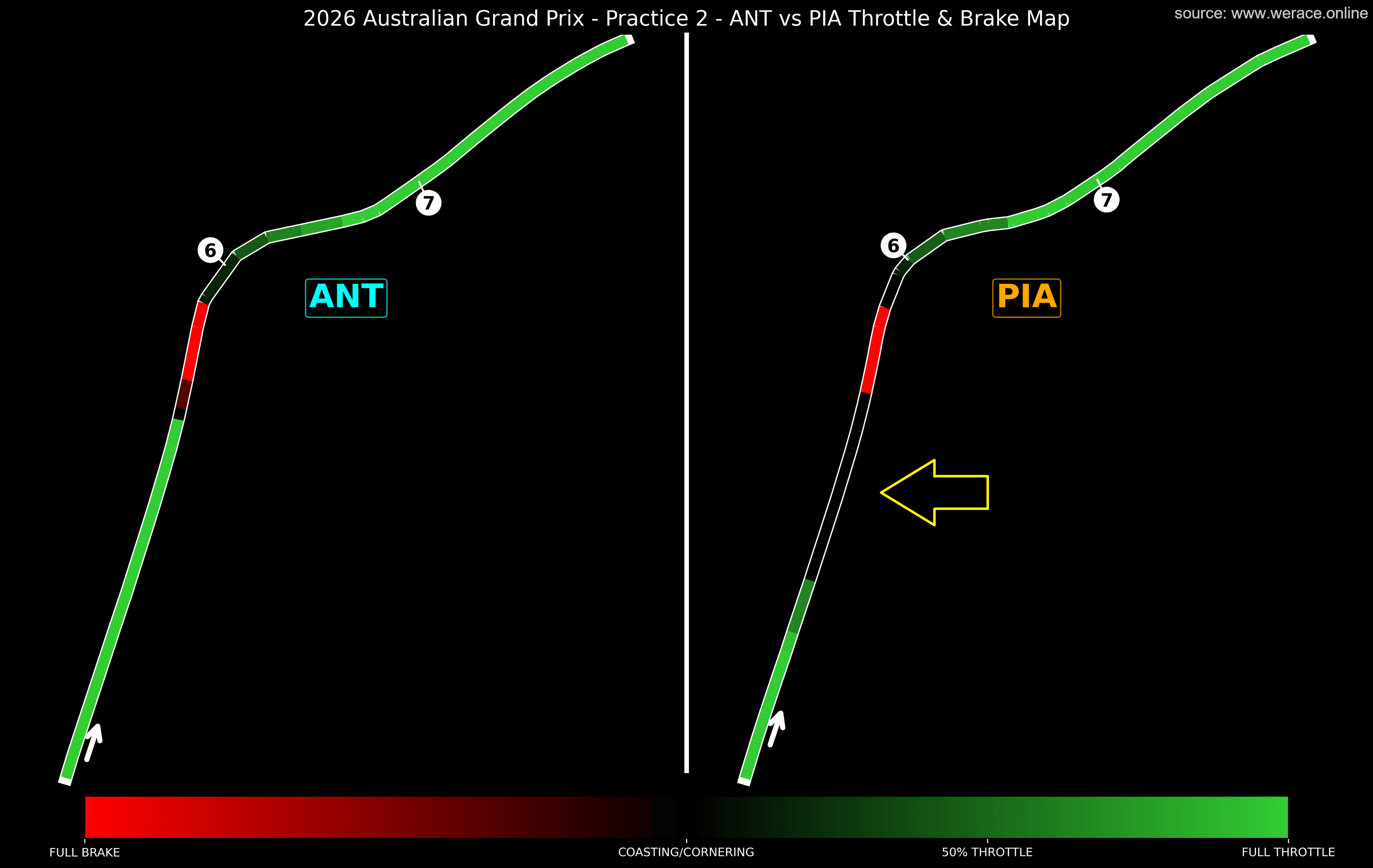
But Turn 6 is where it gets absolutely ridiculous. Look at the difference here: Piastri is doing at least 100 meters of pure lift and coast compared to Antonelli!
Why is Mercedes not doing this? Because they have a completely opposite philosophy. Antonelli pushes hard and unleashes everything on the back straight, but there is a massive price to pay: a brutal power cut (clipping) that costs him over 40 km/h of top speed right before Turn 9. He accepts this deficit to save a vital energy reserve for the twisty section towards Turn 11, where he absolutely dominates.
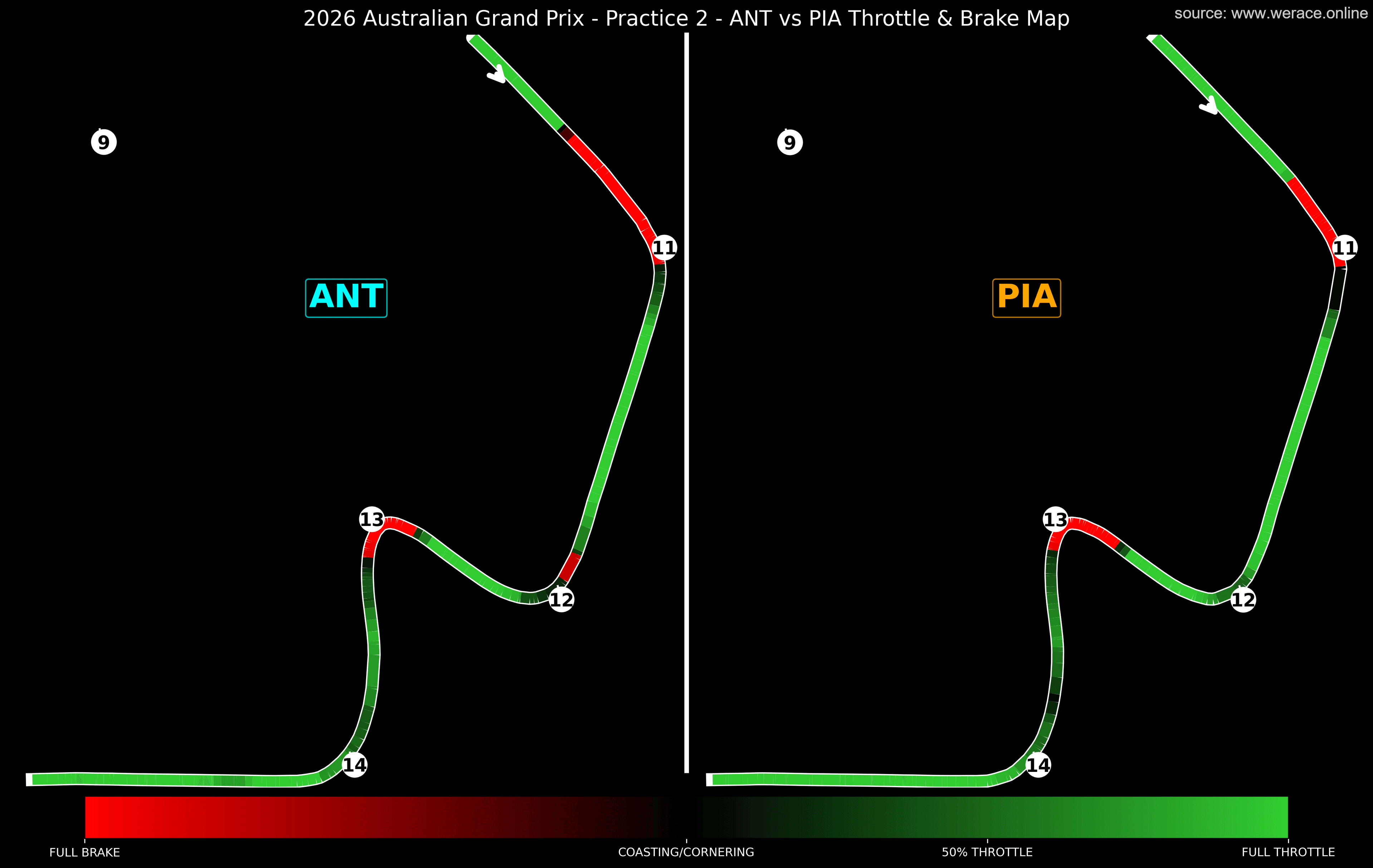
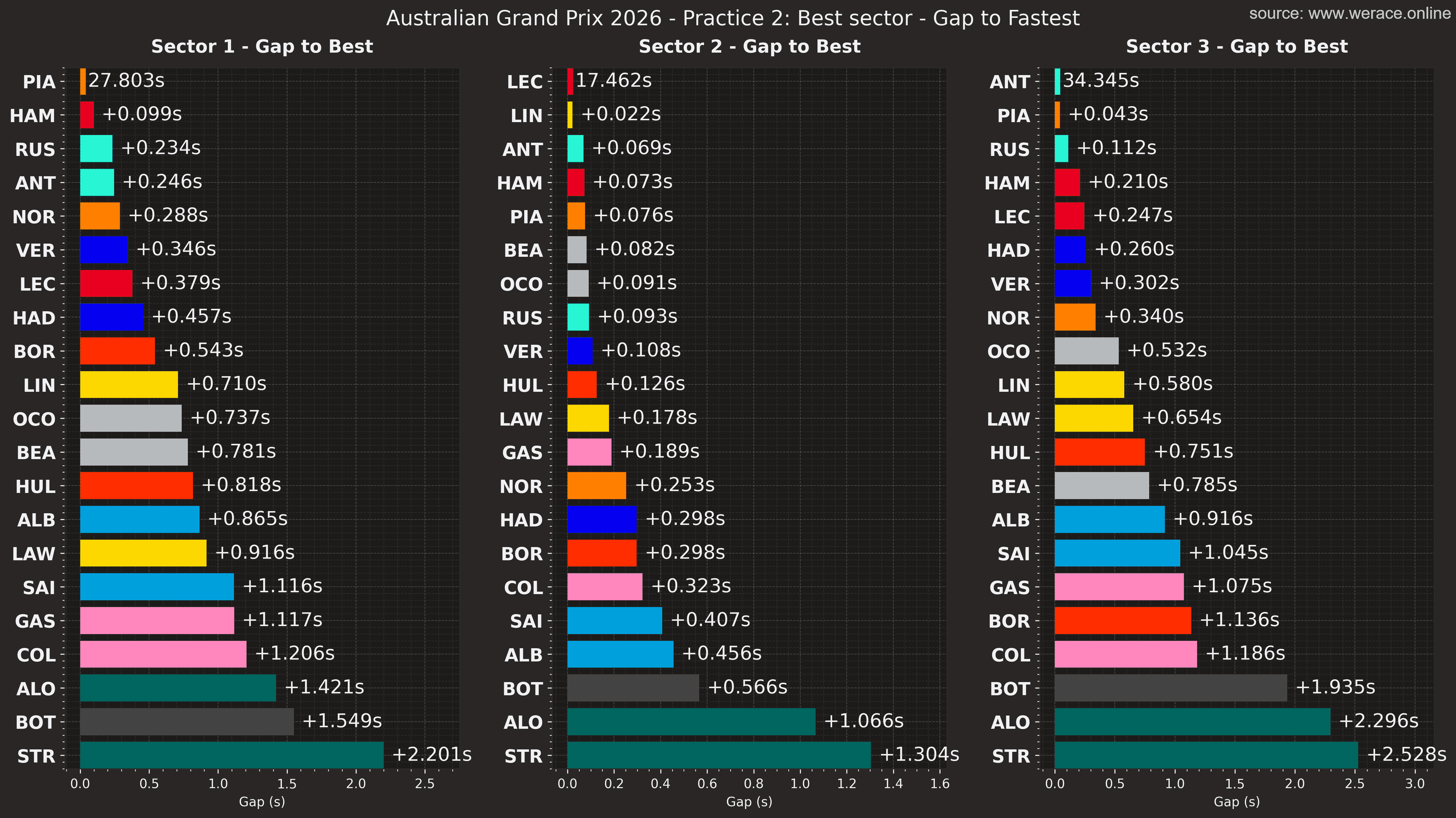
If we look at the final sector graph, these massive differences in coasting actually disappear. McLaren had to do all their saving in the first part of the circuit. This explains why Piastri set an unbeatable Super Sector 1 to grab the fastest lap, showing that McLaren's tire preparation is still top-tier.
Ferrari's Strategy and the "Virtual Mirror"
What about Ferrari? Looking at Hamilton's fastest lap, his telemetry sits right in the middle between the extremes of McLaren and Mercedes. He only has a couple of small lift and coast phases around Turns 3, 4, and 6.
Interestingly, Ferrari's two drivers are interpreting the hybrid management differently: Lewis prefers small, targeted lifts in the first sector, while Charles Leclerc tends to save all his "sailing" for one massive moment before the heavy braking of Turn 11.
To help their drivers manage this complex energy gathering, Ferrari upgraded a brilliant tool: a Virtual Rearview Mirror. It's an information display on the steering wheel that gives drivers hyper-accurate gaps to the cars ahead and behind. Since you need perfectly clean air to regenerate the battery and warm up the tires this year, having this precise spacing information is vital.
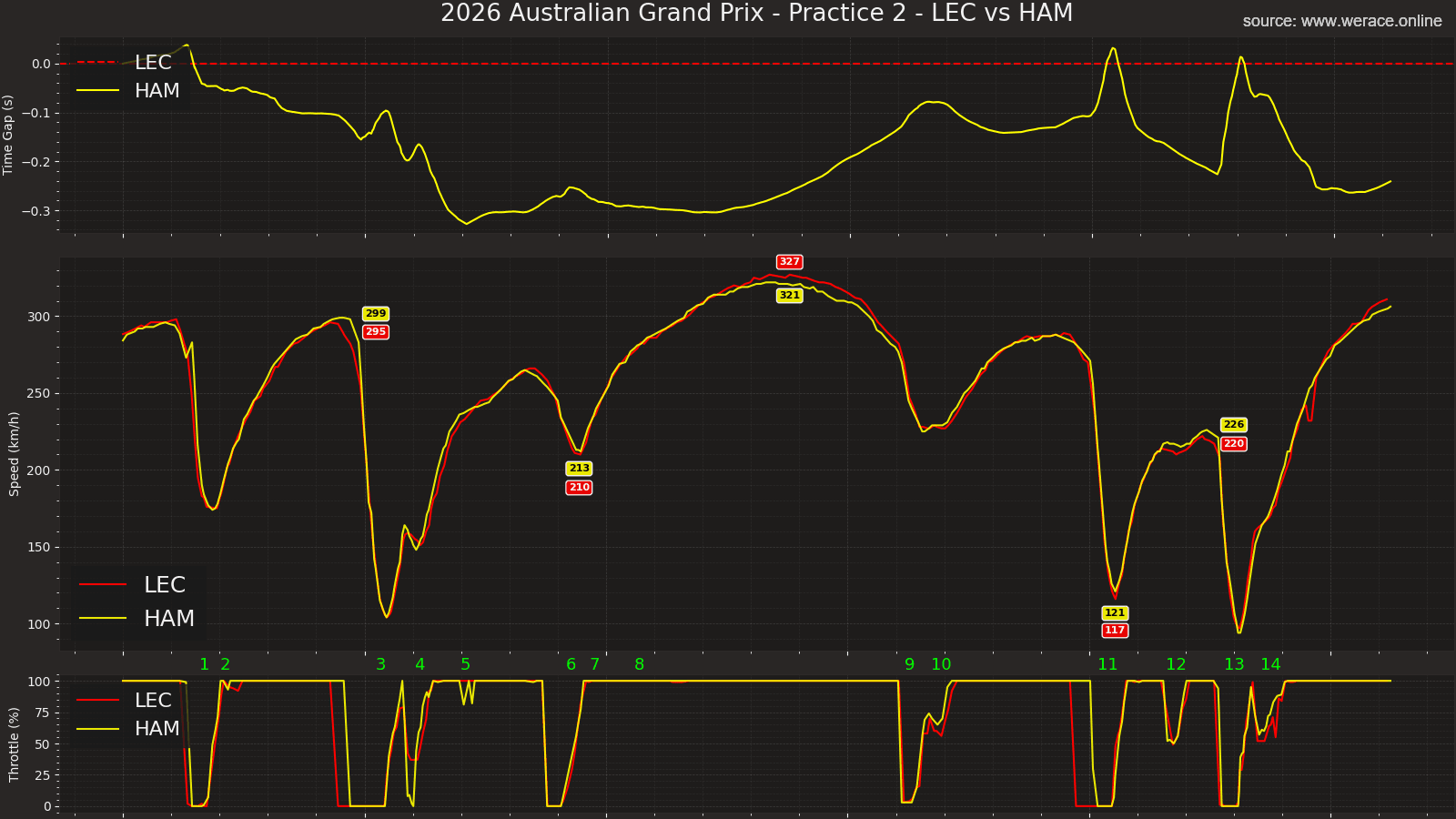
The SF-26 looks solid and they dedicated most of the day to qualifying pace, but they are losing about two-tenths to Kimi in the third sector. Part of this might be due to their engine design: Maranello opted for a slightly smaller turbo, which is fantastic for low-speed acceleration and race starts, but maybe lacks a bit of punch on Melbourne's high-speed sweepers.
Race Pace: The Real Threat
While McLaren and Ferrari focused on single-lap pace, Mercedes dedicated themselves to long runs early on. And frankly, they look scary.
Looking at the race pace chart, Mercedes is clearly ahead. Except for the very first lap, Russell's line drops beautifully, showing an incredibly consistent and fast pace. They have a perfectly optimized Power Unit and fantastic tire management. Furthermore, analyzing the gap between Russell and Antonelli during the long runs proves just how much the driver's skill matters in making the energy yield lap after lap.
The other teams arrived late to their race simulations and were interrupted by the Virtual Safety Car caused by Perez. This leaves Mercedes with a colossal advantage in data gathering for Sunday.
And remember, Sunday will be a completely different game. The FIA rules allow the battery to recover 1 MJ of extra energy during the race compared to qualifying. This means the extreme engine maps and clipping strategies we are analyzing today will completely evolve when the lights go out.
Nobody has fully optimized these new power units or their software yet. I am incredibly curious to see how much lap time teams will find overnight through the simulator. Bring on Saturday!