
- Published on
Barcelona Test: Ferrari SF-26 Debuts "Partial Active Aero"
- Authors

- Name
- Attimini
- @attiminii
The first pre-season tests of 2026 at the Circuit de Barcelona-Catalunya have provided a rare glimpse into the practical application of the new technical regulations. While wet weather hampered dry running for many teams, Scuderia Ferrari turned a potential disadvantage into a critical data-gathering opportunity for the SF-26. Specifically, the Maranello team conducted the first on-track validation of the Partial Active Aero Mode, a configuration designed explicitly for low-grip conditions.
What is "Partial Mode"?
Under the 2026 regulations, cars feature active aerodynamics with two primary states: Corner Mode (high downforce, wings closed) and Straight Mode (low drag, wings open). However, the FIA introduced a third state: the Partial Mode.
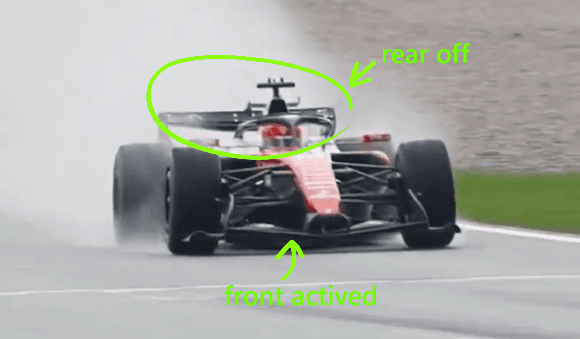
Visual evidence from Barcelona shows Charles Leclerc activating this mode on the main straight. In this configuration, the front wing flaps open (collapse) to reduce drag, while the rear wing remains closed in its high-downforce position.
The Engineering Logic: Stability vs. Efficiency
Why split the aerodynamic configuration? The rationale is twofold: safety and mechanical preservation.
1. Rear Stability and Grip
In wet conditions, activating full Straight Mode (opening the rear wing) would drastically reduce rear downforce. On a damp track, this increases the risk of instability, oversteer, and aquaplaning, particularly if the straight contains high-speed kinks or undulations. By keeping the rear wing closed, the SF-26 maintains essential load on the rear axle, ensuring traction and preventing the car from snapping out of control.
2. Plank Preservation
One might ask: why not keep both wings closed in the rain? The answer lies in the new active aero philosophy. Cars are designed to run with reduced drag on straights. If a car runs a full straight with wings fully closed (high downforce), the immense vertical load at high speeds could push the car too low, causing excessive wear on the floor plank. Excessive plank wear can lead to disqualification. Therefore, opening the front wing helps shed some drag and load, protecting the floor while the rear wing secures stability.
The Regulatory Framework
This is a specific regulatory feature. The FIA Sporting Regulations for 2026 grant the Race Director absolute discretion over active aero usage.
- Safety Override: Just as DRS use was restricted in the past, the Race Director can disable Full Straight Mode if track conditions are deemed "low grip" or dangerous.
- Partial Activation: In these scenarios, the system allows only Partial Mode. The regulations specify distinct activation zones: longer zones for full activation (when dry) and shorter, specific zones for partial activation to manage safety through corners and kinks.
- Implementation: This rule was finalized following simulation concerns that "Zero Downforce" modes on straights would be undriveable in damp conditions.
Ferrari's Unique Implementation
An interesting technical detail observed during the SF-26 shakedown and confirmed in Barcelona is Ferrari's deployment sequence. Unlike Mercedes, which reportedly opens front and rear wings in perfect synchronization, Ferrari appears to employ a slight delay or staggered activation.
On the SF-26, the rear wing seemingly activates slightly before the front wing during standard operation. However, in the wet Partial Mode test, the system proved it can isolate the front actuators while keeping the rear static. This flexibility suggests Ferrari is experimenting with software maps to optimize the center of pressure shift during the transition phases of active aero deployment.
Conclusion
The Barcelona wet test was not a washout for Ferrari; it was a successful "shakedown" of a crucial safety system. By validating the Partial Mode, Ferrari has confirmed the SF-26's ability to balance the competing demands of drag reduction and wet-weather stability, proving that the 2026 regulations will require as much software dexterity as aerodynamic efficiency.