
- Published on
F1 2026 Bahrain Day 1: Monsters on the Loose (and Why Top Speed Matters Again)
- Authors

- Name
- Attimini
- @attiminii
Finally. After the secretive shakedowns in Barcelona—where our best intel came from blurry photos taken by fans climbing trees—we finally saw the 2026 beasts in their natural habitat: the Sakhir International Circuit.
If you thought these new regulations would make the cars slower and clunky, well... think again. The first day of testing gave us plenty of data, a few surprises, and a clear message: this new era is going to be fast, furious, and incredibly complicated to manage.
Here is what we learned from Day 1, beyond the timesheets.
The "Vibe": Hard to Drive, Hard to Stop
First things first: these cars are a handful. Watching the on-boards (during the one measly hour of live TV coverage they graciously granted us), it was obvious that the drivers were fighting the steering wheels.
We saw constant corrections, snaps of oversteer, and plenty of lock-ups. Part of this is the "green" track covered in sand, but the main culprit seems to be the instant torque of the electric motor at low speeds. It kicks in aggressively, and combined with the active aero systems, it's forcing everyone to rewrite their muscle memory.
The Timesheets: Faster Than You Think
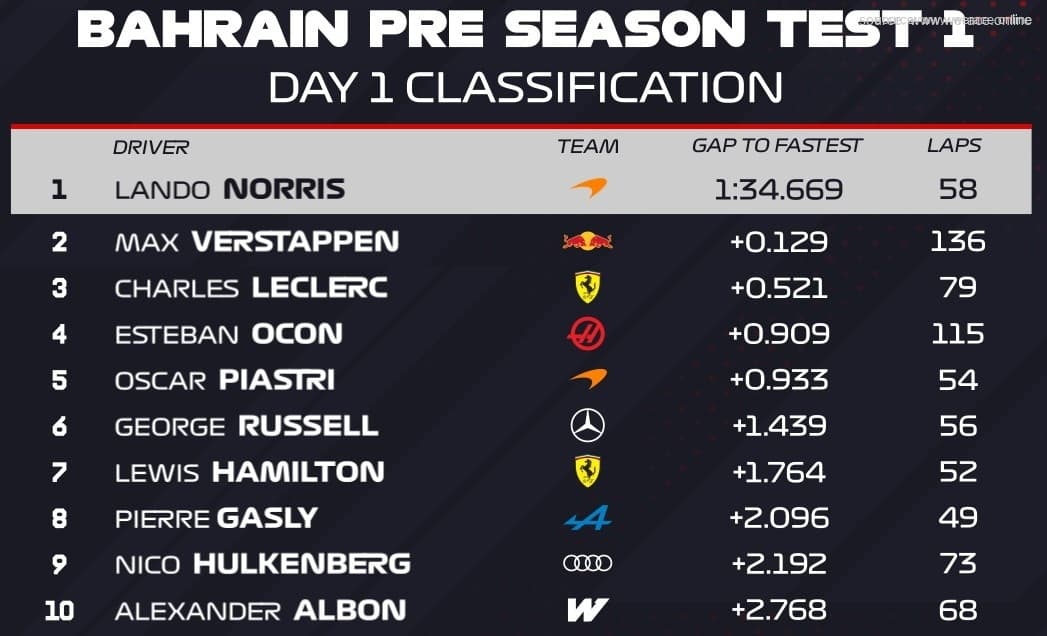
Lando Norris topped the charts with a 1:34.669, followed closely by Max Verstappen (+0.129s). Context is king here: last year's FP1 best time was a 1:33. We are already nearly there on Day 1, with unoptimized setups and engines far from full power. The "5 seconds slower" narrative? You can probably throw that in the bin.
Deep Dive: The Telemetry War (Traction vs. Corners)
This is where it gets nerdy—and interesting. I spent the day glued to the telemetry screens, and a fascinating pattern emerged. We are seeing two completely different philosophies in how to make lap time.
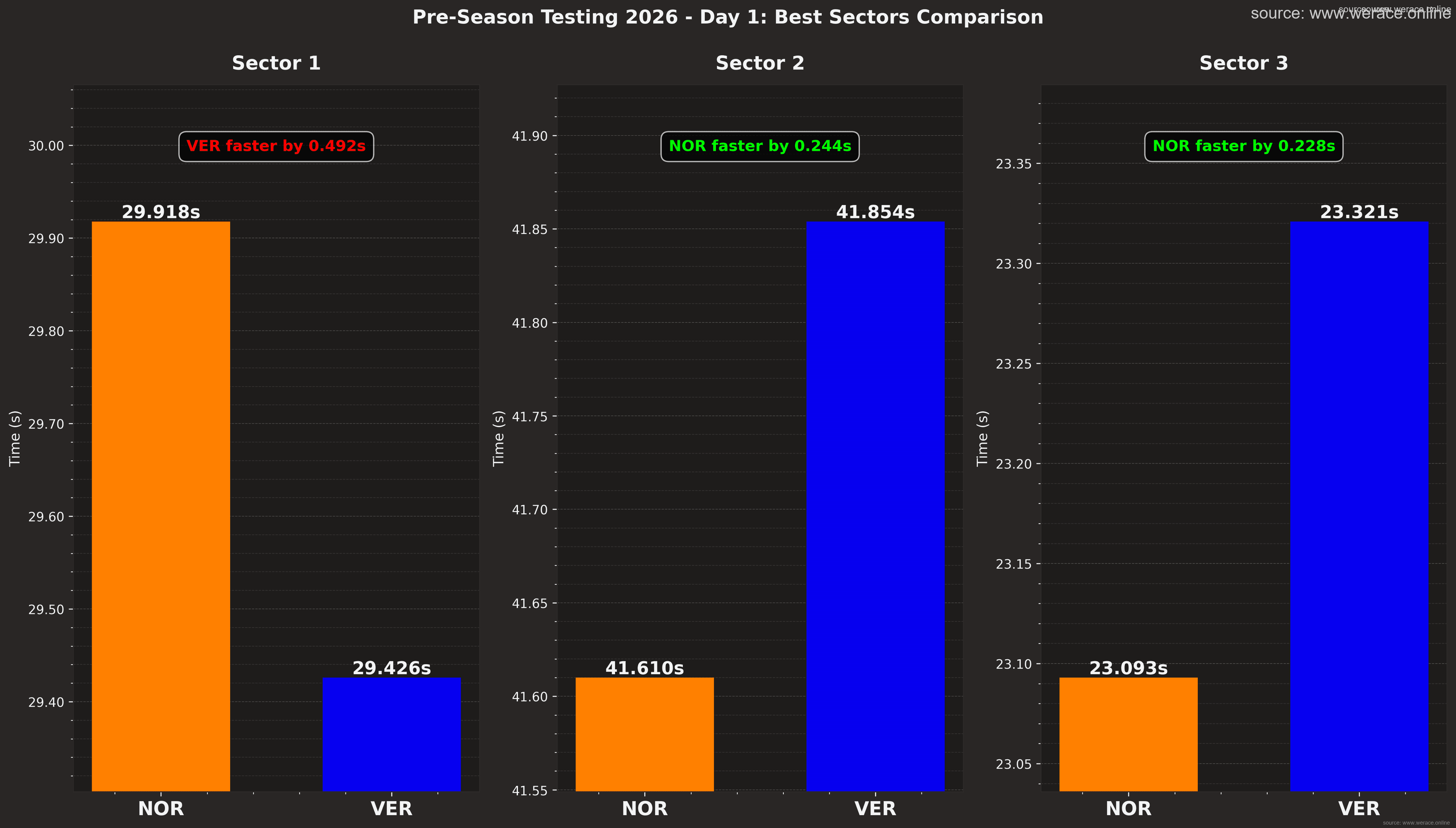
Take the battle between Norris (McLaren) and Verstappen (Red Bull).
- Max was dominating the first sector and the twisty bits (Turns 4 and 7).
- Lando, however, was absolutely crushing it on the straights.
It wasn't just about drag. It was about deployment. In the final run down to the line, Norris was clocking speeds up to 14 km/h faster than Verstappen and Leclerc. McLaren seems to be dumping the battery power perfectly for top-end speed, while Red Bull is perhaps harvesting earlier or running a different aero efficiency map.
Speaking of speed...
The "Wall" at Flat Km/h
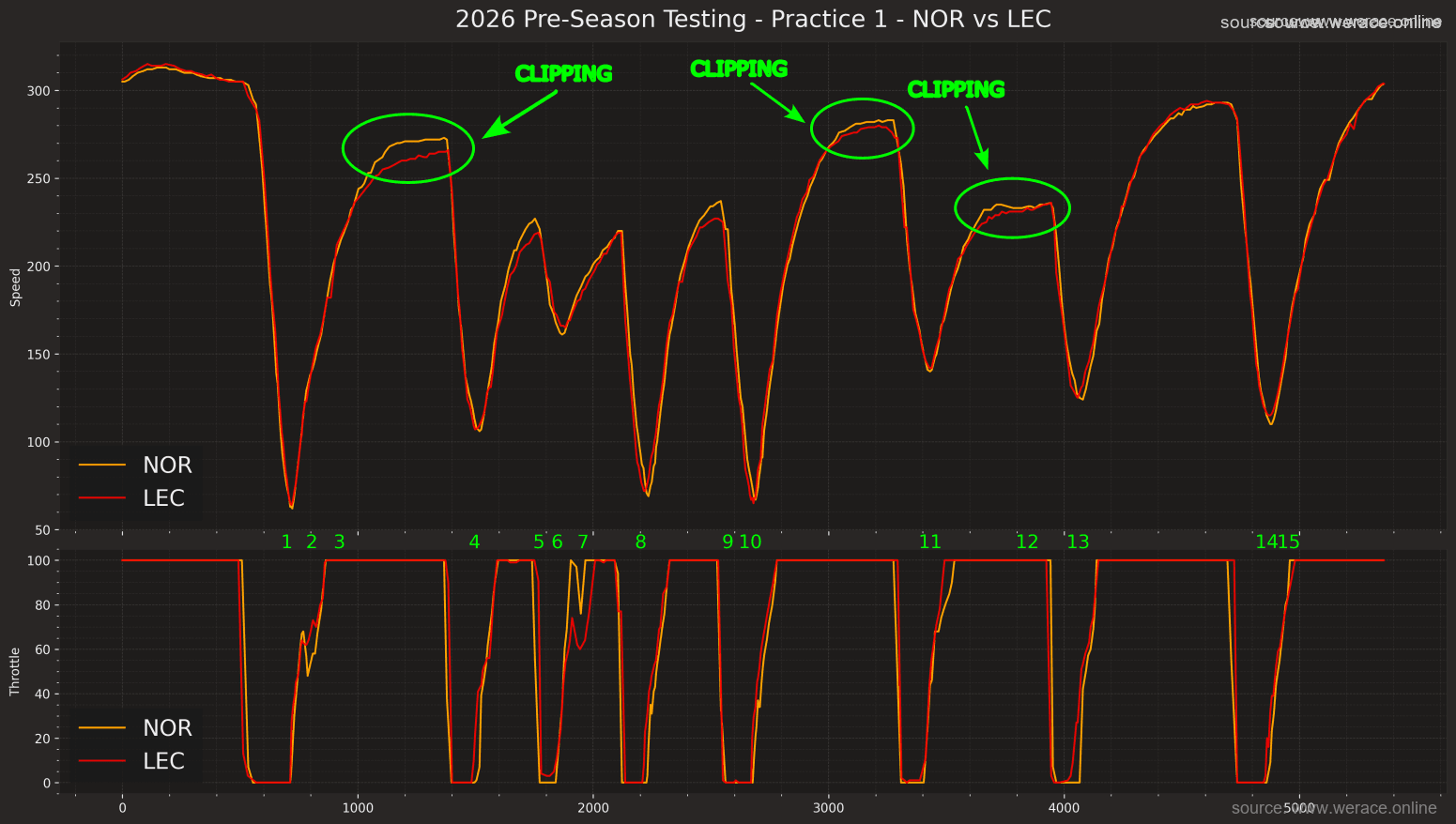
During the race simulations, we saw something weird. Both Ferrari and McLaren seemed to hit a virtual wall. The telemetry showed the cars accelerating and then flatlining at 270 km/h.
This isn't a lack of power; it's strategic clipping. The systems are cutting the electric boost early to save energy for the next lap. This "Lift and Coast" (LiCo) behavior is extreme. However, when they decided to push, the gloves came off.
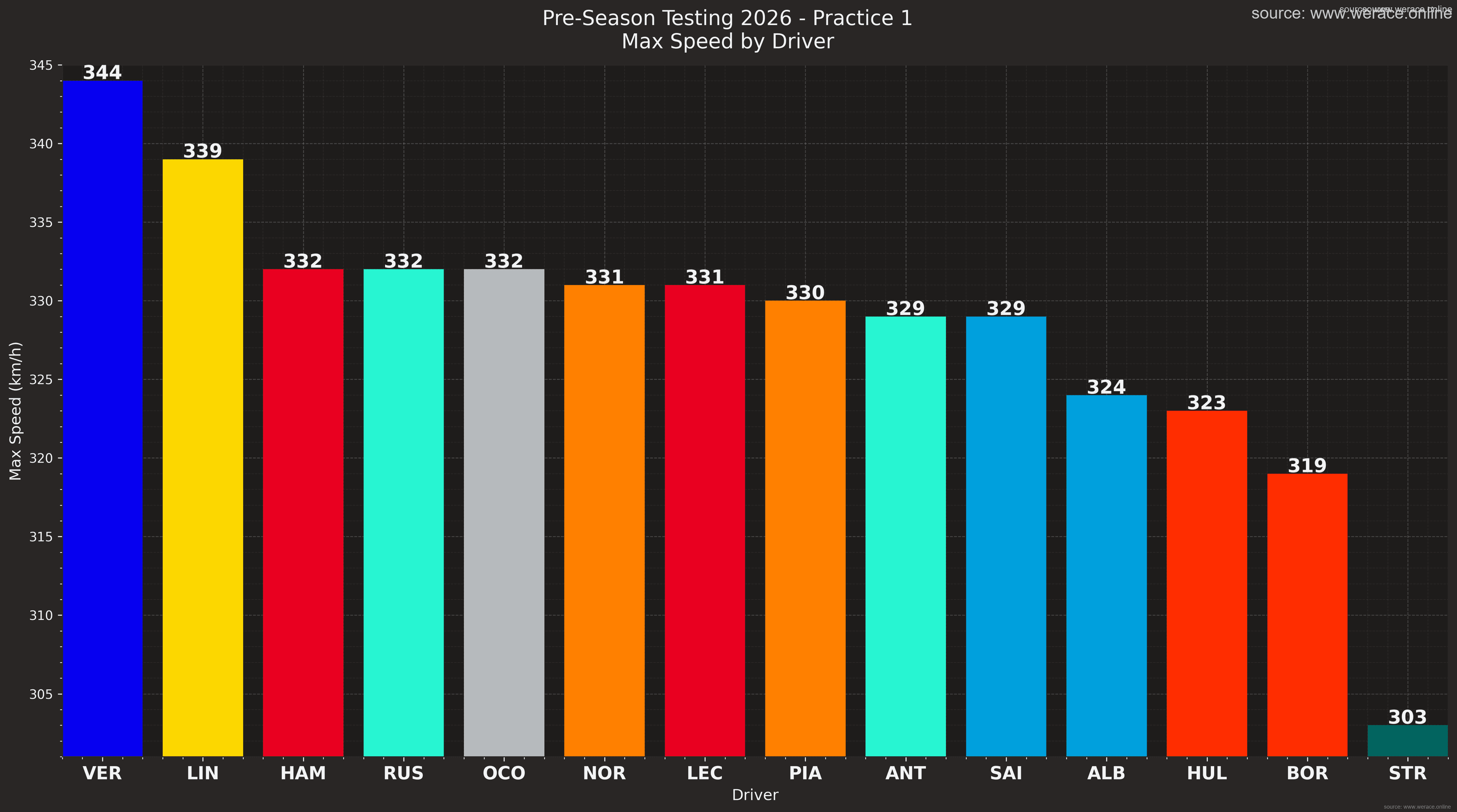
And who pushed the hardest? Red Bull. Max Verstappen hit a top speed of 344 km/h. For a team building their own engine from scratch (Red Bull Powertrains), hitting that speed and doing consistent runs is a massive flex.
The Teams: Winners and Losers of Day 1
Red Bull & The "Political" Engine
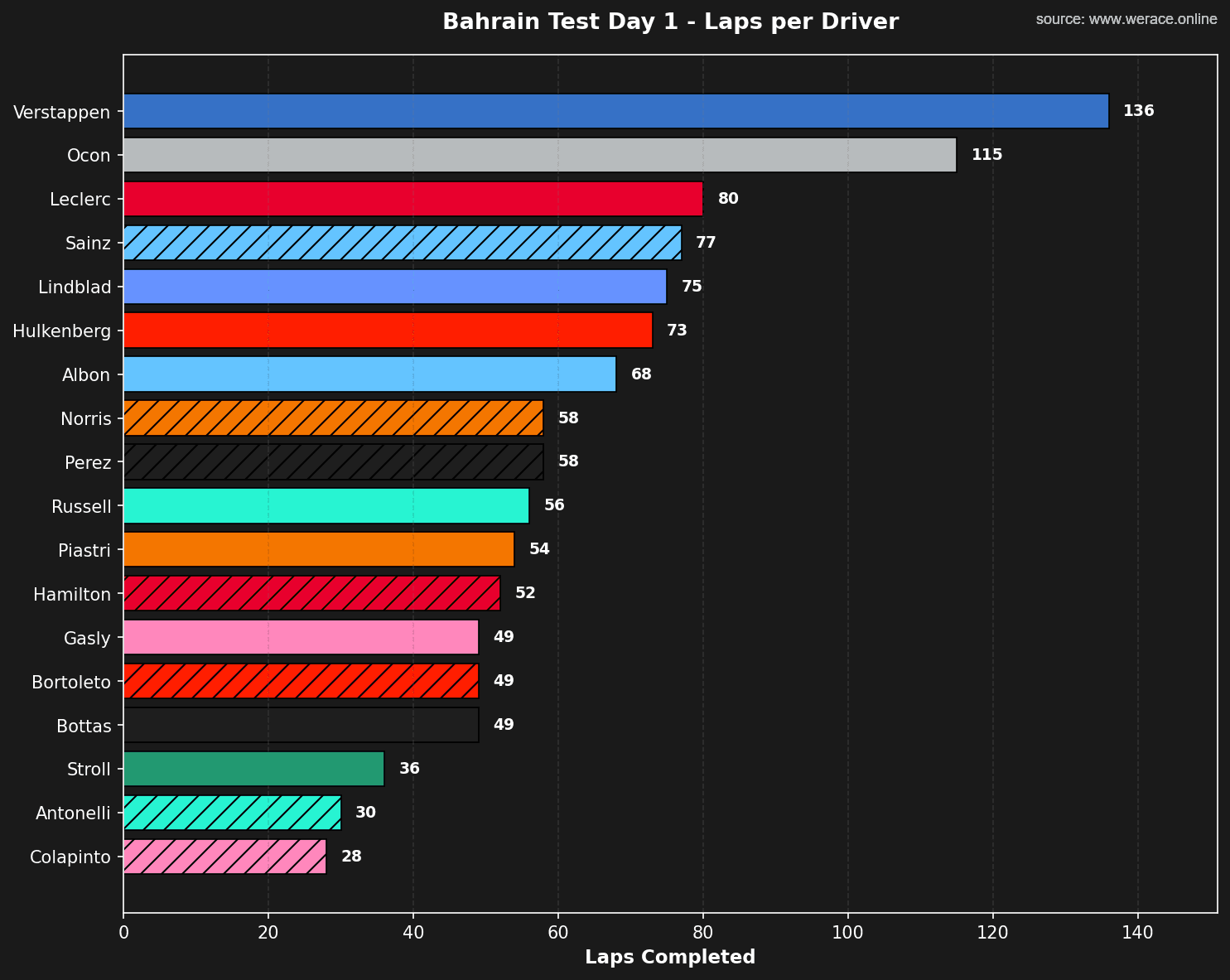
Max was a machine: 136 laps alone. The RB22 looks solid, and the engine didn't explode. In fact, Toto Wolff is already stirring the pot, claiming the Red Bull PU has a "1-second advantage" because of better energy regeneration on consecutive laps. Is it true? Or is Toto just being Toto? We'll find out soon.
Ferrari: A Digital Steering Wheel and a Loose Rear
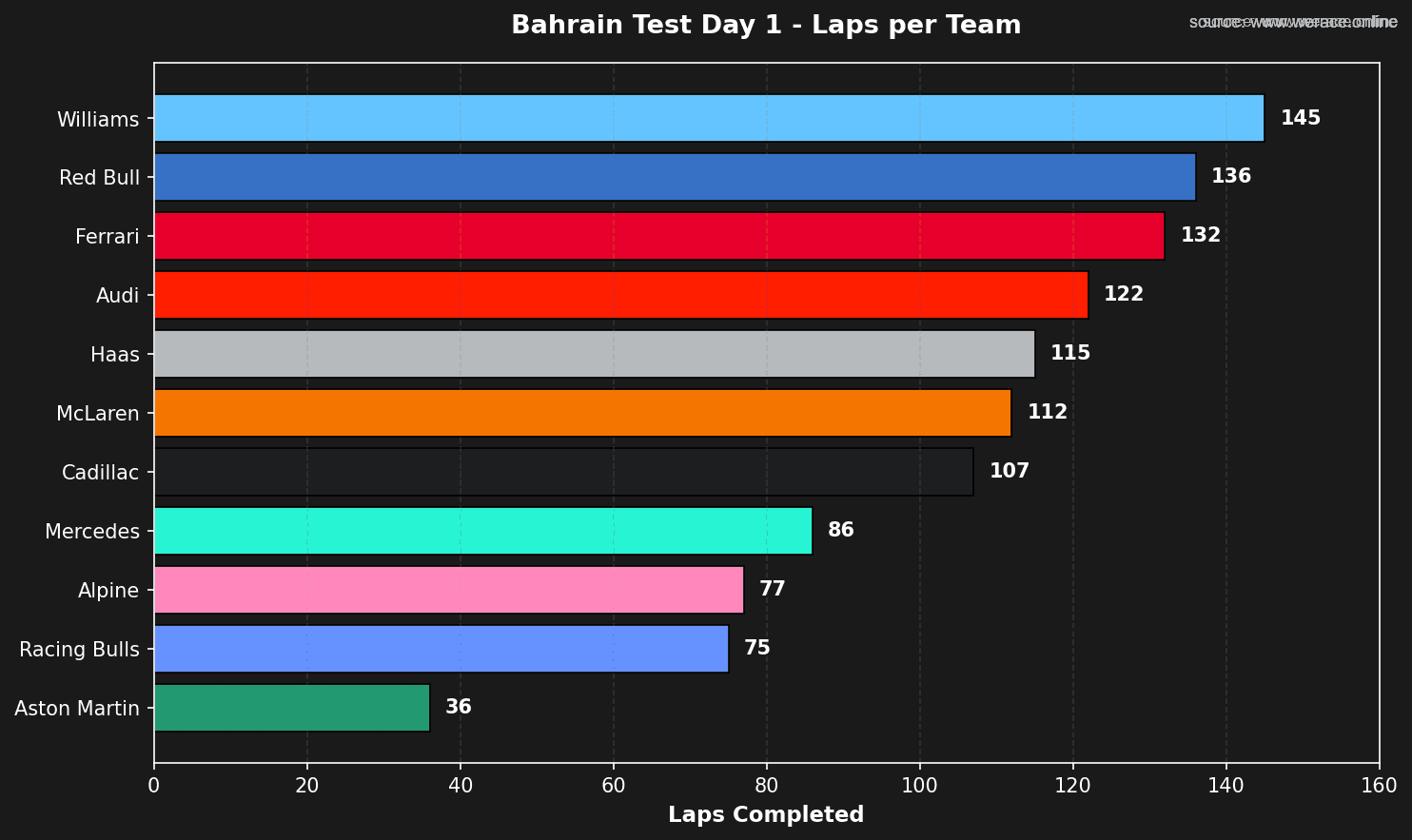
Ferrari put in solid mileage (132 laps combined). However, the SF-26 looks a bit... spicy. Both Hamilton and Leclerc were fighting the rear end, especially in the high-speed snake section (Sector 2).
Also, have you seen the new steering wheel? It has a battery % bar that looks exactly like the one on my smartphone. A bit jarring for F1, but I guess range anxiety is real for everyone now.
Visually interesting note: Ferrari (and McLaren) are sporting a unique "sawtooth" fin on the engine cover. Keep an eye on that.
The Others: Williams Surprises, Mercedes Stumbles
- The Hero: Williams. Quietly, they racked up the most laps of any team (145). Albon and Sainz just kept going.
- The Worry: Mercedes had to shut the garage doors early with reliability issues, limiting young Kimi Antonelli to just 30 laps. Not the start they wanted.
- The Shame: Aston Martin. The car looks incredible with that extreme undercut, but a data anomaly/cooling issue with the Honda PU meant Stroll only did 36 laps. We need to see this car run!
Power Unit Wars: Mercedes Still King of Mileage
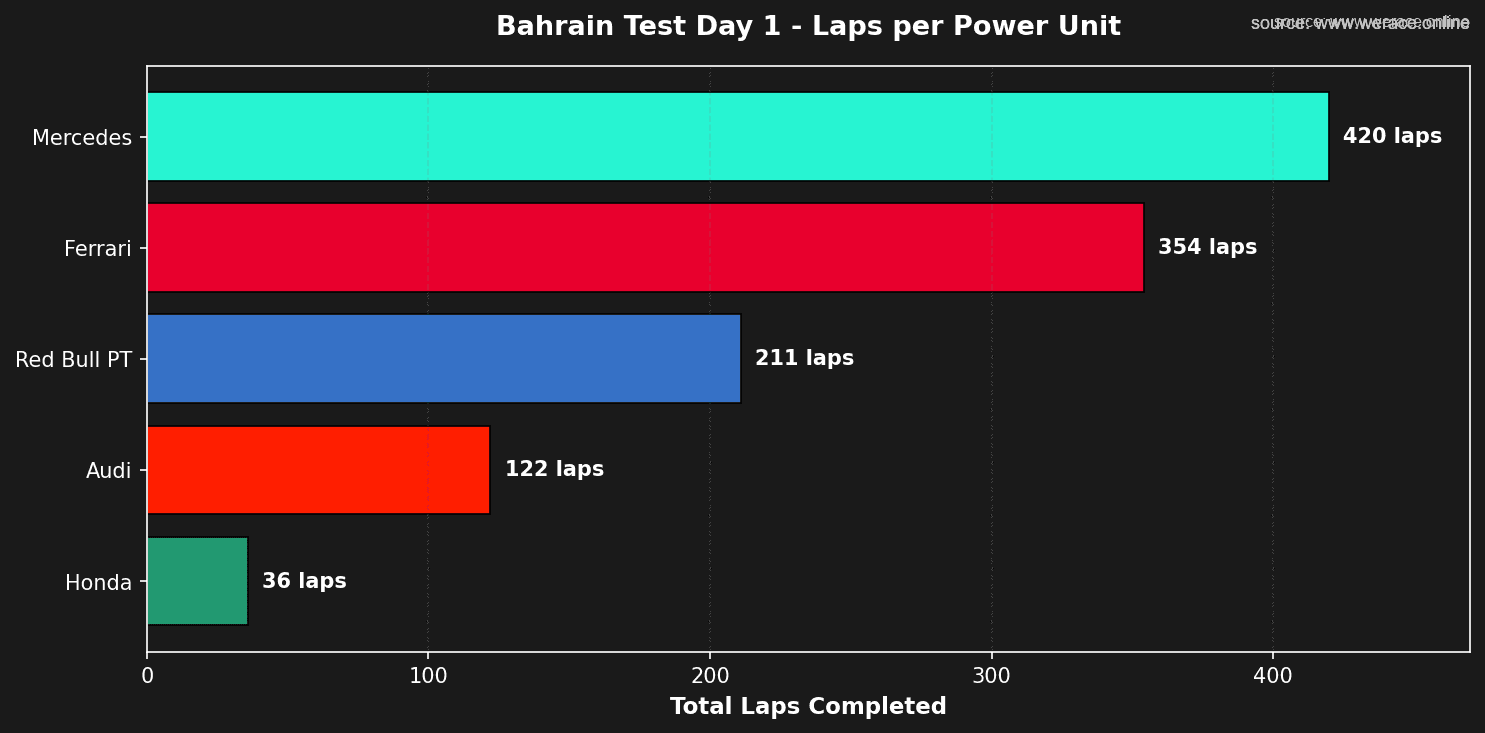
When you add up the numbers across all customer teams, the picture becomes clear:
- Mercedes PU: 420 laps (Mercedes + McLaren + Alpine + Williams)
- Ferrari PU: 354 laps (Ferrari + Haas + Cadillac)
- Red Bull Powertrains: 211 laps (Red Bull + Racing Bulls)
- Audi PU: 122 laps (Audi)
- Honda PU: 36 laps (Aston Martin)
Mercedes' experience and reliability are showing. Ferrari is right behind. Red Bull's debut PU is holding up better than expected. Audi is learning. Honda... needs to fix whatever broke on Stroll's car.
Final Thoughts
Day 1 confirmed that the Power Unit is going to be the main character of 2026. The difference in speeds between "Push" laps and "Race" laps is huge. Overtaking might become a game of chess: who runs out of battery first?
We still have two days left. Let's see if Ferrari fixes that rear end and if anyone can match Red Bull's scary consistency.
Catch you tomorrow for Day 2!